Who Has Power? Harvard Negotiation Expert Addresses Bowdoin Women
By Tom Porter. Photography by Andrew Estey.A donation pool of $24 million is on the table, explained Hannah Riley Bowles, to be split two or three ways. The challenge is to negotiate as a big a slice of the pie as possible for your organization, while also collaborating with at least one of the other groups.
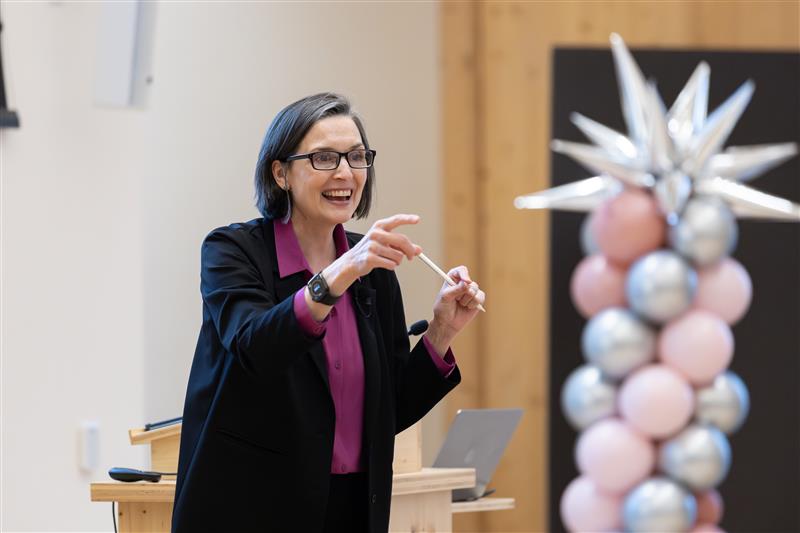
“Who has power in this negotiation and why?” asked Bowles, an expert on gender in negotiation at Harvard University’s Kennedy School. She was on campus recently to lead an interactive workshop focused on negotiation skills and strategies.
She was invited to campus for the third annual Women’s Leadership Celebration, an evening dedicated to celebrating and strengthening women’s leadership at Bowdoin organized by the Sexuality, Women, and Gender Center, the Office for Student Leadership Development, and the Office of Alumni Relations. Around a hundred student leaders also attended the event, alongside a handful of staff members and representatives from the Bowdoin Network of Women, a vibrant community of alumnae now in its third year.
The tabletop exercise required students to split into three groups, representing nonprofits who have been approached by a donor wanting to make a multimillion-dollar gift but not wanting it all to go to one group. “It’s a scenario that’s quite common today in philanthropy and development,” said Bowles. “Donors don’t just want to give to one organization, believing their gift will have more impact if they encourage groups to collaborate.”
The activity works like this: Each table is divided into three color-coded groups—blue, green, and yellow—who then have to strike a deal on how to divide the $24 million. If they agree to split the money three ways, each group can get $8 million. But, to complicate matters, there are rules to follow, and not all the groups are equally weighted. For example, if blue and green strike a deal, they can get $10 million each, so they would be better off individually than splitting the sum three ways—and green would get nothing. The green team, however, or indeed any third party in the negotiation, also gets the chance to make a counteroffer to try to make sure it would not lose out. There are many permutations to these discussions, said Bowles, who leads the Negotiate WELL Lab at the Kennedy School. The activity develops skills of negotiation and collaboration, she explained, while underlining the importance of building coalitions and understanding other people’s positions.
"This was our third year hosting the Women’s Leadership Celebration, and each year I’m reminded how powerful it is to fill a room with women leaders who are making a meaningful impact across campus,” remarked Sara Binkhorst, director of Bowdoin’s Office of Student Leadership Development. This year’s focus on negotiation, she said, seemed to really resonate with everyone who attended. “Our guest, Hannah Riley Bowles, positioned negotiation not just as a professional tool, but as a framework for problem-solving, conflict resolution, leadership, and life."
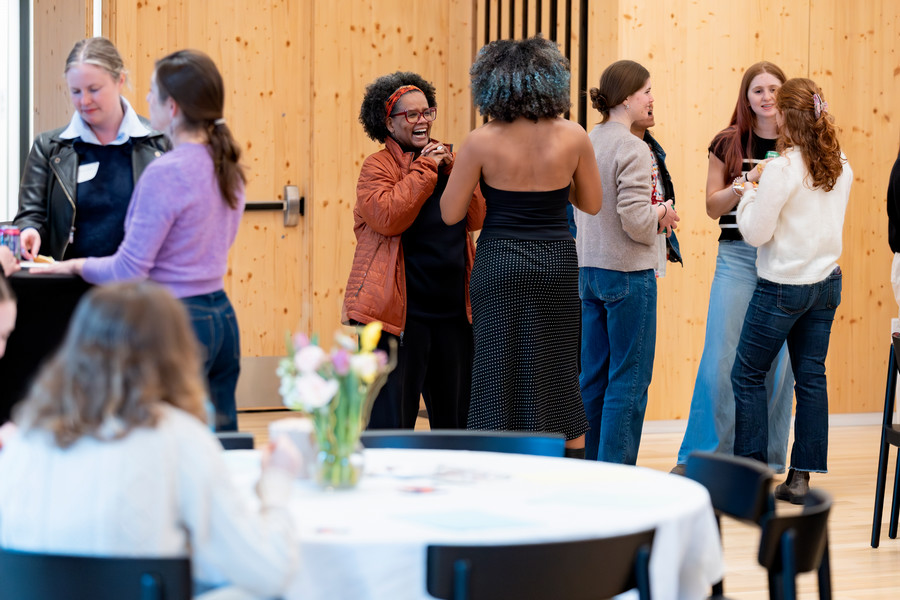

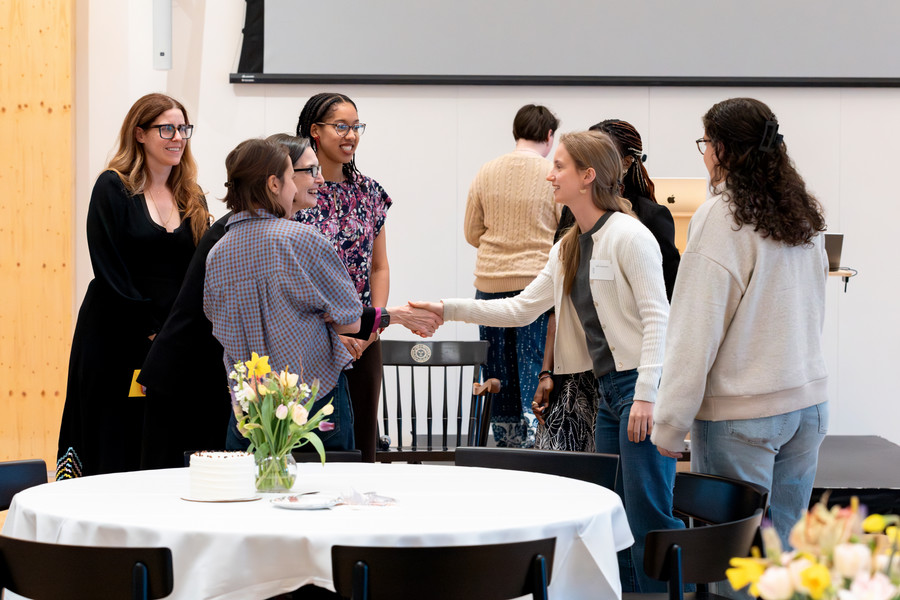
Attending students were energized both by the workshop and the conversation that followed. "I really enjoyed that the event was about celebrating, uplifting, and learning all at the same time,” remarked Julie Janssen ’26. “The combination of learning from a female expert on negotiation and seeing all the amazing women who lead at Bowdoin every single day was really inspiring,” she added.
For Starlette Franklin ’26, the biggest takeaway was that confidence, especially being clear on what you want, is essential to navigating any situation successfully, regardless of the context or who’s on the other side of the table. “Hearing Hannah Bowles say that everything in life is a negotiation really stuck with me,” she said.
The message Anyi Sun ’26 got from this event was that, while there are challenges that may come systemically from being a woman, there are also ways to “empower and equip us with the resources to take space and put ourselves in places of power."
Sophomore Dani Musry, meanwhile, said it was an honor “to be in a room with so many powerful and impactful women from Bowdoin, many of whom I look up to as leaders in the community."
“Three years in, we are officially a tradition,” said Director of the Sexuality, Women, and Gender Center Natalie Turrin in her introductory remarks. This gathering, she explained, springs from the simple but ambitious idea “to bring together the remarkable women who lead, inspire, and shape this campus, whether you're a captain, a president, a mentor, an organizer or, honestly, all four at once.”
Looking around the room, said Turrin, she is reminded that this kind of gathering is something Bowdoin’s founding fathers could never have imagined. “Yet here we are, not just filling the room, but leading it, redefining what leadership looks like, expanding who it belongs to, and building a table big enough for everyone who comes after us.”