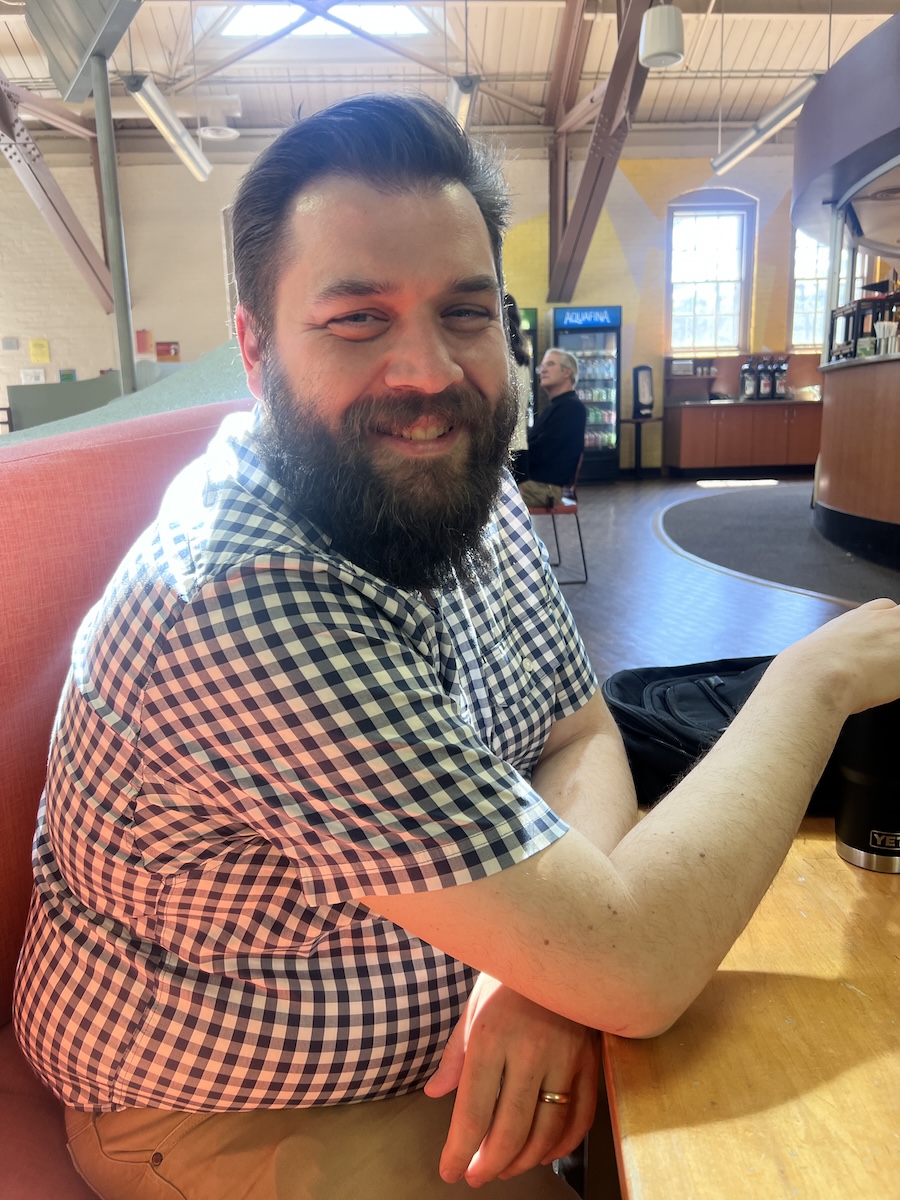
Anthony Reed, a 38-year-old IT specialist at Bowdoin, will receive his diploma at Commencement in May after taking classes here for the last seven years.
Reed started his first job at Bowdoin fourteen years ago as a security guard for the Museum of Art. When he transferred to campus security, he realized a few of their systems were out of date. Since he had always liked tinkering with computers and coding, he offered to build a couple of applications for them.
The IT office noticed his abilities. When an IT job opened up in 2019, Reed applied and was offered a job in enterprise systems. His supervisor immediately encouraged him to return to college. “Jeff Doring, who hired me, told me, ‘We’re so happy you’re here and now we need to work on your degree.’”
Reed, who grew up in Brunswick and attended Brunswick High School, had already completed three years of college at Framingham State University, in Massachusetts, but left before earning his degree. Because of this head start, he was able to transfer some credits. The registrar's office determined that he needed sixteen classes to earn a Bowdoin degree.
First, however, he had to be accepted by the admissions office. “As an employee, you have to apply and matriculate like any student,” Reed said.
Tim Hanson, the former associate director in the Office of Safety and Security, first recognized Reed's technical aptitude and gave him room to explore it, said Bowdoin IT Senior Director and Chief Information Security Officer Jeff Doring, who initially hired Reed.
“He granted Anthony something rare in any workplace: the latitude to try something different.
And Anthony ran with it,” Doring said.
When Reed's proof-of-concept application worked well, IT staff worked with him to refine and launch it. It is still in use today.
Others at Bowdoin got behind him as well, including Chief Information Officer Michael Cato and Tama Spoerri, former director of human resources. “They all believed in Anthony,” Doring said.
“This is a story about one person,” Doring added. “Yet it represents something larger—the very thing that makes Bowdoin what it is. Bowdoin's leadership encouraged thinking outside the box, encouraged growth, and then provided an opportunity. Anthony used that opportunity to reach a level that can only bring a tear to my eye. He will graduate from Bowdoin College—a non-traditional student via a non-traditional path.”
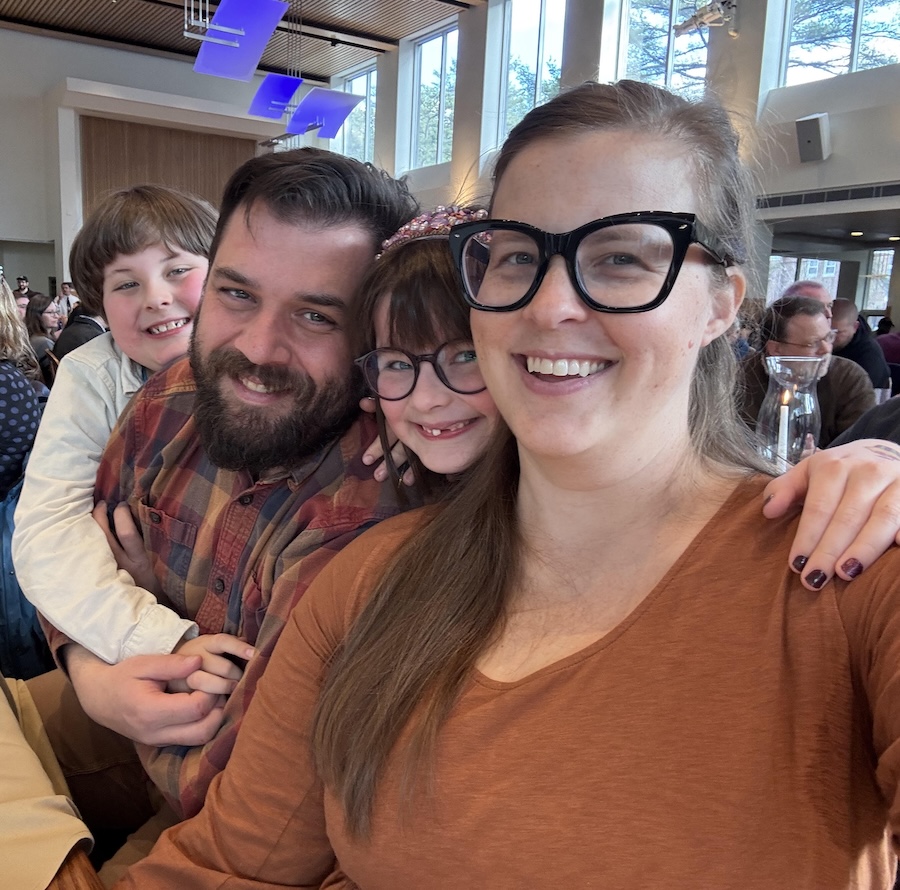
Taking one to two classes a semester, he studied, worked full-time, and raised two young children. “My wife is incredible, and the IT department and HR have been on board and very supportive of me. Everyone has been very flexible,” Reed said.
Each semester, Reed submitted a plan outling how his work schedule would accomodate his classes and how any missed hours would be accounted for, Doring said. “Bowdoin's support was genuine, but it was not unconditional—Anthony was still expected to fulfill the responsibilities of his position,” he explained.
And the professors asked a lot from him, as they would of any traditional student. “The quality and quantity of work expected was significantly demanding, in a great way,” Reed said. “It was challenging and interesting, and I enjoyed what I was doing, but there was no question that it was a rigorous educational experience.”
While a computer science major was a natural fit for him, he ended up adding a cinema studies minor. “I have always loved storytelling and film,” he said. Some of his favorite classes were in the cinema studies department, such as Madness in Korean Literature and Film, with Assistant Professor of Asian Studies John Kim, and the History of Film from 1895 to 1935, with Professor of Cinema Studies Tricia Welsch.
At Framingham, Reed had majored in economics and taken zero computer science classes. He dove into the Bowdoin department’s offerings, enrolling in courses like Data Structures, Computer Networks, Algorithms and Computer Systems, Operating Systems, Software Engineering, Computational Game Theory, Integral Calculus, and Artificial Intelligence.
He singled out the class Distributed Systems with Associate Professor of Computer Science Sean Barker, as especially fun and interesting, as well as relevant to his work. (He and Barker also happen to have graduated in the same high school class!)
“We got to do hands-on learning to understand how computers talk to each other, which is something that we use every day without realizing how much we use it,” Reed said. “Most students are exploring as they learn, they’re not sure what the future will hold. I already had the job I wanted, and it was interesting to ask, ‘How do I bring this back and apply it to my job?’”
Barker also appreciated having Reed in class. “His work with Bowdoin IT gave him a unique perspective into how systems are configured in real-world environments,” he said. “He was always happy to share this perspective, and it was a significant benefit to the entire class.”
At the same time, Reed believes that being a student at Bowdoin has made him a better employee. “It has enhanced my ability to interact with the College community, to understand where people are coming from, their goals, and what their needs are,” he said.
After he walks at Commencement and has his degree in hand, he has one primary professional goal: To keep doing good work at Bowdoin. “I have absolutely loved every minute I have worked at this College,” Reed said. “The College takes care of the community, and there is no other place I want to work.”