More than thirty Bowdoin students opted to spend a recent Saturday doing something a little different: working together to tackle pressing energy issues.
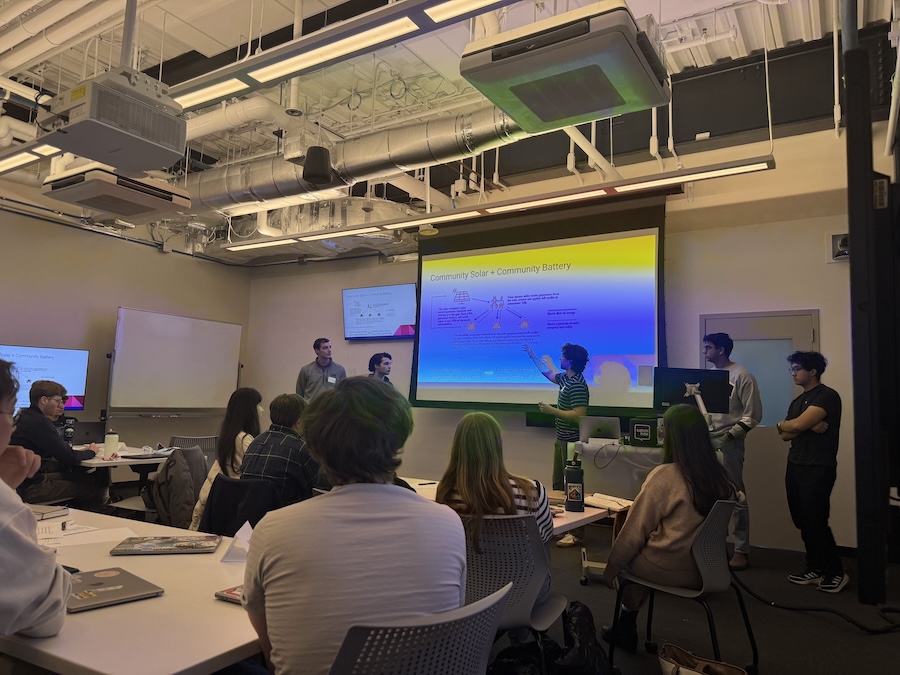
The inaugural Common Good Energy Challenge drew students across disciplines to the Roux Center for the Environment on February 28.
Their task was to work in small groups and spend the day researching, planning, and presenting a solution to an energy issue announced at the beginning of the event. Students heard from guest speakers throughout the day before having several hours to prepare a solution and propose it to a panel of judges.
The proposed challenge was to come up with small-scale renewable energy solutions that do not require federal funding and could be implemented in Maine to help it reach its 100 percent clean-energy goal.
Sponsored by many academic departments, the emphasis of the event was to merge interdisciplinary backgrounds and interests in teams of five. Seven teams competed, and the top three received cash prizes.
“We really wanted to open up more spaces for people of different disciplines to come together,” event organizer Eden Zumbrun ’26 said.
“I really enjoy seeing what people being brought together creates. I was blown away with all the solutions that everybody came up with—it was a good testament to what happens when you get smart people in a room together.”
—Event organizer Eden Zumbrun ’26

Zumbrun, an environmental studies and government coordinate major, decided to organize the event on campus after attending a similar challenge at the Roux Institute in Portland her sophomore year. While the focus of that event was more entrepreneurial, Zumbrun and other students wanted to see if they could host a Bowdoin-specific event.
“We felt like we wanted a way to apply what we learned in class to a real-world situation in a way that felt meaningful,” Zumbrun said. “And also, as seniors, we were trying to think of how we could demonstrate some of these skills in a way that we could put on a resume or in a cover letter.”
Zumbrun planned the event throughout the fall semester, coordinating with academic departments, receiving feedback from students and faculty, and lining up guest speakers and judges.
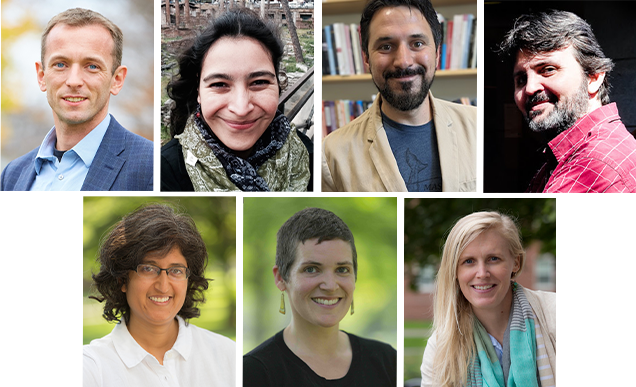
The day began at 10 am with a presentation from Dan Burgess, acting commissioner of the Department of Energy Resources, who provided a broader context of Maine’s energy plan, goals, and current obstacles. Karen Blakelock, climate and energy policy advisor for the Nature Conservancy in Maine, spoke about the components behind a strong renewable energy solution, and Bowdoin Professor of Economics Erik Nelson gave an overview of the complexities behind grids and utilities and what “greening a grid” looks like.
Blakelock and Nelson were both judges for the event, along with Fred Horch, co-founder of Spark Applied Efficiency, a local mechanical contracting firm with a focus on clean energy.
After the presentations concluded, students had three hours to work on designing a small-scale renewable energy solution. Groups were judged on components like feasibility, scalability, funding mechanisms, short-term versus long-term costs, justification to the public, and how they would get support from the public and policymakers.
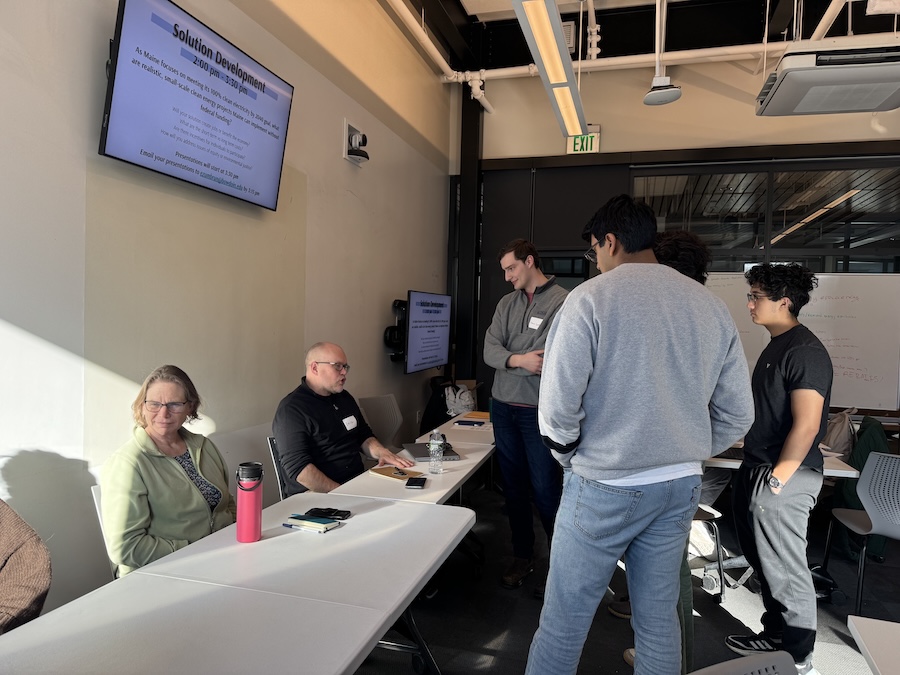
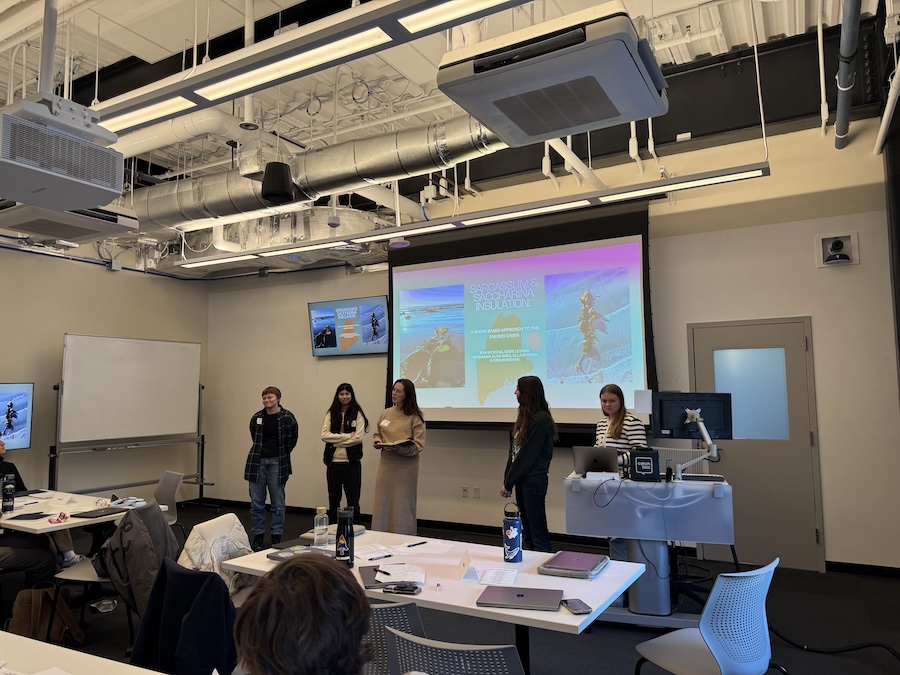
“We were really trying to get people to think small scale—community or state level—but also to think about the scalability of it and have solutions that could be transferred to a different state,” Zumbrun said.
Students had five minutes to present their ideas, which included creative approaches to heat pumps, home batteries, community batteries, kelp as insulation, and biogas systems using compost.
The winning solution involved state-subsidized household batteries, proposed by Annie Moore ’26, Liam Mattox ’29, Graham Reynolds ’29, Adam Rublin ’29, and Ethan Stolper ’29. Zumbrun said she would be sending the top three winning proposals to Burgess and the Department of Energy Resources to see if the state has any interest in what the students devised.
The event concluded with a networking portion in which students spoke with Bowdoin alumni working in energy-related fields.
Emma Butterfield ’26, an environmental studies and Hispanic studies coordinate major who participated in the event, said that as a Mainer, she enjoyed learning about Maine’s energy landscape from the presenters. She also said she enjoyed the exercise because of its focus on collaboration.
“It was nice and comforting to see how many people were spending eight hours of their weekend not only participating in a challenge, but also putting time into environmental solutions,” Butterfield said.
Zumbrun said she hopes the event continues after she graduates and is expanded beyond energy into other sectors.
“I think the bigger takeaway for me was just the value of having so many different people come together. I really enjoy seeing what people together create,” she said. “I was blown away with all the solutions that everybody came up with, and it was a good testament to what happens when you get smart people in a room together.”