When student leaders were planning this February's Black History Month program, they wanted to include a career-focused event with alumni.
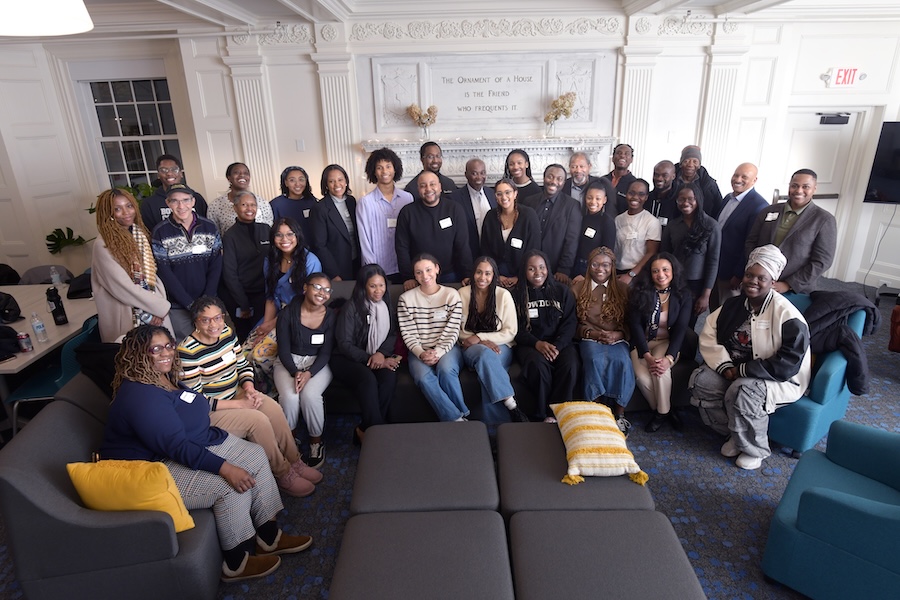
Hall responded to their request by arranging an online conversation with five alumni working in finance, technology, education, medicine, and law: KAYR Robinson ’05, Kiraney Loving ’19, Latasha Ball ’12, Nancy Norman ’79, and Sherrone Torres ’12.
After the panel, Neiman Mocombe ’26, a correspondent for Bowdoin’s communications office, reached out to Hall to ask her about the alumni association and its student outreach. He also wanted to know how Hall, who works as a program manager for Oak Spring Garden Foundation in Virginia, has been personally shaped by volunteering with the relatively new group. The BCBAA was formed in 2021 as an outgrowth of the AF/AM/50 celebration in 2019.
Since then, the BCBAA has grown and developed with the help of dedicated volunteers like Hall. Today, the association serves a community of more than 900 Black alumni, a number that grows to over 1,200 when including those who identify as biracial or multiracial.
Below is an edited and condensed transcript of a recent conversation between Hall, Mocombe, and Rebecca Goldfine of Bowdoin communications.
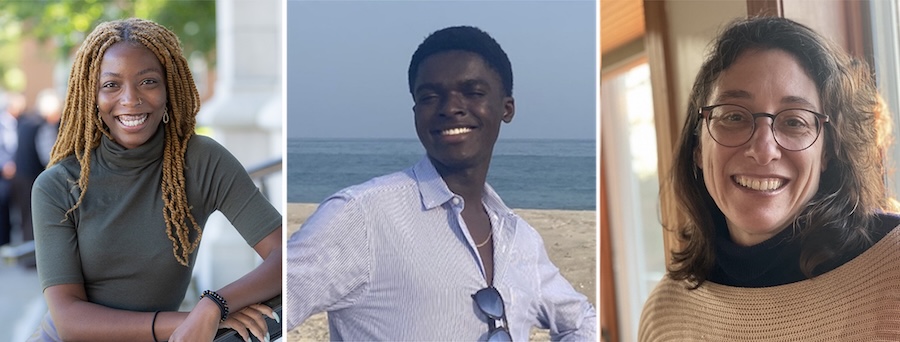
Goldfine: Hi Praise, Hi Neiman. I thought this Q&A could be a way to showcase how alumni support students, and in particular how the Black Alumni Association supports Black students at the College, and why that’s a priority for the group. So first question from Neiman…
Mocombe: Do you put on a career panel annually? If so, how has it changed over the years?
Hall: We’ve done iterations of it, but this was the first one specifically during Black History Month. In general, we want to respond to what students say they want year to year, which is often about careers.
Goldfine: Neiman, as a student what would you like to see from the Black Alumni Association?
Mocombe: The panel was super insightful, but I also enjoyed an in-person dinner I went to last year, in Moulton. It was a more intimate setting, face to face; it wasn't an awkward networking thing! I liked that you could sit down at a circular table and actually talk to the people around you. That was the most personal networking experience I’ve had.
Hall: I agree, you can’t replace being in person, and that's one of the things we’re always talking about, with students in particular. There are ideas circulating about what event would make alumni want to come back to campus, other than Homecoming, because the schedule is packed then. I have been thinking it could be during Black History Month for an annual or biannual event that bridges the gap between alumni and students.
We want to create a pipeline from students to the alumni community, so you know about it as a first-year, and by the time you're a senior, you’re ready to step into it.
“I would love to build towards an in-person event for graduating seniors—a moment to say, 'These are your people, this is your community. You're graduating but you're graduating into something much larger.'”
—Praise Hall ’20, vice president of the Black Alumni Association.
Mocombe: Did you have events like this career panel while you were a Bowdoin student?
Hall: The biggest one was the AF/AM/50 event. Seeing the presence and numbers of the alumni on campus was great. I met so many people—building those connections was great. That absolutely felt like, "More of this, please!" But outside of that, nothing that I can particularly remember that was centered around Black alumni.
Goldfine: Why do you want to help students, why is that a focus of the group? And what can the group do for students?
Hall: I speak for myself and a little bit for the other Black alumni: We loved Bowdoin, and there is an aspect of wanting to make Bowdoin better. For me, being a student, having even small touchpoints with alumni completely changed my perspective about what's possible and what happens after Bowdoin, and planted seeds in my mind I wouldn’t have had otherwise.
So I hope the Black Alumni Association not only helps students navigate life after graduation, but also shows them a multitude of experiences and backgrounds, and provides networking and relationship building.
It all comes back to relationships, that community-centering aspect. I have seen it, experienced it, and been a beneficiary of it, and I think it's super powerful. What we need more of in this world is people truly in relationship with one another—talking, listening, and building real community. When that foundation exists, the exchange of needs—'I need this' or 'I can help with that'—happens naturally. It’s not forced; it’s simply the byproduct of being connected. BCBAA hopes to embody this as an ongoing community—one that remains open and accessible, allowing people to step in and out as they need.
Goldfine: Do you see this association working and helping people find jobs, leads, new jobs, and connections?
Hall: Yeah, I think people are so generous with their time in the Bowdoin community, in general, and that is amplified within this particular community. People really want to help people, with networking or co-networking, connecting them with someone they know. Many alumni have started their own ventures, too, so there are opportunities for students to intern with them or pick their brain—the possibilities are truly endless.
Our bread and butter is our mentorship program for students. We have twenty pairs this year. Tawana Cook Purnell ’75 and Harrison Tate ’70 have done a great job of actualizing it. [After matching students with alumus], they let the pairs take it and run with it. They decide whether they meet twice a week or once a month. They let that cadence be something they establish.
“What we need more of in this world is people truly in relationship with one another—talking, listening, and building real community. ”
—Praise Hall ’20
Goldfine: Will you be reaching out to the graduating senior class to say, 'Come join us'?
Hall: Yes, that has been on my mind. I would like to do some induction ceremony event for graduating seniors. This year, I’m hoping to introduce an alumni-to-senior letter-writing activity as a starting point. Longer term, I would love to build towards an in-person event for graduating seniors—a moment to say, 'These are your people, this is your community. You're graduating but you're graduating into something much larger.' We’re in the process of getting that off the ground.
Mocombe: When do Black alumni usually become most engaged post-graduation? What are some of the most pragmatic ways you've retained community members?
Hall: Twenty-four people serve on the coordinating council, representing class years from the ’60s to 2025. Where we can grow more and where I would like to see more alumni is on our subcommittees. It would be cool to think about how to bolster those positions with young alumni.
Mocombe: How have you seen your leadership skills grow/change since leading the Black Alumni Association?
Hall: I graduated from Bowdoin and didn’t think I would be involved with Bowdoin in the way I have been. I thought you graduate and you go! I never thought about the pipeline; it did not occur to me that this is what people do. Part of that is because growing up, my parents didn’t go to college, so I never saw that model of what it means to be an alum. I had to figure it out.
So it has been an interesting six years, to graduate and immediately join the Alumni Council and Black Alumni Association, which has been amazing and I love it. I certainly have grown and evolved in terms of learning how to lead with love and to center relationships and to care for people, how to work together to make things better—while working within the realities of what life is like right now—and how to have grace and patience. I feel I've learned a lot of those soft skills.
Mocombe: Is there a common song/event/tradition at in-person Black Alumni Association events?
Hall: (Laughs) Right now there are none! If you have ideas, I'd love to take your advice.
Mocombe: At in-person events, there's always the social hour. It would be fun to have a common song when that’s happening, like I’m thinking Beyonce obviously. [Starts singing] “You make me happy,” that one. It's such a Black song, it's so good. Even if it was a certain food that was served every time. Like, we’re going to have apple pie.
Hall: I love that—it makes me think about how Black traditions and cultural symbols are instant connectors. It would be really cool to think about how to bring some of that energy into the events we host—maybe even piloting an annual summer cookout!
Mocombe: That would be so fun! We could make it work!