“Healing in Apartheid South Africa”: A Conversation with David Gordon and Anne Strachan Cross
By Bowdoin College Museum of Art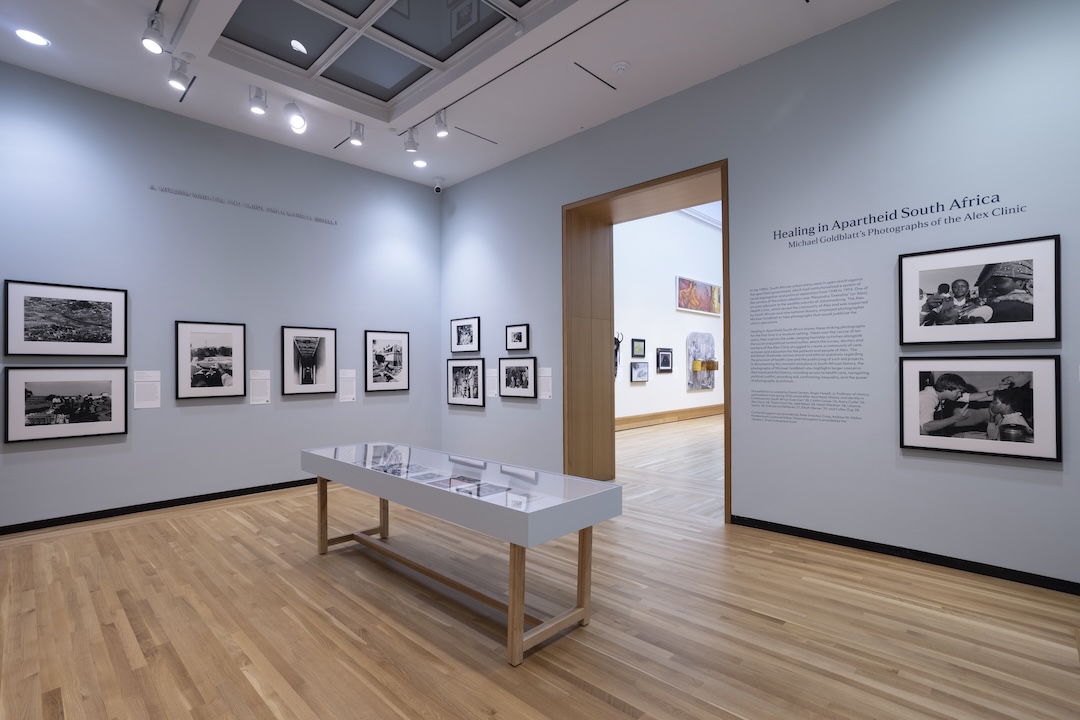
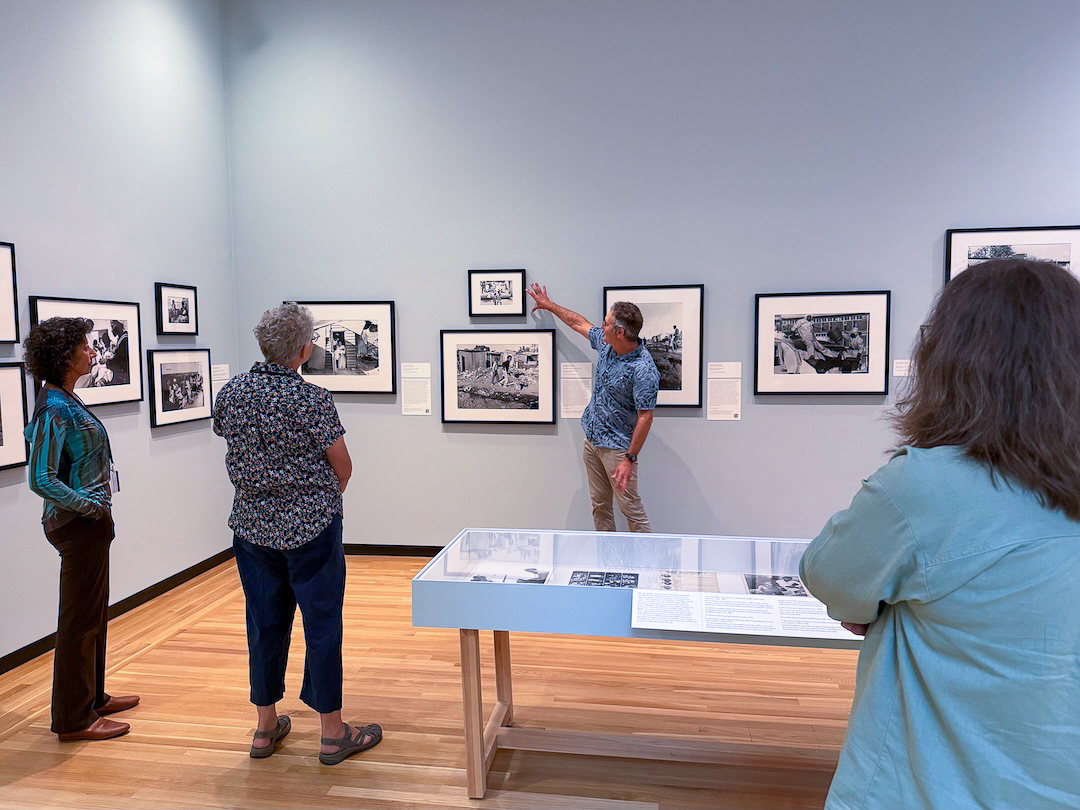
On view at the Bowdoin College Museum of Art (BCMA), Healing in Apartheid: Michael Goldblatt’s Photographs of the Alex Clinic presents Michael Goldblatt's never-before-exhibited photographs of the Alex Health Clinic in Johannesburg's Alexandra Township during the 1980s. This exhibition is curated by David Gordon, Roger Howell, Jr. Professor of History, and his students, with curatorial support provided by Anne Strachan Cross, Andrew W. Mellon Postdoctoral Curatorial Fellow at the BCMA. The following conversation offers a glimpse into the origins of the project, how it developed in the classroom, and what it means for our present moment. The transcript has been condensed and edited for clarity.
This exhibition was developed in the course After Apartheid: History and Identity in Contemporary South Africa. Can you walk us through how a history class became a museum exhibition?
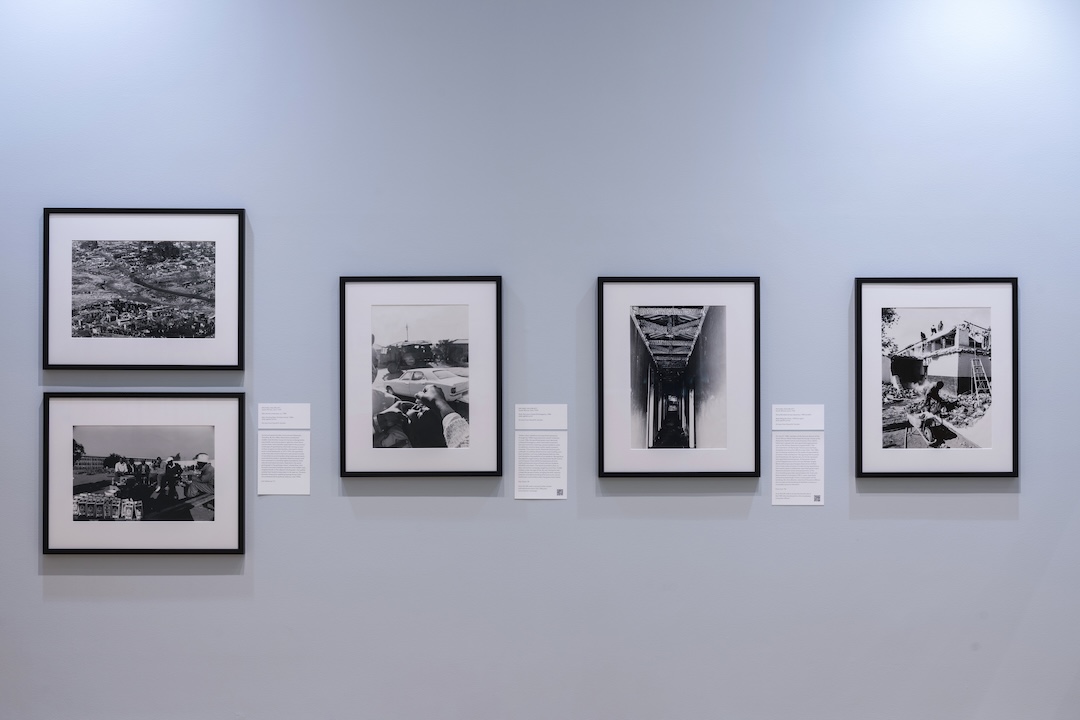
David Gordon (DG): The origins actually go back several decades. My stepfather, Michael Goldblatt, was a photographer in South Africa. He documented the Alex Health Clinic in Alexandra Township—a community adjacent to the wealthy Johannesburg suburb of Sandton, and very much at the center of the country's political upheaval. Over roughly a decade, from the intensification of anti-apartheid rebellion in the middle of the 1980s through the release of Nelson Mandela in 1990 to the democratic elections of 1994, Mike photographed the clinic's work continuously.
After I became a historian, Mike eventually handed me his materials—he’d always hoped to write a book about his decade at Alex Clinic but it did not come to fruition. I wasn't sure what to do with them. They weren't quite my area of research, and I hadn't found a way to bring this history into my teaching in a central way.
Then Anne Cross arrived at the BCMA. We met last fall at an exhibition opening, and I mentioned I was from South Africa. She told me she'd done fieldwork in South African photojournalism. That conversation changed everything. I was already planning to teach my course on apartheid the following semester, and it became clear this was the moment. I adapted the course around Mike's photographs, and the students took on the curatorial work. The results, judged by their evaluations and the exhibition itself, were genuinely rewarding.
Michael Goldblatt was hired by the clinic to document its work. How did that original context shape how you and your students approached interpreting and presenting the photographs?
DG: Documents and photographs are rarely produced for posterity alone. They are interventions in the world at the time they're made. The historian's task, and the curator's, is first to understand what they were doing in their original context, and then to decide how to tell that story to a new audience.
Mike's photographs were made to raise funds for the clinic, within the context of the anti-apartheid struggle. The people behind the clinic believed that fighting for healthcare was inseparable from fighting apartheid itself. That was the purpose—not selling images to the international press, but supporting an internal South African effort.
Anne Cross (AC): What's fascinating from a museum teaching perspective is that as students were learning to think about archival documents as tools, as interventions, they were also learning the history of photography in South Africa. In that context, photography became a specific instrument of the anti-apartheid movement. Mike was working in parallel with some of the most celebrated South African documentary photographers of that era. These photographs weren't simply aesthetic objects; they were devices in a political struggle. And more broadly, art itself came to be understood as a weapon of struggle.
The exhibition raises difficult questions about the ethics of documenting suffering and publicizing aid. How did those conversations unfold?
DG: We introduced these questions in the classroom and let the students develop their own conclusions. The key tension was between paternalism and partnership. The clinic was a space where white and black South Africans engaged with each other in unusual proximity during apartheid. Was that a genuine partnership? Or does it fit the pattern of what Teju Cole has called the "white savior complex"?
I didn't impose my views. In the exhibition, you won't find a single strong argument on either side, but the way students chose to frame and present the photographs reflects the thinking they developed through our discussions.
It's also important to distinguish these photographs from a later genre of nonprofit photography that advertised African suffering to foreign audiences. Mike's work was part of an internal South African conversation about inequality. Understanding that context mattered enormously.
AC: There's actually a moment in the exhibition that captures this tension visually. A clinic brochure pairs Mike's photographs of community life with another photographer's more explicit images of rebellion and destruction. That juxtaposition invites viewers to think about how different images can serve very different purposes, even within the same context.
What do you hope visitors carry with them when they leave?
DG: Photographs give us a mediated window into the past—we often see more than the photographer intended, which is what makes them such compelling historical documents. At a baseline, I hope visitors come away with a sense of what South Africa was living through in the 1980s and 1990s. But beyond that, there are harder questions: how do we act in times of upheaval? What do we do in the face of inequality?
There is also an underlying paradox here. The doctors and nurses at Alex Clinic were building something remarkable—a model of primary healthcare that, in fact, had been exported to North Carolina and became influential in the United States. And yet, with the coming of democracy, much of that optimism about community health has not been realized in South Africa or here.
AC: That parallel feels important. Many communities in rural Maine have faced hospital closures and the erosion of primary healthcare. The story from Alexandra Township isn't as distant as it might seem. I hope visitors consider where they stand in their own moments of change and need.
DG: Absolutely. And the other intention of the exhibit is to draw attention to the artistic and historical value of Mike’s photographs, and find a home for them, preferably close to Alex, where they can be appreciated as part of the Alex’s history. I am currently working with scholars and museums in South Africa to bring that about.
Healing in Apartheid: Michael Goldblatt’s Photographs of the Alex Clinic is on view through February 7, 2027. Programming includes “Social Justice and Medicine: Lessons from Apartheid South Africa” on October 22, 2026 from 5:00–6:30 p.m. in Beam Classroom, Visual Arts Center; this talk will explore how the South African government established community-based medicine and clinics—and how, as apartheid deepened, those same clinics and their practitioners became sites of opposition, in South Africa and beyond.