How did your career unfold?
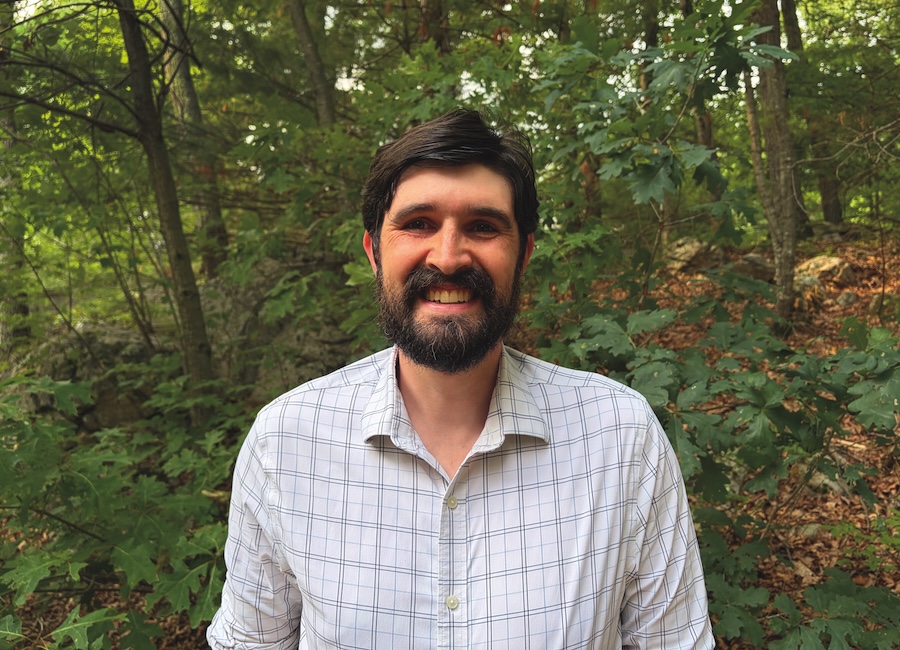
I began my scientific career at Bowdoin in 2013 as a summer research fellow in the chemistry department, working on an electrochemistry project with applications for understanding how pollutants degrade in the environment. This project turned into my honor’s thesis during my senior year at Bowdoin. This experience got me excited about scientific research, but I was unsure when I graduated if I wanted to pursue a career in biochemistry or inorganic chemistry.
An opportunity came my way to join a research group at Massachusetts General Hospital in Boston. I spent three years as a research technician studying epigenetics and learning molecular biology/biomedical lab techniques. This was a fantastic opportunity to learn how to conduct long-term scientific research, gain experience in scientific writing, and determine if I was interested in a biology-focused career.
While I enjoyed my time at Mass General, I realized I was more excited by the physical sciences. So, I decided to pursue a PhD in materials science at Yale University. Materials science is an exciting field sitting at the intersection of chemistry, physics, and engineering. Additionally, it is readily applicable to industrial R&D, which was important to me as I knew that I wanted to pursue a career in industry following my PhD. I studied nanomaterials, specifically atomically thin compounds called “2D materials.” Graphene, formed from single-atom thick sheets, is the most well-known 2D material. My research focused on a class of three-atom thick 2D materials that combine metal atoms and with sulfur, selenium, or tellurium. I studied the electrochemical applications of these materials in the production of hydrogen fuel and their use in energy storage technology such as lithium-ion batteries.
Following completion of my PhD in 2022, I joined a small battery startup in Marlborough, Massachusetts, as a senior research scientist. Ambri was developing "liquid metal" batteries to support intermittent renewables like solar. The idea was to charge large capacity batteries during times when power generation was plentiful (i.e., during the day) and then discharge that energy to the grid when demand was higher (i.e., at night). The unique aspect of the chemistry was that the batteries ran hot—so hot that the metal electrodes were molten, hence the name “liquid metal" battery. My work at Ambri focused on material failure analysis and materials R&D, investigating the advanced materials that contained all of this molten metal. It was a complex problem to engineer materials capable of withstanding the harsh chemistry and aggressive oxidation that occurs at temperatures exceeding 900 degrees F. Ambri was a fantastic place to work, filled with purpose and wonderful people; however, as with many start-ups, Ambri ended up failing.
After Ambri closed its doors, I transitioned into my current role in the natural gas industry as the lead engineer of the Energy Lab at Eversource. Eversource is a utility company providing electricity and natural gas to MA, CT, and NH. My group is dedicated to material failure analysis and materials research for Eversource’s gas distribution network. If a component breaks on our pipeline, my group finds out why, and then we utilize those findings to prevent recurrence of that failure. It is a rewarding job, where I can leverage my materials science and failure analysis expertise to safeguard the public and Eversource field personnel by preventing hazardous gas leaks. It is also an exciting opportunity to expand Eversource's analysis capabilities and set up a new materials laboratory. We aim to provide a platform to test out new materials and technology that can improve the safety and reliability of the pipeline.
What do you find rewarding, exciting, challenging about working in the energy sector?
I enjoy working in an industry that is so integral to everyone’s day-to-day lives. As a graduate student, I was able to work in cutting-edge research to understand how a relatively new class of materials (2D materials were only discovered in 2004) can be used to advance energy production and storage. There are exciting applications to improve existing energy technologies and develop new ones. At Ambri, we were working on creating a reliable storage platform to make solar and wind power generation more efficient (excess energy generated during the day cannot be used later without a battery) and safer (many current battery technologies have serious safety concerns). As a failure analysis investigator at Eversource, my job directly impacts pipeline safety and helps to keep natural gas flowing to people’s homes to provide heat, hot water, and cooking gas while protecting public safety. In all of these roles, it is fulfilling to know that my work can directly impact how people power their lives.
At the same time, the energy sector can be challenging to work in due to the already-established infrastructure that provides us with electricity and fuel. Much of the research I conducted in graduate school and at Ambri sought to circumvent or reimagine established, mature technologies. The standard is really high when you need to compete with tried-and-true technologies that have been engineered toward maximum efficiency for decades. At Eversource, I am leaning into that established infrastructure, but there are challenges with mature technologies as well. Many gas pipelines were installed a century ago, and the mindset within the pipeline industry is to install pipe that will last for over a century. Managing the maintenance of these aging pipelines and establishing quality control procedures to ensure the longevity of new installations and repairs is difficult. As an industry, there is no margin for error when piping a flammable product under public streets and into people's homes and businesses.
Research can be painstaking and long—what do you like about it? What are things you would change if you could?
Laboratory research is not for the faint of heart. It involves long hours of laboratory work developing experimental methods and conducting experiments. In reality, those long hours are all about failure. Most of the work that scientists do never makes it into publication because so much of the work amounts to nothing for one reason or another. In graduate school, a postdoc and I found about ten different ways to mess up an experiment before we succeeded. But the excitement when you finally get an experiment to work is what keeps me coming back for more. The moment an experiment works is so satisfying, whether it is through sheer stubbornness and perseverance or a clever new way of approaching a problem. Similarly, the thrill of discovering something new is also a big driver of research. It is especially exciting when you stumble upon something new by accident; one of my favorite publications was based on unexpected results. Scientific research is about expanding the bounds of human knowledge, so often you are working in a realm where no one has gone before.
I think the biggest thing that I would change about research, if I could, are the politics behind it. Science is supposed to be dispassionate and based purely on the quality of the research and what the data says. In reality, politics at both the institutional and national/international level often interfere. New researchers can find it incredibly challenging to publish in high-impact journals with quality research, while more established, well-known researchers may face less scrutiny due to their past work. The peer review process can be fraught with conflicts of interest that are not always managed well. Similarly, who and what gets funded is often subject to various political whims and is not always based on the scientific merits of the proposal.
Are there ways that your academic or extracurricular work at Bowdoin has come into play in your life or career?
I would say that Bowdoin was integral in preparing me for my career. The solid grounding in chemistry that I gained during my major study has allowed me to work in a variety of scientific disciplines studying molecular biology, nanomaterials, high temperature electrochemistry, and failure analysis of steel and plastic pipelines. The problem-solving skills and approach to scientific reasoning that I learned at Bowdoin are the reason I am a successful scientist today. Additionally, the opportunity to conduct research at Bowdoin was crucial in developing my interest in becoming a research scientist. Often, undergraduate research opportunities are mundane “projects” that in reality are carefully controlled experiences where a graduate student or postdoc watches you to make sure that you don’t mess up their work. At Bowdoin, you get to essentially be a graduate student: you design experiments, conduct the research, troubleshoot when experimental methods don’t work, adjust the experiments based on initial findings, conduct data analysis, and do formal writing. That experience made it easier for me to find jobs in science and prepared me for the rigor of scientific research.
What brought you to Bowdoin?
I am originally from Massachusetts. I knew that I wasn’t interested in a big city school and that I wanted to stay within the New England area for college. I did a college tour in Maine with my parents during my junior year of high school and really liked the campus and the atmosphere at Bowdoin. After applying to schools, I found that Bowdoin had a much stronger science program than any of the other schools that I was accepted to. When I came to the accepted students day, everything about that experience confirmed that Bowdoin was the place for me.
What inspires you?
Watching the wonder and excitement that my two-year-old daughter has as she experiences things for the first time has inspired me to appreciate the beauty in the natural world and take a step back to enjoy the things that I often take for granted. She inspires me to approach life with a little bit of that child-like wonder. Some of the instruments and techniques that I have used in my career like imaging materials at the atomic scale or creating microscopic circuits or visualizing leak pathways with x-ray imaging are truly amazing when you think about what the technology is doing. It can be easy to get lost in the grind of research and my long to-do-list, but it has been rewarding to stay excited about the work that I get to be a part of.
Is there something about your work or life that others would find surprising?
I run a group called the "Energy Lab," which conjures up images of scientists in white lab coats looking in microscopes. While we do conduct scientific analysis, I think many people would be surprised to discover how much of my job is more like being a detective. When a failed component comes into my lab, we have to consider so much more than just the material at hand. It may have been installed over fifty years ago, which means that we pore over maintenance and installation records to understand the service life of that component. For items that fail during installation, we often go talk with the field personnel who were installing it to get the full picture of what was happening that day. Their insight is invaluable, as they are the experts at installing gas pipelines. We also read engineering drawings, talk with the training department, research industry literature, consult technical standards, and talk with manufacturers. In some cases, we may go out to the field and walk the jobsite; many times, a failure at one location is the result of a multitude of factors across a large jobsite. Once we understand the full picture, we can begin the laboratory analysis, which is also a lot of detective work. Every failure is different, and it is always fun to see where our investigation will lead.
Is there something about YOU that others might find surprising?
My career over the past decade has focused on scientific research, so people may find it surprising that I wrote more papers at Bowdoin in German than in English. I took German in high school and was able to start studying German literature my first year at Bowdoin. I was a double-major in chemistry and German and also studied abroad in the summer of my sophomore year in Freiburg, Germany. The German department is a small group of amazing professors, and I am grateful for their mentorship in making me a better writer, which has served me well in my scientific career. Unfortunately, I don't get to utilize my German much these days, but I try to read a novel in German whenever I get the chance. I also was the group translator on a recent trip to Germany, Austria, and Switzerland. I think the funniest use I found for my German was on my honeymoon in Costa Rica. My wife and I were hiking in the rainforest, and we rounded the bend and came upon another couple. The man was very excited and exclaimed, pointing at the path, "Hallo! Hier gibt's ein Hundertfuesser!!" ("Hello! Here's a centipede!"). I responded to him quickly in German, and we continued hiking. I think that he was so excited about seeing a centipede that he didn't note how odd it was that a stranger he met in the middle of the Costa Rican jungle would respond to him in German. My wife and I still laugh about this years later.
What do you enjoy doing in your spare time?
As the parent of a toddler, "spare time" seems like a foreign concept these days. I enjoy being outside, particularly hiking whenever I can get to the mountains, but I usually settle for walks in the woods with my dog. My daughter joins us, and it has been fun to see her develop an interest in nature as she rides around in the backpack. My wife and I both share a passion for travel, and we feel very lucky to have been able to travel to many places around the world. Probably the most memorable trip we took was a safari in South Africa; the wildlife was spectacular. We are both excited to share our love of travel with our kids when they get a bit older.
Best Bowdoin memory, or most-lasting lesson from your Bowdoin days?
That would have to be a party at Quinby House early in my sophomore year. This girl walked across the room and started a conversation that would change my life. Fifteen years later, we have been happily married for a decade, with a beautiful daughter and a baby on the way. As formative and important the education that I got at Bowdoin was, I think the friendships I made there were much more meaningful to who I am as a person. In addition to meeting my wife at Bowdoin, I made many lasting friendships with people who I am still in contact with to this day, sixteen years after we first met.

This story first appeared in the Fall 2026 issue of Bowdoin Magazine. Manage your subscription and see other stories from the magazine on the Bowdoin Magazine website.