The topic of public education is often a lightning rod for intense debate. Yet in focusing on what different factions feel is “wrong,” we risk overlooking what we have collectively done “right,” two education scholars recently argued at Bowdoin.
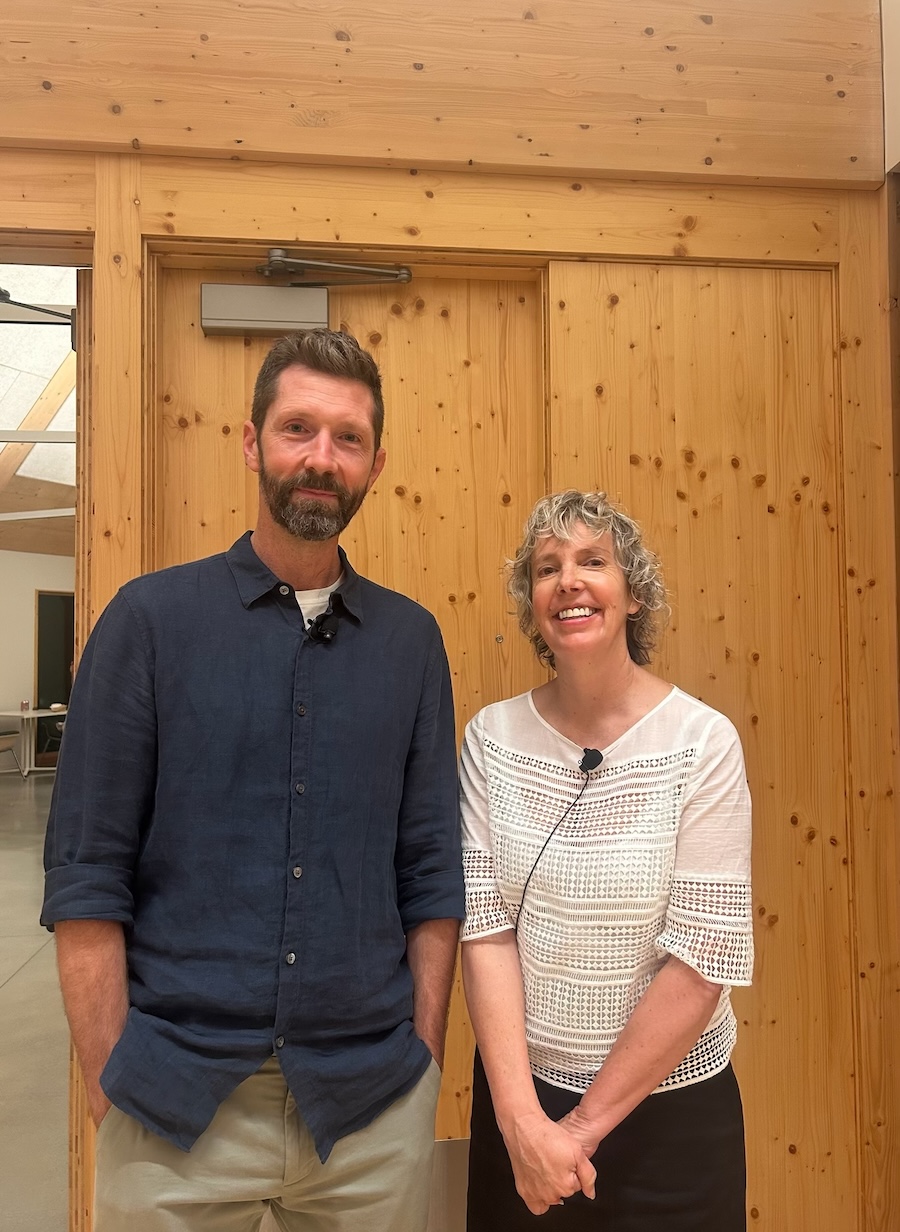
On October 1, co-speakers and coauthors Jack Shneider and Jennifer Berkshire visited Bowdoin as guest seakers in the Brodie Family Lecture series. Established in 1997 through the generosity of Theodore H. Brodie ’52, the goal of the program is to bring experts in the field of education to interact with the Bowdoin community on topics related to dilemmas, debates, and pedagogical practices in education.
Schneider and Berkshire are co-hosts of “Have You Heard,” an “occasionally funny and periodically informative” examination of “the age-old quest to finally fix the nation's public schools, one policy issue at a time,” they say. They have also coauthored two books: A Wolf at the Schoolhouse Door: The Dismantling of Public Education and the Future of School and The Education Wars: A Citizen’s Guide and Defense Manual.
Beyond their professional partnership, Berkshire is also a journalist with work published in The Nation, The New Republic, the Baffler, and The New York Times. She teaches in the Boston College prison education program and in Yale’s education studies program. Schneider is an educational historian. He divides his time between academic research on public education, teaching at the University of Massachusetts–Amherst, and writing for outlets such as The New York Times and The Atlantic magazine.
A significant portion of their lecture at Bowdoin centered on the history of education, as well as analyzing alternatives to public schooling and talking about how Bowdoin students can play a role in tackling the challenges of public education.
They argued that since the dawn of public education there has been a continuous debate concerning how it should be run. Schneider, in a loose quoting of Horace Mann, stated that schooling “has to be the same that is afforded to the greatest among us. In other words, our public schools have to serve everybody equally if anybody is going to be willing to participate.”
However, both scholars acknowledge that over time the focus has turned away from schools as a place of education to a be-all-end-all for social ills. Instead of appreciating the system for what it is—a place to encourage curiosity and develop young minds—we criticize it for not resolving the nation's inequities.
To combat this, Berkshire argued that we should address economic inequality as its own distinct issue, not place that responsibility on schools. “We can lower the stakes, and then maybe start to think about what else schools can do and be besides a ticket to a job,” she said.
Schneider and Berkshire argued that we, as a society, should turn our attention to celebrating and encouraging the successes already present in public education, including its greatest success—solidarity. Not only does teaching solidarity and creating community—especially with people from diverse backgrounds—help students, it can also be used as a tacit way to support public schools. Instead of abandoning public schools in favor of alternatives like voucher programs or alpha schools, our focus should be on how schools can embrace the “motivator of solidarity,” they said.
Finally, Berkshire mapped out how we can reshape our thinking of schools through her policy of “big us, small them.” This mantra emphasizes how many people are on the same page in terms of education. “The only way you win is by convincing everybody that they have a place in the system, by making everyone feel like they haven’t lost.”
Looking at differences in small components of education allows society to fragment until it feels that everyone is on opposite sides of an unending war. The solution to this is to stop and consider that everyone is fighting with the same goal—the best education for children.
The key takeaway of Schneider and Berkshire’s lecture was not to focus on the ways in which our schools are failing us, but rather on the ways in which they are succeeding. Once we reset the definition of success to something more realistic, we can collectively appreciate that achievement and build from there.