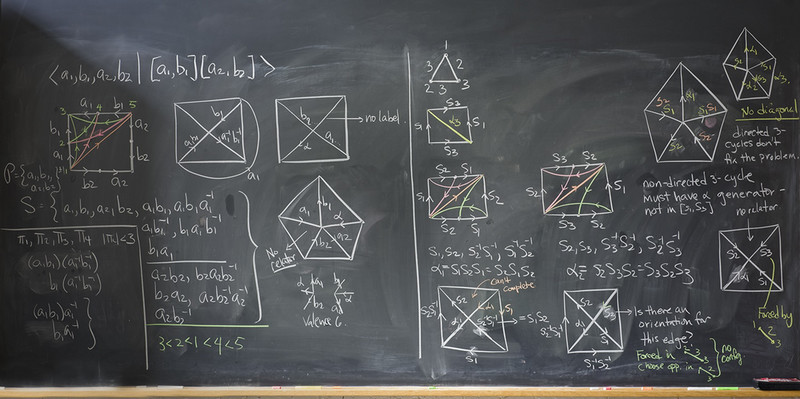
The Aesthetics of Math on a Chalkboard
By Tom PorterDespite the high-tech options now available, this centuries-old form of classroom communication remains a favored tool of many mathematicians for teaching and collaborating.
Wynne, a professor of photography at the Fashion Institute of Technology in New York, was on campus recently to talk about her work capturing images of mathematicians’ chalkboards.
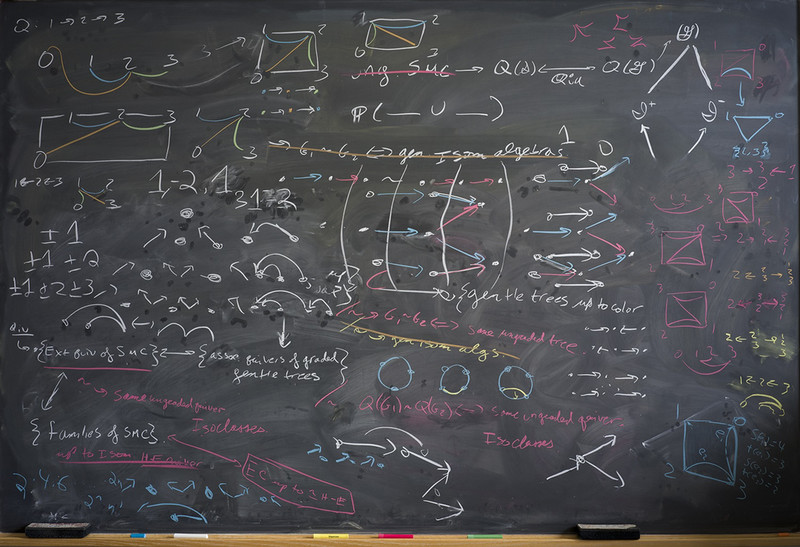
This work was embodied in Wynne’s 2020 book, Do Not Erase: Mathematicians and Their Chalkboards (Princeton University Press), which features a hundred striking photographs of blackboards gathered from a diverse group of mathematicians around the world. The photographs are accompanied by essays from each mathematician, reflecting on their work and processes.
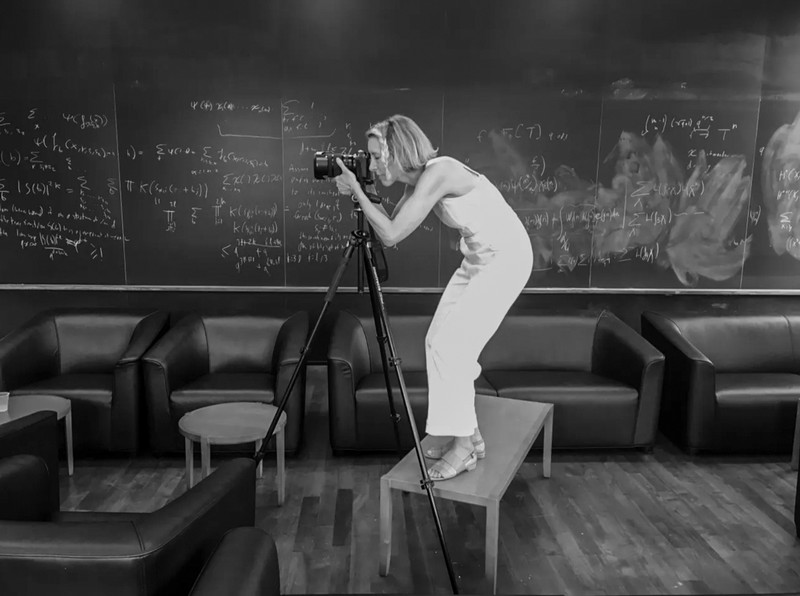
Even though she does not know what the writing on the blackboards means (only a math scholar would understand), Wynne was struck by the aesthetic appeal of the images. “The camera gives me an entry point into these worlds that I’m curious about but where I’m an outsider,” she said.
Part of the artistic appeal of chalkboard work, said Wynne, is its physicality and the longer time constraints imposed by the movement of a body through space. “Mathematicians have told me there’s something about the process of physically drawing and standing at a chalkboard that’s more closely aligned with the function of the brain. Digital tech is so fast that there’s not that same kind of alignment.”
Furthermore, she added, there’s a distinctive collaborative element that’s unique to chalkboards, some of which can be thirty-feet wide, enabling scholars and students to have visual conversations as they add their calculations to the board and erase earlier ones over a period of time. Whiteboards, meanwhile, are viewed less favorably by many mathematicians. This is partly because of the smell of the markers and how easy it is to get stains on your hands, said Wynne (“It’s not an enjoyable process”), but also because blackboards offer a more tactile, thoughtful, and clean experience, especially if using superior Japanese Hagoromo chalk, she added. Chalkboards are also more visible from a distance, many mathematicians say.
Wynne also likes what she called the “playfulness” of chalkboards and the spirit of adventure and experimentation they encourage among math scholars. “There’s no sense of permanence,” she stressed, pointing out that mathematicians might be more hesitant to write certain things on paper or on a screen. Sometimes, of course, they do want to leave their calculations on a chalkboard in order to come back to them next time and continue the work. In this case, Wynne explained, they write “do not erase” on the board so no well-intentioned janitor accidentally deletes some earth-shattering equation (hence her book’s title). She recalled one mathematician who “had a corner of his board that was untouched in about five years because he was still trying to figure it out. He wanted to see it every day he went to his office.”
“Mathematicians have told me there’s something about the process of physically drawing and standing at a chalkboard that’s more closely aligned with the function of the brain. Digital tech is so fast that there’s not that same kind of alignment.” Jessica Wynne.
As well as delivering a lecture at Bowdoin, Wynne took time to visit classes in the math department (where she captured some chalkboard images) and the visual arts department. “I really enjoyed her interdisciplinary perspective relating to art and mathematics,” said Assistant Professor of Mathematics Alex Black. “It raises an important question that the math community is actively thinking about right now: How does the medium in which we do math impact the math itself?” For example, he explained, when scholars started to produce math using computers, this led to many controversies in the community: “Most famously, the only known proof of the famous and important four-color theorem was done by computer, and my experience is that the majority of mathematicians find this dissatisfying.”
Wynne’s work, said Black, gives a good broad summary of the emotional connection between mathematicians and their most classical tool of a blackboard. “She gave me some new ideas for what being interdisciplinary can mean in the context of the liberal arts community, leaving me with questions I look forward to bringing up with Bowdoin faculty in the humanities over lunch!”
Wynne also visited Professor of Art Michael Kolstser’s introductory photography class, where she shared her work with students and fielded their questions. “Wynne’s work provided them with a wonderful example of the rewards of being curious and what can happen when we closely regard and try to describe what is often in plain view,” observed Kolster. “Like the blackboard, the bounded view through her camera is yet another instance of a frame waiting to be filled. By seeing the chalkboard as analogous to the photographer's frame, Wynne explores how the concerns of the mathematician and the photographer converge in a common search for elegance, originality, and beauty.”
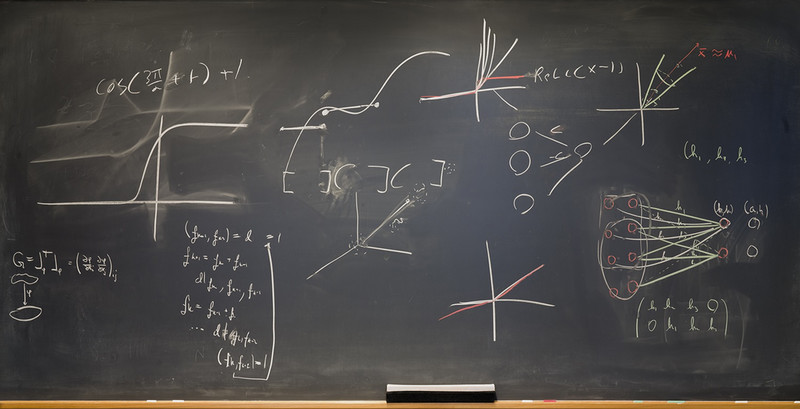
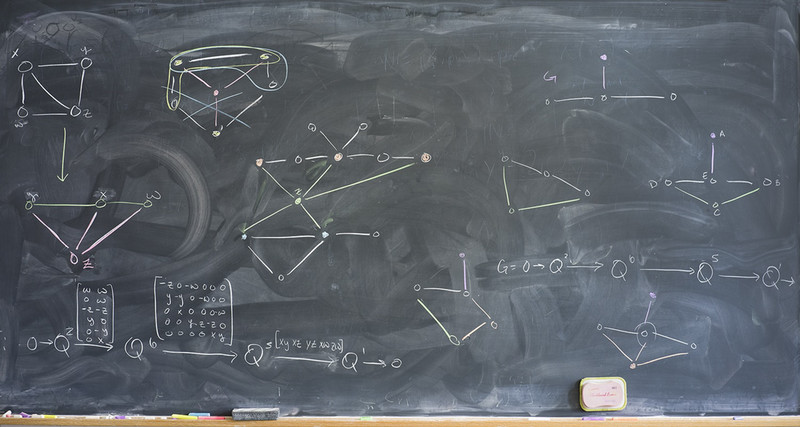
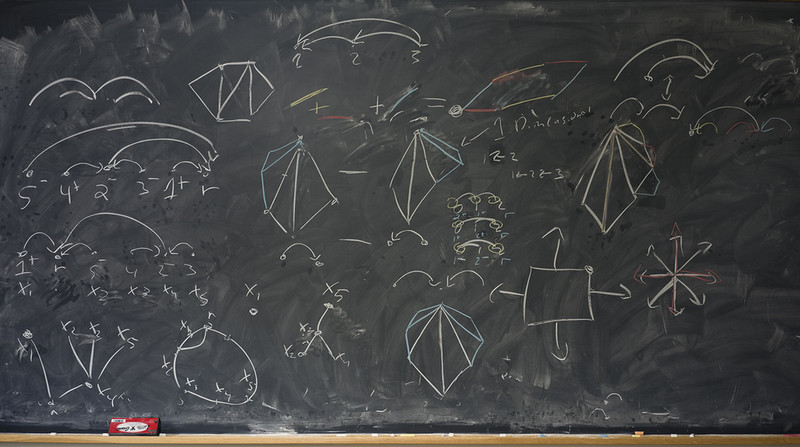
During her visit, Wynne photographed some of the Bowdoin math faculty's chalkboards: