Renovated Peucinian Room Connects the New and the Old
By Tom PorterWhen the newly renovated Sills Hall welcomed students in the fall of 2025, the idea was to offer an updated and improved place of learning, while respecting the older elements of the building—and this approach applies to the Peucinian Room as much as anywhere.
"Modernizing the room's instructional equipment while concealing it to retain the room's aesthetic was an important goal,” said Sharon Ames from Bowdoin’s Office of Facilities Management.
To this end, she explained, an effort was made to reuse or replicate some of the original features. “Salvaged wood was used for the fireplace wall; the wood ceiling is new material finished to match the original, while the fireplace mantel, brick, and andirons remain.”
The College describes the renovated room, situated on the building’s lower level, as being “intentionally Luddite with limited technology and no modern writing surfaces.”
It’s all about trying to honor the spirit of the group for which the room is named. The Peucinian Society was founded in 1805, taking its name from the Greek work for “pine-covered” (the society’s motto is Pinos loquentes semper habemus, meaning "We always have the whispering pines"). It is one of the nation’s oldest literary societies and the oldest student organization at Bowdoin, although it was inactive for more than a century before being revived in 2007.

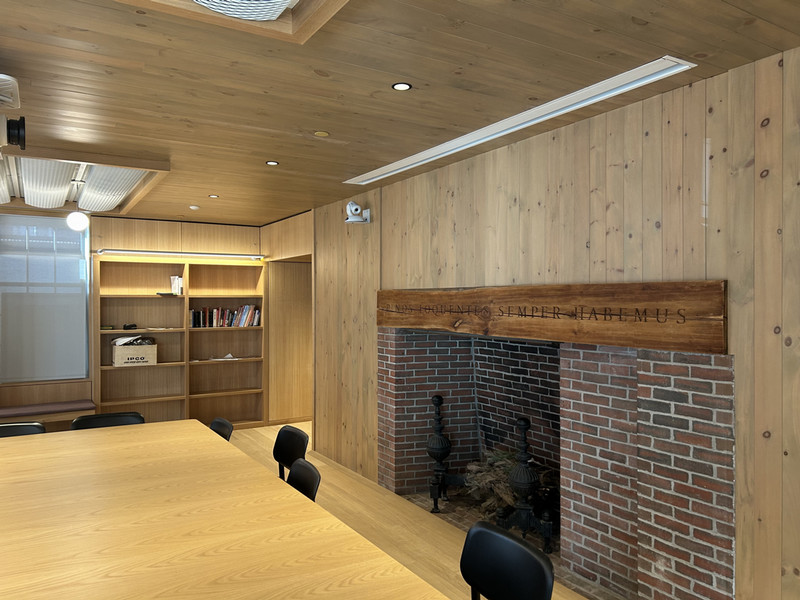
Today the Peucinian Society holds weekly debates—or disputations, as it calls them—concerning statesmanship, culture, and political thought. These disputations have been held in Massachusetts Hall for about the past fifteen years, explained Mark Mateo ’26, ever since the society’s membership got too large to meet in the room itself. “But the Council of Eight meets in the Peucinian Room for an hour or so before our weekly disputations,” he said, referring to the society’s student leadership council, of which he is president. “Honestly, we’re really pleased with how the room turned out.”
One important and continuing feature of the Peucinian Room is the library, added Mateo, and members are free to check out books as they wish. “The library has been accumulating for a long time now, and most of our books are donated by graduating members or professors who have developed an especially close relationship with our society and its members over the years. Actually, Peucinian hosted the College’s library during its first iteration in the 1800s, so it’s nice to feel some connection with the generations of Bowdoin students who came before us when we’re in there. Other than that,” said Mateo, “the room remains—as it was before the renovation—a great place for our members to study with one another and hang out outside of the classroom.”


The Peucinian Room, however, is primarily a teaching space, housing classes and seminars where students and their tutors can engage face-to-face. Senior Classics Lecturer Michael Nerdahl has his students hold "civil suits" in the space, where, in the role of senators, they argue legal cases for their clients based on legal controversies from ancient Rome. He said it was important that the College kept the room and its spirit alive when renovations took place.
“There's an essence to it that speaks to many of us. The room serves as a kind microcosm of change at Bowdoin: Like the renovation of Sills, it's much changed and much improved but is still identifiable as a place of learning and debate and collegiality and growth.”
Inevtiably, perhaps, there remains a degree of nostalgia for the antiquated nature of the old room among some on campus. “The old Peucinian Room lacked any and all technology,” recalls Michael Bagnoli ’26, who has taken several classes in the room. “Rather than a whiteboard with dry erase markers, it featured a large revolving chalkboard that could be wheeled around the room. The only natural light came from smaller egress windows than those that exist now. The entire room was covered in wood paneling, giving it a cozy feel, warmer than how it feels now.”
In a concession to the technological needs of the modern classroom, the renovated room features a ceiling mounted projector and screen, with wall-mounted touch-panel audiovisual controls. Nevertheless, Mateo Pacelli ’26 feels the new space still, essentially, feels like the old one. “As a student who prefers courses that are discussions, seminar-based, in which we gather around a table to discuss the text, I feel this room facilitates just that.” Last fall Pacelli took a seminar in the Peucinian Room on Dante’s Inferno and this semester is doing one on Sicilian literature. “I find the room itself to be inviting, yet demanding, as it begs for an intellectual discussion.”
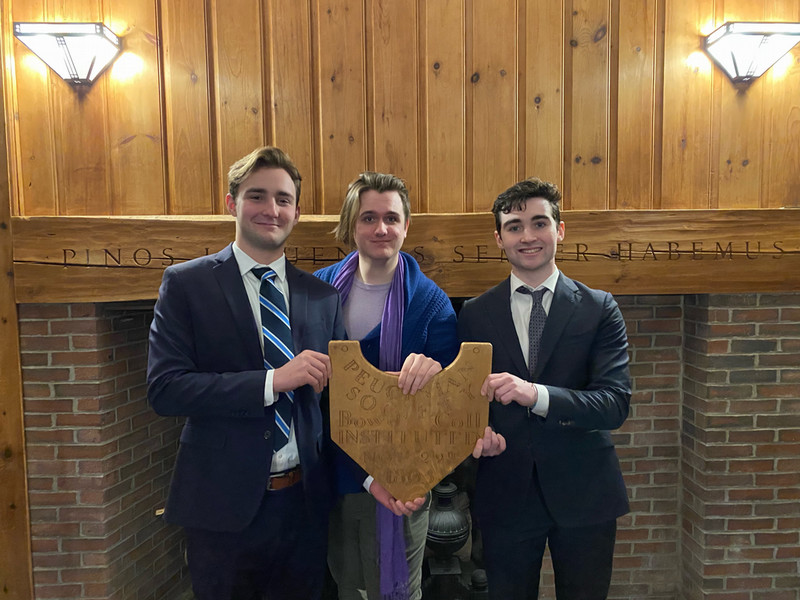

Assistant Professor of Romance Languages and Literatures Alejandro Cuadrado, who teaches the class on Dante, said the room remains the ideal setting for this type of text- focused conversation-based seminar.
“In reading Dante’s Inferno, there were several moments when the poem would riff on a scene from Virgil or Ovid. Being able to reach over to the Peucinian bookcases and pluck a red Loeb copy off the shelf made the work of teaching intertextuality feel more alive than, say, looking up an online version of a Latin epic.” The intentionally tech-free environment, said Cuadrado, not only reduces distractions, but also sharpens the stakes of reading literature that has stood the test of time. “The Peucinian Room—more than any other space on Bowdoin’s campus—demonstrates how the original learning technologies of the codex and the seminar table are really all you need.”