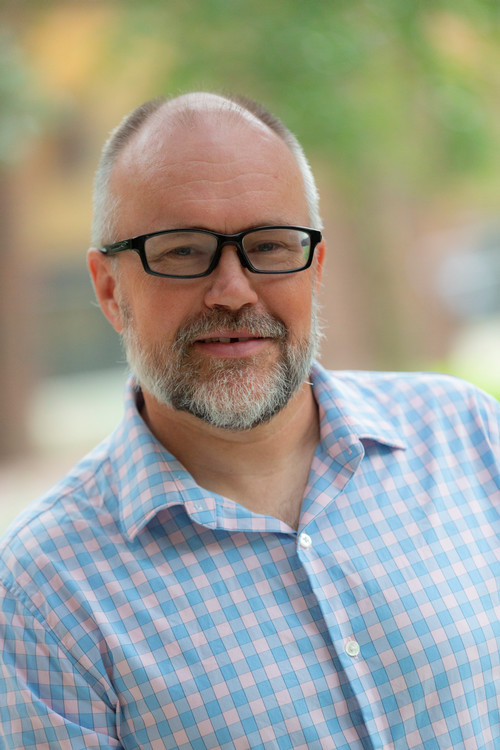
Bowdoin’s R. Wells Johnson Professor of Mathematics Mary Lou Zeeman is visiting Hawai’i to take part in a number of events highlighting how the power of mathematics can be harnessed to understand environmental tipping points.
On February 10, Zeeman, who is on sabbatical for the current academic year, gave a talk at the University of Hawaiʻi Mānoa Mathematics Department. It was the first of several events Zeeman is taking part in over the week as part of the department’s Mathematics of Resilience lecture series.
She also featured on Hawai’i Public Radio’s weekday magazine show The Conversation, where she was asked to describe how math could be used to find an environmental tipping point. Zeeman gave the example of shallow lakes, which can be very rich with wildlife and biodiversity. This is due to sunlight reaching the bottom of the lake that causes the growth of vegetation, which itself becomes a home for many other species. But, she added, this same body of water could pass a tipping point, where the gradual buildup of algae blocks the sunlight and prevents the vegetation at the bottom, causing the lake to become turbid.
This change from clear state to turbidity, said Zeeman, can appear to happen suddenly but is often due to an incremental loss of resilience that can be hard to recognize. “We often don’t know we’re at a tipping point until something dramatic happens,” she explained, “and that’s one example where we hope mathematical modeling can help.” Zeeman’s visit to Hawai’i includes a field trip to a local lake as part of a wetland restoration project to help in the recovery of native species and plants.
The kind of data-driven applied math that Zeeman promotes requires collaboration with scientists and other stakeholders to tackle real-world problems such as environmental challenges. “I find it thrilling that I can use this particular mathematical mind of mine to do something that is really helpful for the world,” she added.
“We often don’t know we’re at a tipping point until something dramatic happens.”
Zeeman is cofounder of the Mathematics and Climate Research Network (MCRN), an interdisciplinary group of researchers focused on using mathematical modeling to understand climate change and sustainability.