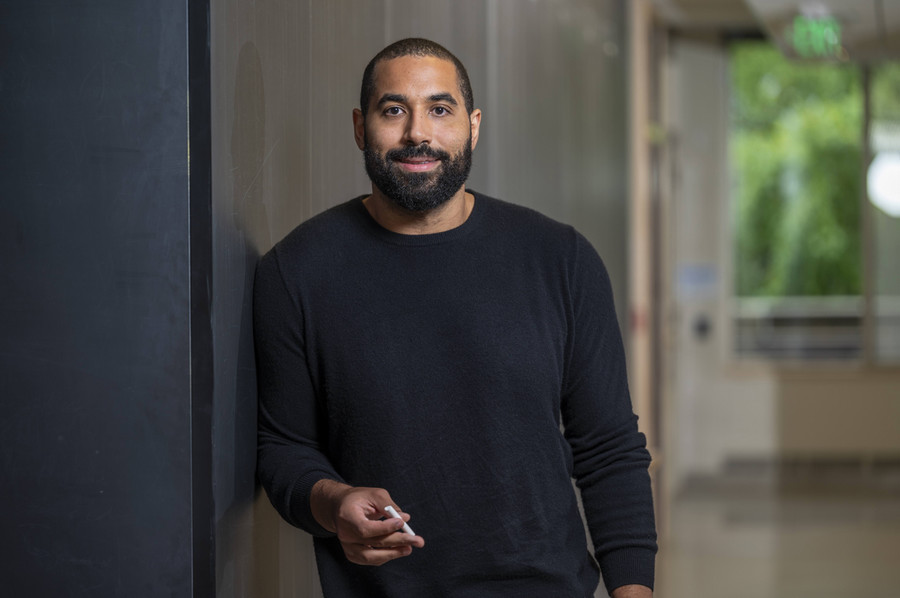
Taback, the Isaac Henry Wing Professor of Mathematics, was announcing the visit of John Urschel to campus. Formerly an offensive lineman with the Baltimore Ravens, Urschel played three seasons in the NFL before earning a PhD at the Massachusetts Institute of Technology, where he is now a professor in the math department.
“I enjoyed football, but it was never the long-term plan,” explained Urschel, who said he had always aimed to return to college and pursue an academic career. “I got a chance to play at the highest level, and you can’t pass this up!”
The discipline of being a top-level athlete helped mentally equip Urschel for the rigors of academia, he added. “I think some of the skills I developed in football—resilience, determination, the ability to struggle with something and persevere—have served me well in mathematics.”
Urschel, whose book, Mind Over Matter: A Life in Math and Football, was a New York Times best seller, spent a couple of days on the Bowdoin campus last week. He delivered two lectures—a public talk for the Bowdoin community and a more specialized academic address for math students, who also got the chance to meet with Urschel and ask him questions. On top of this, he hung out with members of the Bowdoin football squad, who came to pick him up at 5.30 a.m. for an early workout.
“He warmed up with us and joined in for a few drills,” said team member Chase Hinton ’27. “He also came to breakfast, where he talked about his time being recruited from Penn State, and answered some of our questions about his teammates on the Ravens and some of the hardest opponents he had faced. He's a great dude!” Hinton, a math minor, also enjoyed hearing Urschel’s lecture. “He was able to break down complex equations in an intuitive fashion.”
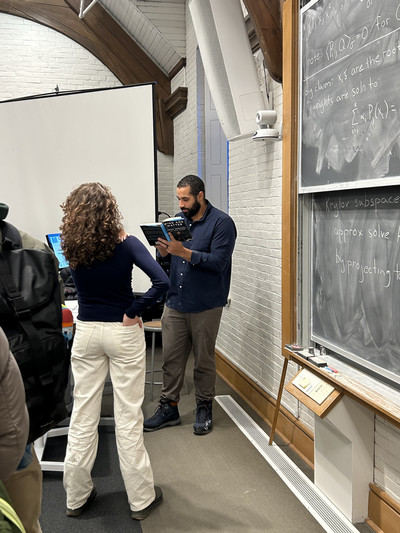
In Urschel’s public lecture, “Gaussian Elimination: Old Algorithm, New World,” he talked about numerical analysis and the study of algorithms for problems in continuous mathematics.
Although algorithms have been around for thousands of years, he told the audience, the advent of the computer age in the 1940s enabled numerical calculations on a scale that was previously unimaginable. But, he added, it has also led to concerns about the stability of these algorithms and what kind of errors might creep in as accuracy is sacrificed for speed.
“When we do even basic operations, errors build up, and these errors can become quite large and accumulate in strange and unexpected ways,” Urschel said. These considerations grow increasingly important today, we are told, with unprecedented volumes of data and computing power embedded in every corner of science, engineering, and business.
In response to a question from the audience, Urschel also discussed the issue of artificial intelligence in the classroom, its benefits and drawbacks. “I don't ban it,” he explained. “I actually don't even explicitly refer to it, but I strongly suggest to students that if they’re doing homework in collaboration with others, whether they be human or machine, that you really understand everything yourself, independently.
“It is perhaps a little heartwarming that I tend to find that students who really try to interact organically with the material do well on exams, even if they have slightly lower homework scores than other students who, when I see them in office hours and ask ‘Why did you do that?’ they say ‘ChatGPT told me.’”
Math major and prospective graduate scholar Graham Lucas ’26 attended Urschel’s lecture specifically for math students, titled Matrices, Moments, and Quadrature. Lucas said he was interested in how Urschel shed light on the historical development of a mathematical idea—in this case a quandary called a “moment problem,” explored over a century ago by scholars who laid the groundwork for the modern computational techniques used in numerical analysis and linear algebra. “In math classes, you tend to be more concerned with presenting a lot of information in concise, neat ways, rather than thinking about the history,” said Lucas.
“The department was delighted to host Professor Urschel, whose visit sparked a dialogue on both the technical and the social landscapes of mathematics,” remarked Associate Professor of Mathematics Thomas Pietraho, who is also department chair.
“As a researcher at the intersection of matrix algebra and machine learning and a former NFL player, he offered a rare perspective on discipline and discovery. He was a rich source of inspiration, challenging us to see the 'scholar' as someone whose influence transcends the classroom.”
John Urschel's visit was to Bowdoin was supported by the Cecil T. and Marion C. Holmes Mathematics Lectureship Fund and the Bowdoin College Athletics Department.