“What I love about the Bowdoin Coastal Studies Semester”
By Delaney Jones '26Hundreds of snail shells covered the lab tables, sorted into plastic bags and arranged by size and shape. Outside, the ocean swelled in the coastal Maine breeze.

On a typical day this fall in the benthic ecology lab at the Schiller Coastal Studies Center in Harpswell, Maine, students worked in small groups collecting data for their semester-long research on the common periwinkle. Each one tackled a different question, such as how wave exposure affects foot size, how pH impacts shell density, or how man-made changes influence snail length and biofouling.
The snails can serve as a bellwether for the broader health of mollusk populations. “These results have real implications for Maine’s economy, where coastal livelihoods depend on shellfish,” said Eli Bundy ’27, an earth and oceanographic science major and one of the eleven students who participated in Bowdoin's Coastal Studies Semester (BCSS) this year.
By choosing their own questions to address, students got deeply engaged in the research project. “Many even volunteered to collect samples at extra sites, simply out of curiosity,” said Christopher Wells, the course instructor and this year’s Bowdoin’s Doherty Marine Biology Postdoctoral Scholar.
BCSS is an immersive semester-long experience that centers on the Gulf of Maine, with the aim of giving students an interdisciplinary understanding of the changing coastal environment and the forces that shape it.
Students take four courses, all based at the Schiller Center. While these change each semester, this year the classes are Benthic Ecology, Ocean Acidification, Talking to Farmers and Fishermen, and Maine Writers and the Environment.
“Visiting Schiller on Admitted Students Day was a big part of why I chose Bowdoin.”
—Greta Ahlefeld ’27, BCSS 2025
Deepening Academic Interests and a Connection to Maine
"Growing up in Maine and then studying earth and oceanographic science at Bowdoin, I thought the BCSS would be a great way to connect those two experiences," said Greta Ahlefeld ’27. “Visiting Schiller on Admitted Students Day was a big part of why I chose Bowdoin.”
Many students are drawn to the program for the way it enhances their academic interests. “I’m from the South Carolina coast and grew up exploring salt marshes,” said Bundy. “I developed an interest in coastal resilience and how environmental damage affects coastal communities, which I now get to study at Schiller.”
Students from Maine learn about their home state in a new way. “I’d never taken a class focused on the region I grew up in,” said Lily Watts ’27, an earth and oceanographic science major and math minor from Kittery. “I’ve seen the common periwinkle my whole life, and now that’s my ongoing research this semester. I’m studying marine biology in the Galápagos Islands this spring and can’t wait to compare the two coastal ecosystems.”
The semester offers many opportunities to build skills essential to marine science, from conducting field research to engaging with coastal stakeholders like clam-diggers, lobstermen, conservation biologists, and more. “You can even get your boat license!” said Stephanie Goerck de Carvalho Macedo ’27.
View this post on Instagram
Christina Korn ’28 shared a day in the life at the Schiller Center for Bowdoin's admissions office this fall.
“I was nervous about being in a small group, but have realized this is an academic environment I thrive in.”
—Lily Watts ’27, BCSS 2025

A Tight-Knit Community
With only eleven students in the cohort, building relationships comes easy. Students take all four courses together, carpool to and from Schiller twice a day, share lunches on the island, and spend weekends side-by-side on field trips.
“I love that all of our classes are interrelated and we get to do them with the same group of people. It makes for a tight-knit community,” said Ahlefeld.
Watts noted that the small size encourages both academic growth and close ties. “I was nervous about being in a small group, but have realized this is an academic environment I thrive in,” she said. “We’ve lost most of our embarrassment with one another in class. We can totally be ourselves and have more room to make mistakes and speak up.”
Sometimes that lack of embarrassment surfaces as jokes inspired by class material. During a quiet moment while measuring snails, Gabe Marra-Perrault ’28 broke the silence:
“What does the clam in the mudflat say to the oyster in the surface aquaculture setup?”
He grinned.
“You’re being a little shellfish.”
(Oysters tend to take most of the nutrients near the water’s surface).
“Learning in nature is a welcome change from sitting inside on my laptop.”
—Eli Bundy ’27, BCSS 2025

Spending Time Outdoors, and the “Polar Plunge” Pledge
For many, the chance to spend more time outdoors and take advantage of Bowdoin’s location on the coast is appealing. “Learning in nature is a welcome change from sitting inside on my laptop,” said Bundy.
“Spending time at Schiller and on Kent Island were two big bucket-list items for me coming into Bowdoin,” added Catherine Benavides ’27. “I spent the summer on Kent Island, and now I’m at Schiller!”
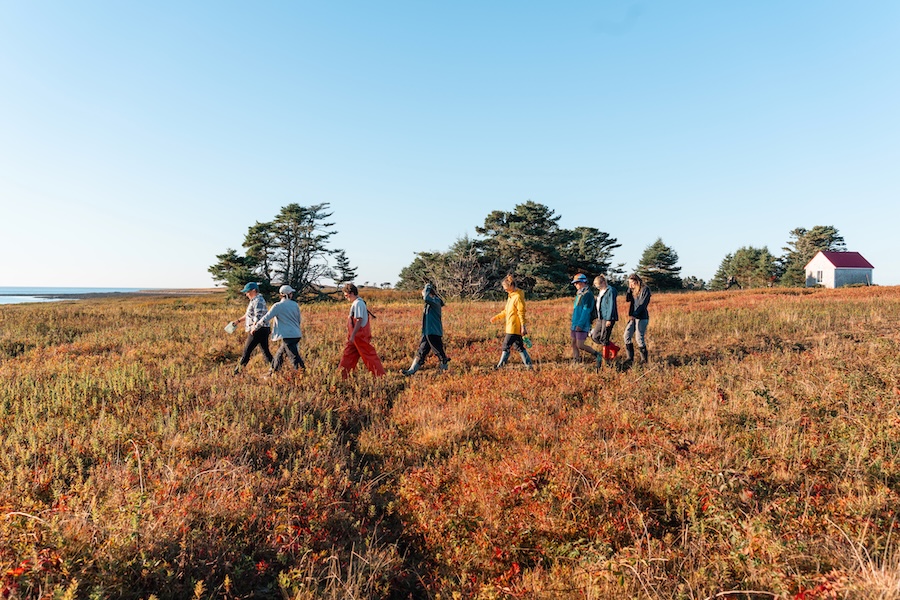
Many courses include substantial fieldwork in intertidal zones, out at sea, or even at commercial docks. But even between classes, students find time to explore Schiller, enjoy the coastline, and swim by the docks.
“We get to jump in the ocean every day,” Ahlefeld said, even in late October.
Of the eleven students in the cohort, eight have taken a “polar plunge” daily, a tradition begun by past cohorts. “We jump off the dock until it gets too cold and they remove it,” Ahlefeld said with a grin. “Then we shift to plunging from the beach.”

BCSS students spend a lot of time in the ocean, whether for their daily polar plunge or coursework. Here, they float off the dock at the Schiller Coastal Studies Center.
Exploring through Field Trips
Overnight field trips to Kent Island, the Hurricane Island Center for Science and Leadership, and the Downeast Institute give students the chance to explore Maine while enhancing their studies. “It’s a great opportunity to get to know our professors, too, since they join us on the trips,” said Goerck de Carvalho Macedo.
“A lot of what we do on field trips involves exploring,” said Ahlefeld. The Kent Island trip focused on the benthic ecology. “We conducted fieldwork in the intertidals, picking up anything we were curious about and asking about it. And we sampled the snails, of course.”
The Hurricane Island trip took a more interdisciplinary approach. “We learned about the history of the island and chatted with researchers living there,” Ahlefeld said.
The semester also includes shorter excursions to nearby salt marshes, oyster farms, and coastal ecosystems. In late October, the group visited Portland’s working waterfront, where they met with Bill Needelman, the city’s waterfront coordinator.
Needelman led a tour of the Portland Fish Pier, explaining the economics, politics, and best practices of the Portland Fish Exchange, which is where fishing boats offload and sell their fresh catch to buyers. Needelman emphasized how remarkable it is for a city of Portland’s size to play such a central role in the regional and global seafood economy.
“It was fascinating to examine the fishing industry from the perspective of how fish gets sold,” said Ahlefeld. “Earlier in the semester, our conversations with fishermen focused on the practice of fishing itself. The waterfront tour helped me see how that work connects to the industries that depend on it.”


“Getting to know our neighbors and learning from them is something we value here in Maine. These conversations expose students to how local politics, economics, and environment intersect along Maine’s coast.”
—Holly Parker, Schiller Coastal Studies Center director
The Interdisciplinary Approach: All You Have to Do is Ask
Though the BCSS attracts many science majors, its approach to coastal studies spans disciplines, from ecology and policy to literature and ethics. “I love the English class Maine Writers and the Environment; it might be my favorite,” Watts shared. “It’s a great brain change from the science courses.”
Every other Wednesday, students gather for a “Lunch and Learn” series, where Mainers from diverse backgrounds join them for conversation and a meal. They’ve spoken with clam-diggers, lobstermen, conservation biologists, and more.
“Getting to know our neighbors and learning from them is something we value here in Maine,” said Holly Parker, director of the Schiller Coastal Studies Center. “These conversations expose students to how local politics, economics, and environment intersect along Maine’s coast.”
The program’s unofficial motto is “all you have to do is ask.” It encourages students to bring their curiosity to discussions and to not worry about what they don’t yet know. “We’ve talked with people who had very different views on the same issues,” said Watts. “You might ask the same question to every group and get wildly different answers.”
Students say they hope to carry this practice of asking questions and embracing complexity back to campus. “When I return next semester, I want to dive deeper into research and make more connections between industry and science,” Ahlefeld said. “During my remaining time at Bowdoin and after I graduate, I hope to keep weaving together these approaches and perspectives.”
Photos by Khalil Wilkinson ’28.