First to See the Sunrise: The Spirit of Bowdoin Crew
By Kenny Hamann ’30They joined more than 2,600 boats and nearly 12,000 athletes from thirty-two countries on a three-mile stretch of the Charles River lined by boathouses, parks, and crowds of spectators.
The race is technical and challenging. The Charles requires that athletes and coxswains pilot a bridge-spanned course of tight, technical turns and narrow, buoyed lanes.
But the athletes competing for Bowdoin were ready. Mostly sophomores, juniors, and seniors, the College's racing fleet had dedicated extra hours on the New Meadows River and on the ergs (rowing machines) to prepare for the big day.
Boats race against the clock on the three-mile (4.8 km) course, starting sequentially ten to fifteen seconds apart, a style called head racing. “[Head racing] just adds a whole other element of racing: you have to try to hold off the boat behind you and try to chase down the one ahead,” team captain Cassidy Dean ’27 said.
This year, Bowdoin raced in the collegiate and alumni divisions. In addition to the College men’s four, women's four, and women’s eight, the club raced a women’s alumni four and a men’s alumni four.
“It was exciting to see alums returning from the class of 2015 to present day,” Head Coach Doug Welling said. The men’s alumni four scored tenth in a competitive race.
Crews who place in the upper half in their racing fleet automatically qualify for next year’s Charles event. The college women’s eight met this threshold, a feat not seen in more than twenty years of Bowdoin crew. “It’s really phenomenal, placing that well against some of the top DIII and collegiate crews in the country,” Welling said.
Dean said the race was tough, but fulfilling. “Thinking back on my experience at the Head of the Charles, I was in so much pain at the end but I also couldn’t stop smiling. My boat was just so happy—we knew how hard each of us pushed for each other and for this team,” she said.
“I think about remembering why you're doing this, who you're doing this for, and that you have eight other people in that boat all there, too, and they're all in it with you, and that you need to do it for them.”
—Sophia Chester ’30, on what goes through her head on race day.
Gliding on the New Meadows
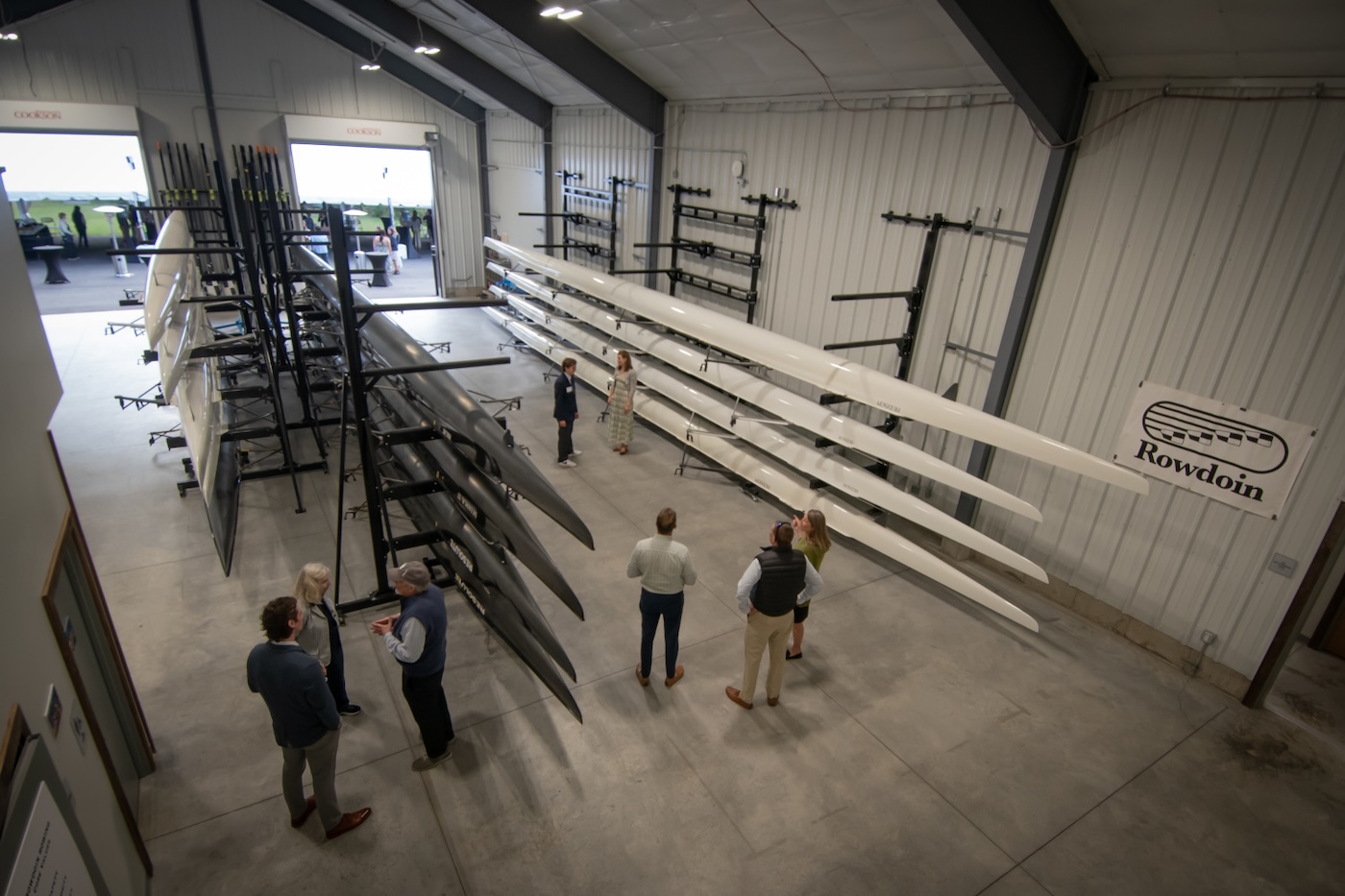
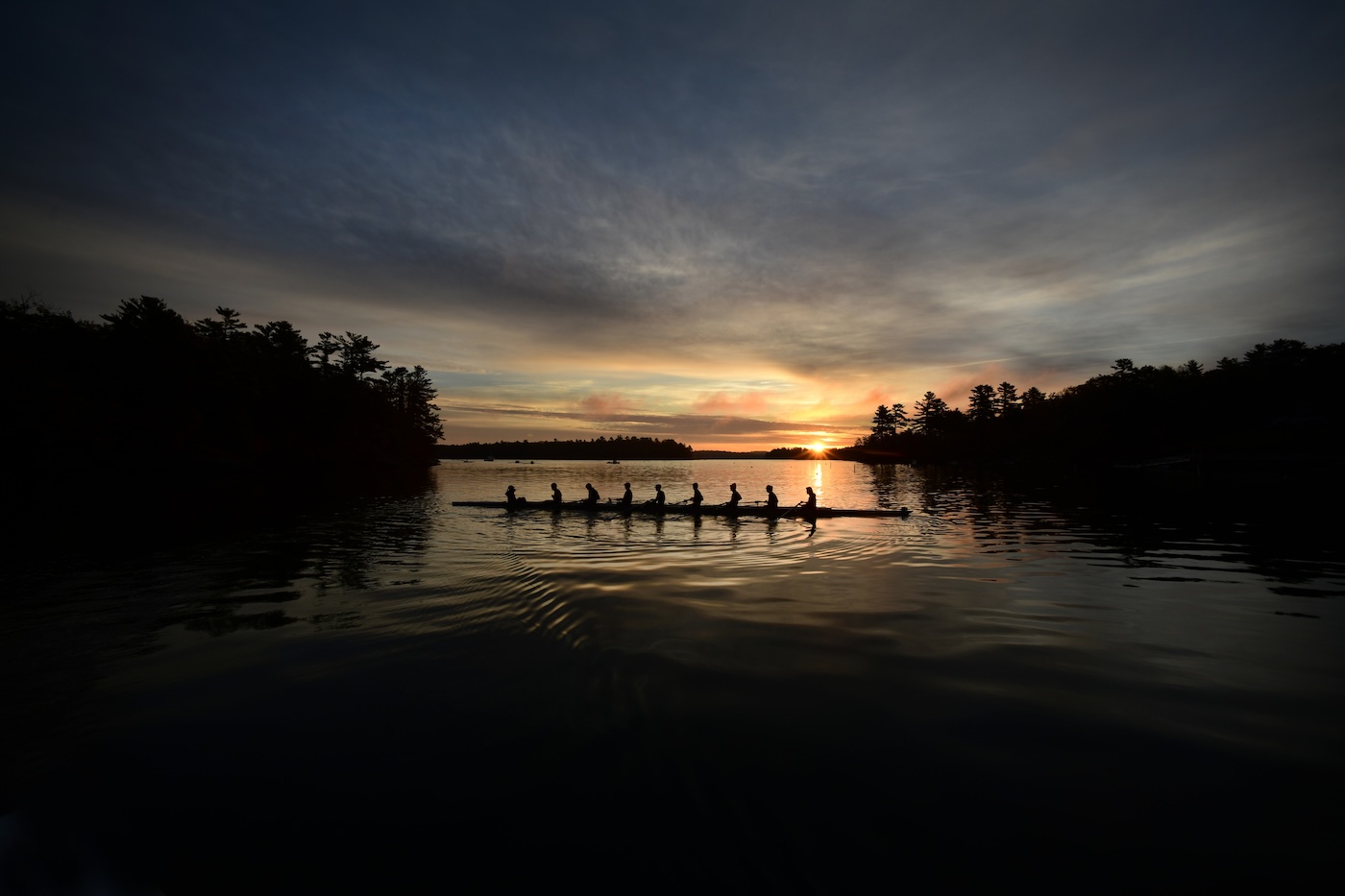
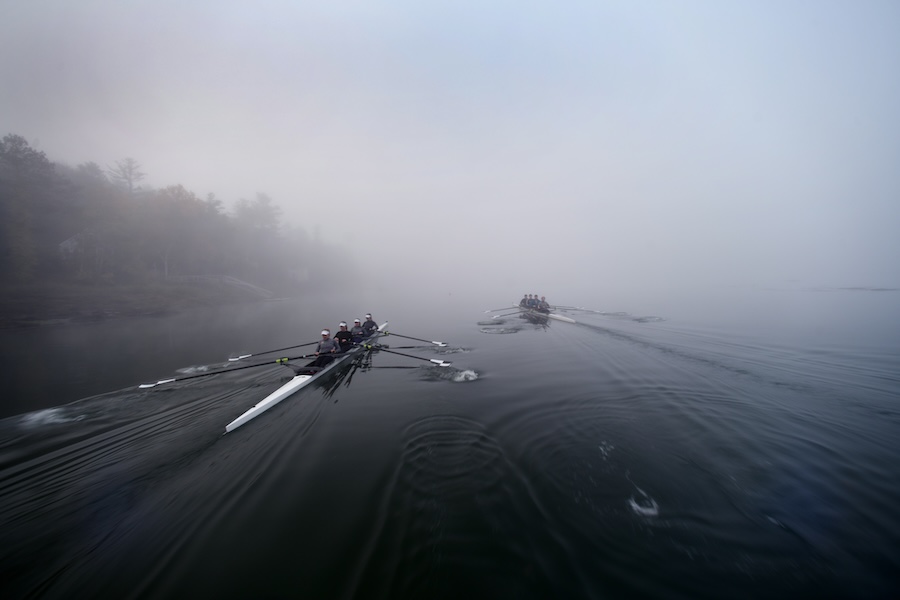
Bowdoin’s crew team of seventy students rows out of the year-old Steinwachs Boathouse in Cooks Corner. The boathouse sits on the New Meadows River, a tidal inlet of Casco Bay.
“The old boathouse, the Smith house, was very homey and had very good vibes. But the team had grown so much,” Dean said. “It's been really amazing to see the transition to our new facility,” she added. Team growth was one of the main reasons for the new Steinwachs Boathouse, which opened last fall.
“One of the peak years was immediately coming off of COVID, actually,” Welling said. With nearly 100 athletes at that point, Bowdoin partnered with a local crew team in Brunswick to put athletes in singles. This met social distancing regulations and provided a unique, fun experience.
Running three rotations a day to get everyone out on the water, Welling says it was a silver lining in that time to find such a successful solution. In the next few years, the roster averaged around eighty athletes.
With the new boathouse came new state-of-the-art equipment, including a telemetry-tracking technology that records live, stroke-by-stroke data for individual rowers on the water.
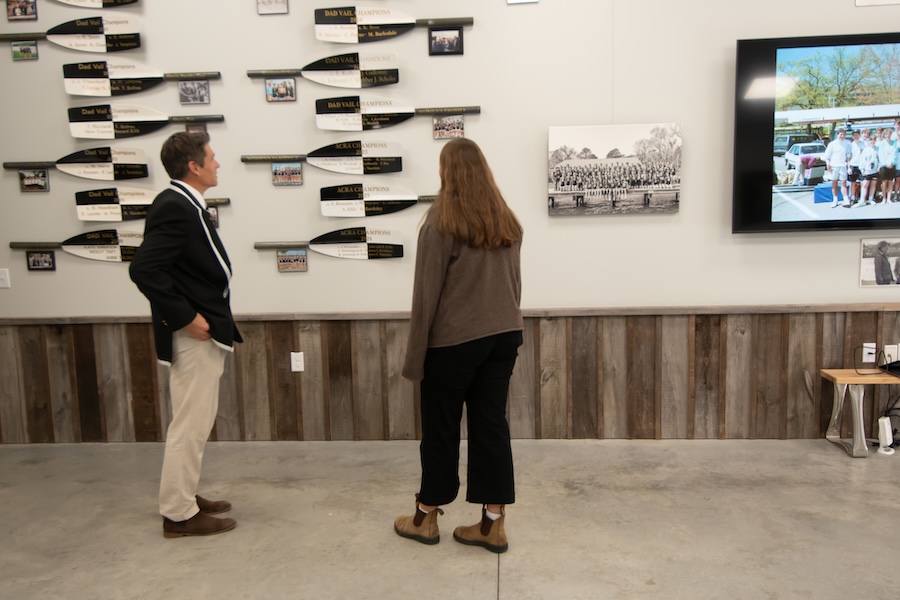
But what's really special about Steinwachs, in Dean’s opinion, is the team room. Trophies, mementos, newspaper clippings, and historic posters line the walls to showcase Bowdoin rowing’s history, which goes back to 1858, when students launched the first rowing clubs.
There are also many photos of teams smiling, laughing, and posing with coaches, capturing the kind of attitude that's helpful for enduring arduous, early-morning practices—athletes meet at 5:15 a.m. Consisting of collaborative men's and women's squads, the crew practices until 7:30 a.m., when they get back into vans and drive to campus.
“Rowing’s definitely type-two fun. I think the very nature of it sustains these bonds that we have with each other,” Dean said. “You get to see each other at your absolute worst moments. You see people after they've pushed so hard in races. They've thrown up out the side of the boat or their back hurts. And you just say, ‘How can I support you?’”
“When I'm paddling up to the start, I think about why I'm pulling, why I'm doing this race, and who I'm pulling for.”
—Cassidy Dean ’27, on her race-day thoughts
“BowRow”
Dean found a welcoming community of rowers when she signed up as a first-year student, urged on by her mom who had rowed when she was in college. And she appreciated the short learning curve—she went from total novice to able competitor quickly. “I think there aren’t many opportunities to pick up a completely new skill with a built-in community like that,” she said.
Sophia Chester ’30 is a first-year on the team who did row before college. “In high school, I realized that I really loved the team aspect. I like feeling like a part of a boat and a part of a bigger collective.” Now, at Bowdoin, she was the strokeseat of the Charles-racing womens eight: eight rowers plus a coxswain, with Chester the lead rower.
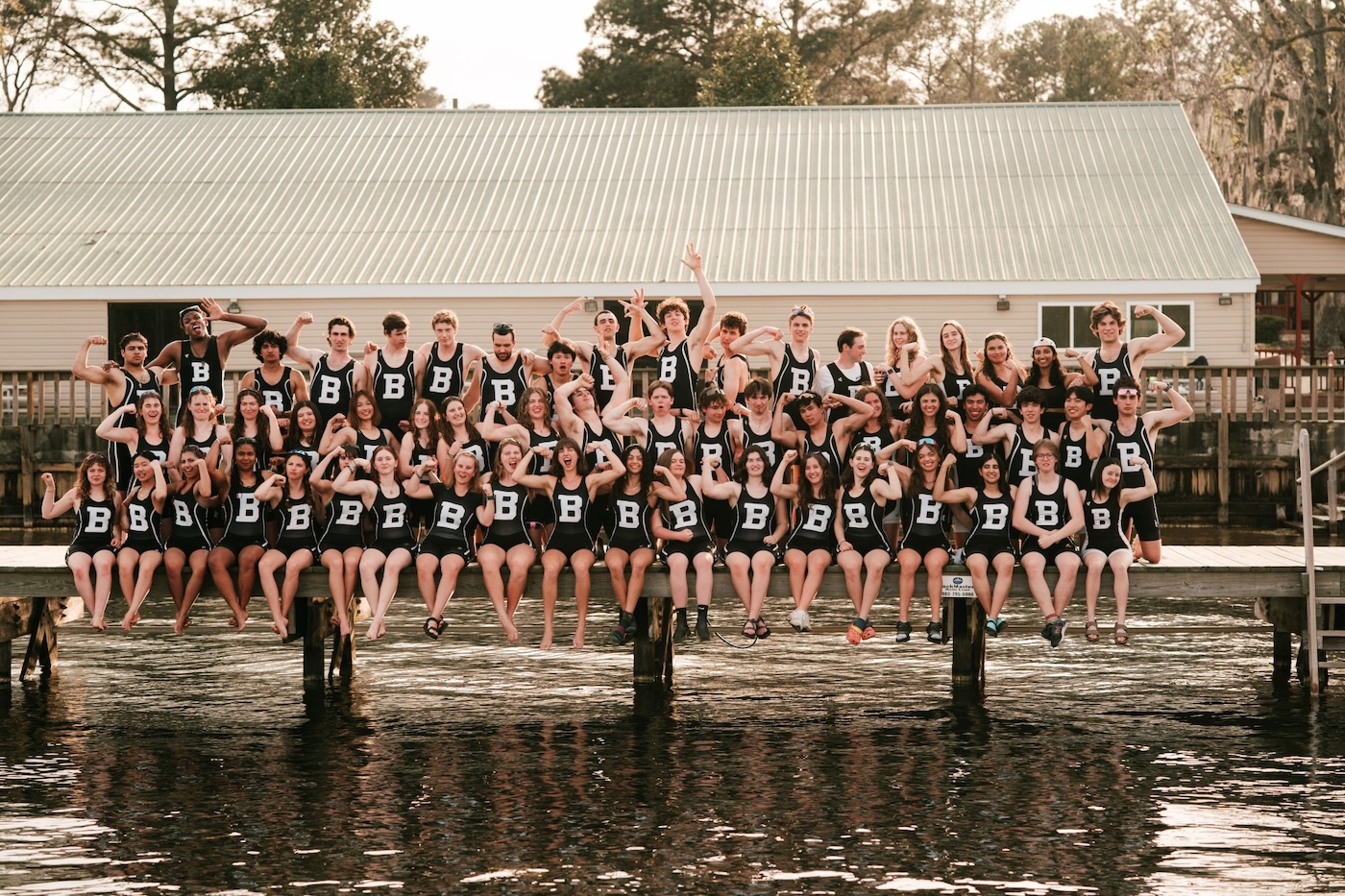
Though 4:55 a.m. wake-ups are hard, Chester is always excited for practice. “Everyone's chatting and laughing and having a good time, but still kind of serious and wanting to do a good job in the boat. And when we get off the water, people put their smiles back on and that's the best team energy you can have,” she said.
An American Collegiate Rowing Association (ACRA)-governed collegiate club team, rowing at Bowdoin functions differently than a Division III or Division I program. Exempt from season caps, coaches can schedule coached on-water rows, winter conditioning, and spring training trips whenever scheduling, boathouse access, and weather permit.
Bowdoin rowing operates on distinct fall, winter, and spring seasons. In the fall, when the races are all five-kilometer head races, the season lasts from the school year’s commencement until Halloween. Winter training is indoors from November through March, when the New Meadows thaws. Then the team resumes water practices through the end of the year, racing in two-kilometer sprints that culminate at ACRA championships in Tennessee.
While Division III teams are limited to certain types of competitions and how often they can enter them, teams like Bowdoin's can enter head races, club regattas, masters/alumni mixes, or ACRA events with far fewer jurisdictional hurdles.
And though Division III limits the number of recruits a team can absorb each year, ACRA teams like Bowdoin's can invite athletes with unrestricted entry.
The fleet recruits new athletes at the start of the school year, starting with a learn-to-row program. Recruits learn about the rowing stroke, components of the boat, and common calls from coxswains (who pilot the water, steer the boat, and direct the rowers). Novices practice together before all joining the varsity fleet later in the fall season.
Early Risers
The Bowdoin rowing team advances their sense of community off the water, too. Stewards serve as the team’s executive leadership and plan events like apple-picking expeditions and watch parties (most recently, of the new Netflix show Crew Girl). “Our stewards work very hard to try to make programming that gets people involved,” Dean said.
Sharing a post-practice breakfast is also a team tradition. Every morning, the hungry athletes gather at 8:00 a.m. in Thorne Dining Hall. “Everyone mixes up where they sit every day. You just sit where there's an open seat at the table. So you do truly get to know everyone,” Dean said.
And at the end of their morning meal, the athletes start their academic day. Often very busy, rowers are known for being some of the most involved students on campus. They lead a cappella ensembles, work different student jobs, lead outdoor trips through the Bowdoin Outing Club, and perform with the Bowdoin Symphony Orchestra.
“Every day I'm excited to work with these students. They’re a really special group,” Welling said. After all, he added, “We’re the first crew in the country to see the sunrise.”