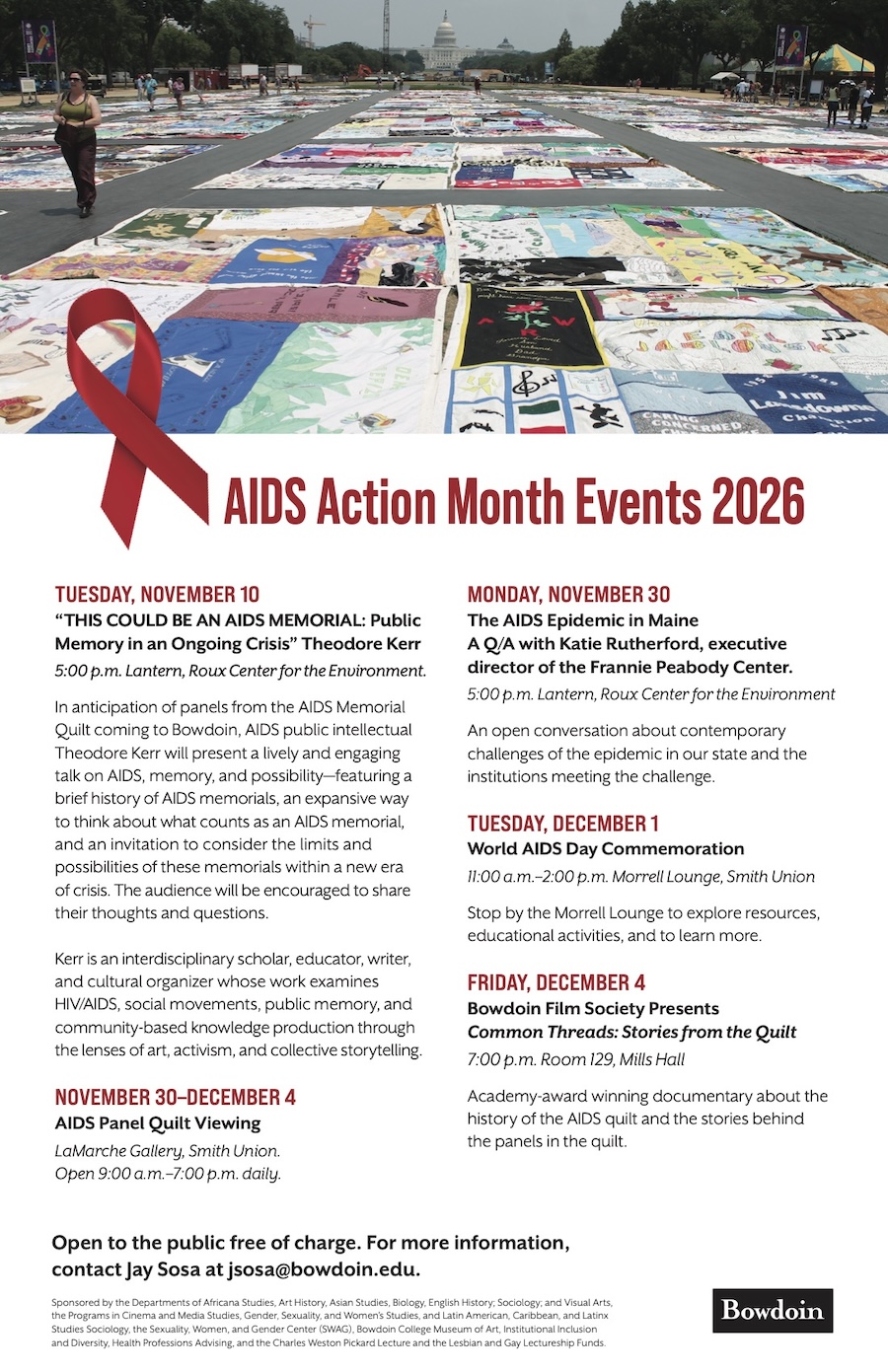
While programming begins this week, it is concentrated around the first week of December, with World AIDS Day occurring December 1.
The first event is Nov. 10, Tuesday at 5 p.m. in the Roux Lantern, when writer and organizer Theodore Kerr will give a talk on the history of AIDS memorials, a new way to think about what counts as an AIDS memorial, and an invitation to consider the limits and possibilities of memorials within a new era of crisis.
Sosa, associate professor and program director of Gender, Sexuality, and Women's Studies, is a political anthropologist and queer studies scholar. He teaches classes on queer theory, global culture wars, pharmaceutic politics, citizenship and activism, and HIV/AIDS. He is currently teaching a course titled The Ongoing AIDS Crisis.
Sosa said he felt it was especially important to commemorate World AIDS Day in light of federal cuts to HIV/AIDS programs and international aid that have undermined efforts to combat the disease worldwide.
He wanted to explore having events on campus that could take up the mantle of spreading awareness and information to the wider community. The College has held AIDS awareness events in the past and he wanted to continue that tradition in an inclusive, collaborative way.
The events will include lectures from Kerr and Katie Rutherford, both experts on the contemporary AIDS crisis, a film screening with the Bowdoin Film Society, and an installation of the AIDS Panel Quilt from November 3 to December 4 in Lamarch Gallery, Smith Union.
Three panels from the AIDS memorial quilt—a national project honoring the lives of those lost to AIDS—will be on display at Bowdoin. “It is one of our most significant national memorials to people that this country has lost from AIDS,” Sosa said.
The quilt project was designed as a “participatory and de-centered living memorial” where any person can make a patch in honor of a lost loved one. Each patch becomes part of a larger quilt panel, which is designed to be about the size of a grave site. The project started in 1985 and is still growing today as the epidemic continues.
Sosa had help from Maddy Magnuson, who came to Bowdoin this year as associate director of Gender Violence Prevention and Health Education. Magnuson previously worked for an organization on the front lines of AIDS response in Maine.
“Prior to working at Bowdoin, I had been in the public health area in Maine for a while for an AIDS/HIV services organization in Bangor. When I heard about the events Jay was planning, I said I’d love to share more information about what HIV is and how you can prevent it,” Magnuson said.
Magnuson has arranged for tabling in Smith Union from 11 a.m. to 2 p.m. on December 1 to recognize World AIDS Day. Bowdoin Health Services, the Maine Center for Disease Control, and Maine Family Planning, among others, will share information about available services, AIDS prevention, and the power of medication.
“I want to make sure that we are also providing information about what the current landscape is and that AIDS is not a death sentence, if you have access to medication and health services,” Magnuson said. “I hope students understand how the current landscape is a lot more hopeful than it was forty years ago, but that it still does require investment.”
Since the 1980s, 40 million people around the world have died from AIDS, and another 40 million are HIV positive or living with AIDS today.
All events will be open to the public. Sosa said he was heartened that faculty, staff, and students have all responded with strong support and enthusiasm for the programming.
“The collective effort behind AIDS Action Week really speaks to the enthusiasm across campus, and it is inspiring to see students show a profound desire to know more about our past and to refuse to think that AIDS is over.”