Herd Mentality
By Kylie Mohr for Bowdoin MagazineWhen Whit Hibbard arrived at Bowdoin for Orientation in 1970, he made an impression. A fourth-generation Montanan who grew up on a ranch near Helena, Hibbard met his new classmates wearing jeans and cowboy boots—and, for good measure, a cowboy hat. “I was kind of an anomaly, a curiosity,” he says.
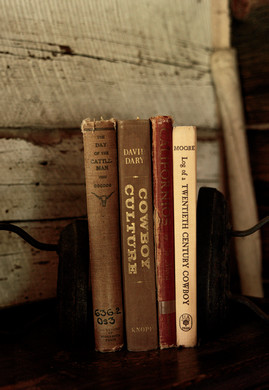
A selection of books in Hibbard’s office, a spring house constructed with logs from his family’s ranch. Photograph by Rebecca Stumpf
In the decades since, Hibbard has made a name for himself as a lifelong student, park ranger, rancher, and champion of low-stress livestock handling, a modern take on ranching that puts the animals’ well-being first. Hibbard challenges stereotypes of the West that include a rough-and-tumble cowboy forcing livestock to do his bidding with a whip, cattle prods, a nipping dog, or all of the above. Hibbard, on the other hand, takes a more soft-spoken approach, one that relies on observation and a deep understanding of an animal’s psyche.
I wanted to know how Hibbard went from studying psychology at Bowdoin to an exciting and varied career that included earning a triple black belt in Aikido and rounding up mustangs, both on and off camera. So, I drove out to the summer satellite operation of his family’s ranch, Sieben Livestock Company, which is nestled at the base of MacDonald Pass in western Montana. The land is extensive, with grassy pastures giving way to dense forests. It’s just Hibbard, his partner, Laine, roughly five hundred yearling cows, and over a million acres of peace and quiet. Here, you’re more likely to see a moose or a coyote than another person.
We talked in Hibbard’s office, a refurbished old spring house made with lodgepole pine logs from the property. The scent of linseed oil and pine lingered in the cabin’s cool interior. A pronghorn antelope skull is mounted to the back wall, a beaver hide is affixed to another wall, and a bison skull hangs over the doorway. Western artifacts like an old candle holder and blacksmithing tools are neatly arranged on windowsills. Titles like The Horse Behavior Handbook, Cowboys of the Americas, Ride Smart, and Think Like a Horse fill a tidy bookshelf in the corner of the room. A classic Bowdoin chair sits by the window. “When I graduated in 1974,” he laughs, “I bought one and hauled it home.” Despite many moves and adventures, that chair has remained in Montana with him ever since.
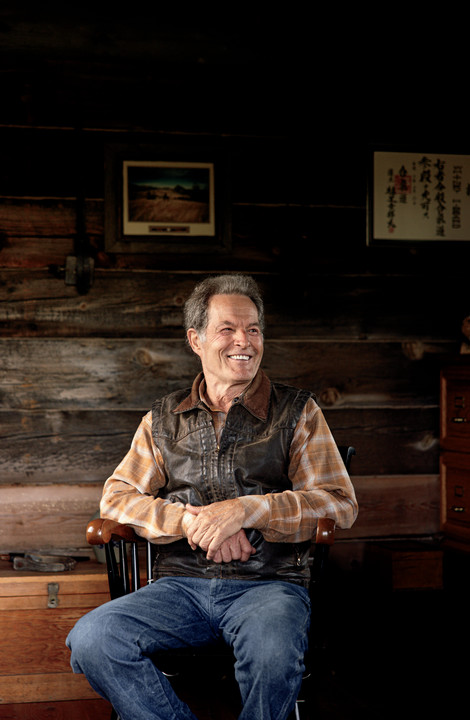
Hibbard sits in the Bowdoin chair he purchased when he graduated that now sits in his western Montana ranch office. Photograph by Rebecca Stumpf
Hibbard’s connection to Montana runs deep. His great-grandfather, a German immigrant named Henry Sieben, journeyed West as an orphan with his older brother. The teenagers reached Virginia City, Montana, a gold rush boomtown, in 1864. Sieben was seventeen years old and did odd jobs to get by—working on mining operations, freight trains, and fledgling ranches in the area. He started fattening up and selling oxen (large cattle with horns) in 1868, and that turned into the founding of the Sieben Livestock Company that still runs in the family.
Hibbard grew up splitting time between Helena, where he went to school with his older brother and twin brother, and the family ranch in the Big Belt Mountains. He joined the ranch’s cowboy crew full time at fourteen years old. Despite the family ranch, his mother always wanted her sons to get a New England education. “My mother felt that it was really important that we go to college and get a little Eastern culture,” he chuckles. “I don’t know if it worked or not.” His older brother, Chase, went to Amherst College, and his twin brother, Scott, went to Williams College. A family friend’s son went to Bowdoin and convinced Hibbard to follow in his footsteps.
When Hibbard arrived at the College, he found himself immediately impressed by the fall leaves, and less than impressed by the wet, cold winter that followed. Even coming from blustery Montana, he recalls the Maine winters a shock to the system. Still, he fit right in, drawing parallels between the small town, tight-knit feel of Brunswick and his hometown of Helena. “Living in New England gave me an appreciation for what I had in Montana,” he says.
A few pivotal classes shaped Hibbard’s experience at Bowdoin. A foundational course for him was called “The Interpretation of History.” “The professor disabused me of my notions of what history was and [taught me] history depended on your point of view,” Hibbard says. He also deeply admired a theology professor whom students nicknamed “God,” and a political science professor, remembering both as knowledgeable and passionate about their subjects. Academic mentors like them served Hibbard well, long after graduation. “My Bowdoin education helped teach me the importance of evidence-based rationality and to think in a logical, disciplined, and critical way that has served me well regardless of what I do,” Hibbard says.
The most interesting course he took, though, was one in astronomy. The professor “took a subject that I knew absolutely nothing about, and it was just riveting,” Hibbard says. Today, when he looks up from his Montana ranch at a night sky with nary a hint of light pollution, he finds himself still pondering “the vastness and the mysteriousness of the universe.”
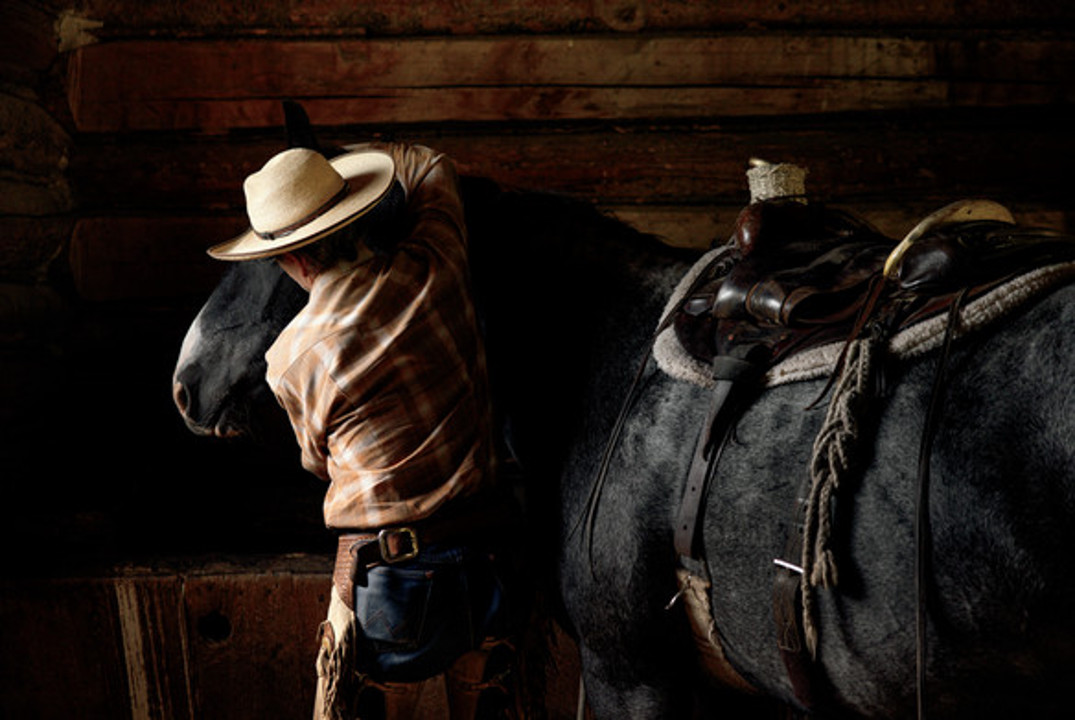
Hibbard saddles up Teddy, who was caught as a wild horse in Theodore Roosevelt National Park. Photograph by Rebecca Stumpf
After graduating from Bowdoin, Hibbard took a hiatus from the family ranch to pursue a stint in criminal justice work between 1975 and 1982. “I kind of rebelled against my family history and legacy,” Hibbard says. He earned a master’s degree in psychology at the University of Montana in Missoula and codirected the Missoula City County Crime Attack Team, which focused on targeting burglary and felony theft as part of President Richard Nixon’s war on crime. During that time, he wrote a book titled Forensic Hypnosis: A Practical Guide to Using Hypnosis in Criminal Investigation. After taking another similar criminal justice consulting job in Great Falls, Montana, he took a year off and moved to Everett, Washington, to train full time in the Japanese martial arts discipline of Aikido.
In 1984, he moved back to his family’s ranch (where he has now, he says, “developed a deep appreciation for my family’s history, legacy, pioneer, and ranching heritage”) and became the manager of the summer satellite operation. But he wanted to continue the practice of Aikido. So, he started a “dojo,” or training school, in Helena. Hibbard ran the dojo and helped manage his family’s ranch for about a decade and then went on to earn a PhD in human science from Saybrook Graduate School. His doctorate focused on consciousness, spirituality, and writer and philosopher Ken Wilber’s integral theory, which Hibbard described as “an attempt to come up with a unifying theory for all of human knowledge and how it all fits together.”
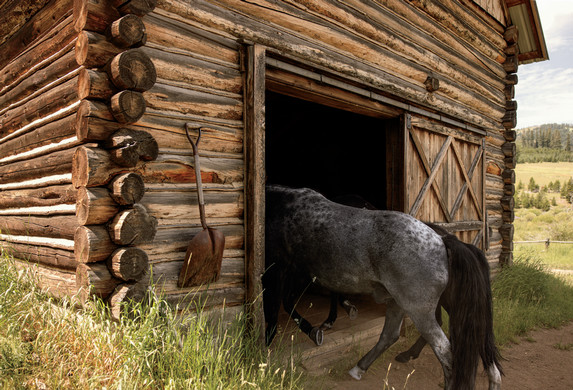
Teddy walks into the barn. Photograph by Rebecca Stumpf
Hibbard’s diverse résumé doesn’t end there. He can also say he’s been a model. Marlboro recruited him for a European advertising blitz circa 1990, part of the cigarette brand’s larger “Marlboro Man” campaign that ran between 1954 and 1999. The advertising heavily featured rugged men, Western iconography, and cowboy culture, making Hibbard, a real-life cowboy with just the look they wanted, the perfect fit.
But Hibbard wasn’t just part of the talent of the campaign, he was also the horse wrangler. Crews would shoot early in the day or late in the evening when the light was right. Models and twenty or so horses bounced between Montana and the Dakotas, with many miles and dizzying logistics in between. Where would the horses sleep? How would they be transported? Were all their physical and medical needs being taken care of? That was Hibbard’s job. He slept only a few hours a night for twelve days straight, he says. “It was the hardest job of my life,” he recalls. “It was brutal.” One day, when it was all over, he received a phone call from a friend in England—his face was plastered on a billboard overseas. Wearing Wrangler jeans, a waxed leather vest, a leather belt with a silver buckle, and a flannel shirt the day we met, Hibbard still looks the part decades later.
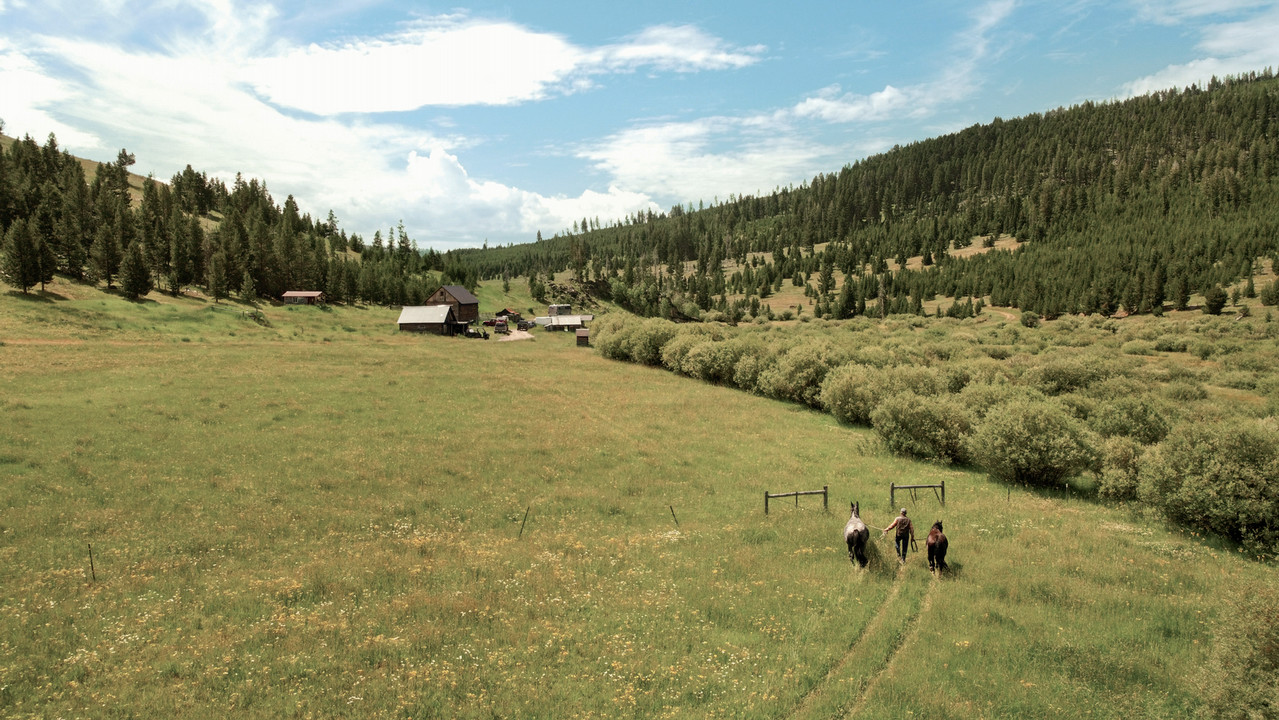
Hibbard leads Mojo and Teddy in from pasture to prepare for an afternoon cattle drive. Photograph by Rebecca Stumpf
Hibbard knew how to work cattle. After all, it was practically in his blood. But when his family attended a stockmanship school led by Bud Williams, a rancher with a unique method of handling cattle, in 2005, everything changed. “I realized, contrary to what I firmly believed—that there was only one way to work a cow, and it happened to be the way I knew—that I was mistaken.” Hibbard surrendered, retooled, and started to preach the gospel of a low-stress approach. “I drank the low-stress Kool-Aid,” he says.
The approach “all begins with your mindset about how and what we think about handling our animals,” Hibbard says. Instead of using force or coercion, Williams’s teachings emphasize working with animals’ minds to make your idea, their idea. This increases willing compliance. The school of thought seems like a natural fit for Hibbard, with an undergraduate degree in psychology and a deep curiosity about behavior and minds. Picking up on animals’ behavioral cues is paramount to the technique. While evidence of the effectiveness of low-stress techniques can be documented in a lab by measuring animals’ heart rates or cortisol levels, Hibbard says it’s also easy to tell right on the range if animals are stressed out. Unhappy cows are loud and wide-eyed, crowding together or wanting to get away.
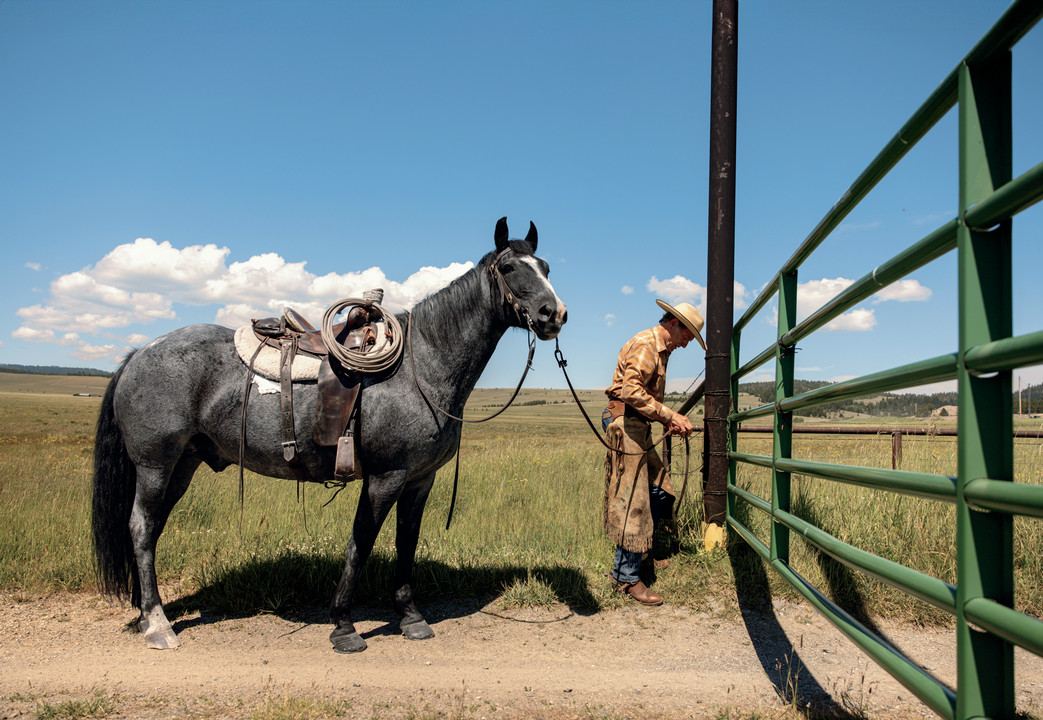
Hibbard and Teddy prepare to round up cattle. Photograph by Rebecca Stumpf
Hibbard was working then at Big Bend National Park, as a seasonal park ranger—mostly on horseback. The 1,252-square-mile park in southern Texas is larger than the state of Rhode Island. Horses are vital teammates for patrols, rescues, and livestock roundups throughout the rugged, vast, high desert landscape. It was here that Hibbard began to bring the technique of low-stress livestock handling to use in a major way.
A big problem in the national park was “trespass livestock,” or horses, burros, and cows who enter the park through its 118-mile border with Mexico, the usually shallow Rio Grande. The animals disrupt Big Bend’s natural environment, trampling the soil, causing erosion, destroying archaeological sites, and altering the ecosystem. Park staff had historically taken a conventional approach to roundups, hiring dozens of cowboys to conduct high-speed chases that ended with animals captured in portable corrals. “They’re very inefficient and ineffective,” Hibbard says. “Animals got injured and so did people.” He began a pilot program exploring a calmer approach.
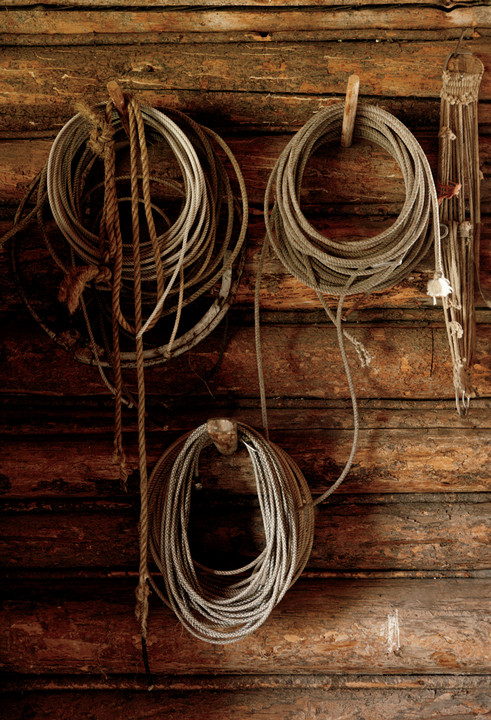
Ropes hang on the barn wall. Photograph by Rebecca Stumpf
Capture operations soon looked fundamentally different than they had. Hibbard and one other rider would approach loose livestock in a slow, zig-zagging pattern to avoid triggering their flight-or-flight response. If riders unintentionally got too close and the animals spooked, they’d back off until tensions subsided. With time and patience, they could get close enough to the animals to encourage them to move in the desired direction. Over the span of two winters, Hibbard and a small team captured every trespass animal in the park. “We never got our horses out of a walk,” Hibbard says. “Never chased. Didn’t have to.”
Raymond Skiles, a retired wildlife biologist with over thirty years of experience at Big Bend, describes the pleasure of watching Hibbard at work, praising his accomplishments and saying that his “calm, animal-oriented method got more done and sacrificed a lot less.”
“He’s a special guy,” Skiles says. “There just aren’t many people like him.” Hibbard garnered respect amid both the local community and the park during his time there. “He’s very articulate, passionate, and a gentleman,” Skiles says. “Even when discussion got heated, he could always lead in a very calm, reassuring, even friendly manner.”
Low-stress livestock handling has become Hibbard’s calling card. He’s helped to safely round up wild horses in numerous national parks, including Theodore Roosevelt National Park in North Dakota and Mesa Verde National Park in Colorado. He’s also expanded his expertise to bison, an iconic American mammal hunted to near extinction by settlers in the late nineteenth century. Today, as Indigenous groups and conservationists across the West work to bring the animals back, Hibbard’s bison expertise has proven useful—including on the late Ted Turner’s conservation ranches and as part of the Banff National Park Bison Reintroduction Project in Canada.
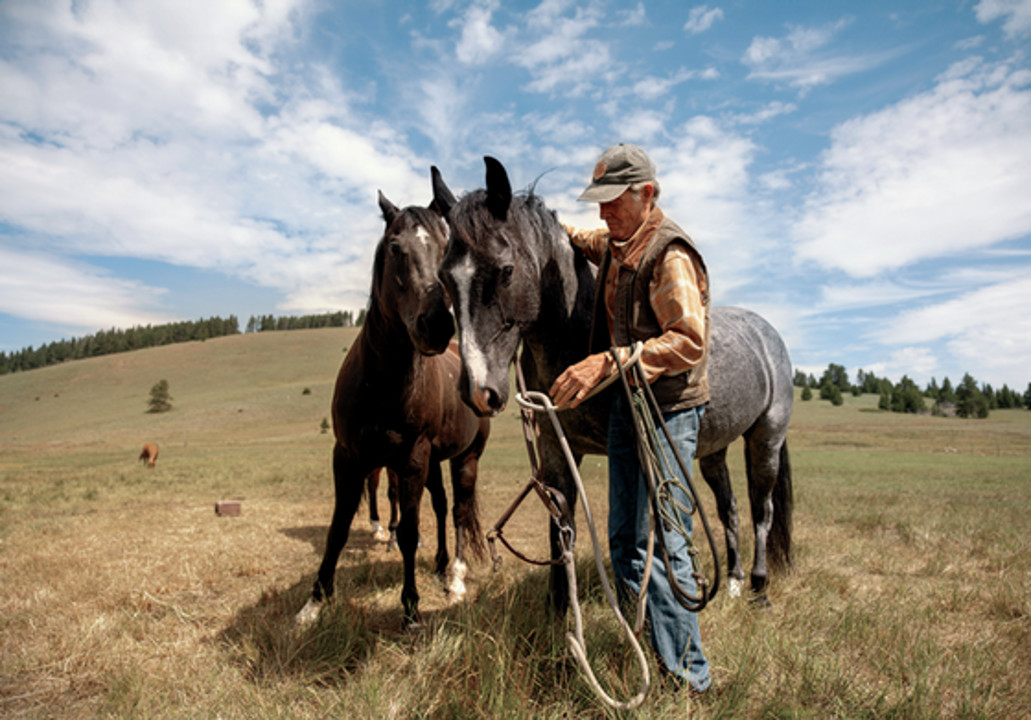
Hibbard slips rope halters over Teddy and Mojo before leading them to the barn. Photograph by Rebecca Stumpf
Hibbard’s take on low-stress techniques even made it up to the Department of the Interior in 2020 as broader guidance for handling bison herds that the National Park Service and the US Fish and Wildlife Service manage. Leaders took note of how the approach resulted in fewer, if any, bison dying during handling. The new Bison Conservation Initiative lists “adopt low-stress capturing and handling practices” as one of four key actions.
Hibbard hasn’t stopped there. He founded the Stockmanship Journal, an online publication, in 2012, encouraging a rigorous, documented approach to the craft. As he moves into an attempted semiretirement, the journal is turning into a “as I feel like it or as the spirit moves me,” project, he says. Hibbard has also written more than forty stories for Drovers Magazine, a beef industry publication.
Hibbard says low-stress livestock handling is growing in popularity, albeit slowly. He faces resistance from the traditional livestock industry and ranchers who are entrenched in their old ways. But he’s committed to the cause. Although he was initially reticent to start teaching, word of mouth spread throughout ranching communities after a successful clinic in 2014. Today, having taught more than 215 clinics, he remains steadfast in chipping away at the status quo and helping to cultivate the next generation of converts. Hibbard wants to create a formalized teacher training institute, complete with a certification program, to help carry on Bud Williams’ legacy, preserving and protecting his teachings in a meaningful way. “It’s important, because if that isn’t done, it’s going to get diluted, watered-down, bastardized, and a lot of it lost,” Hibbard says. “It’s too important for the animals.”
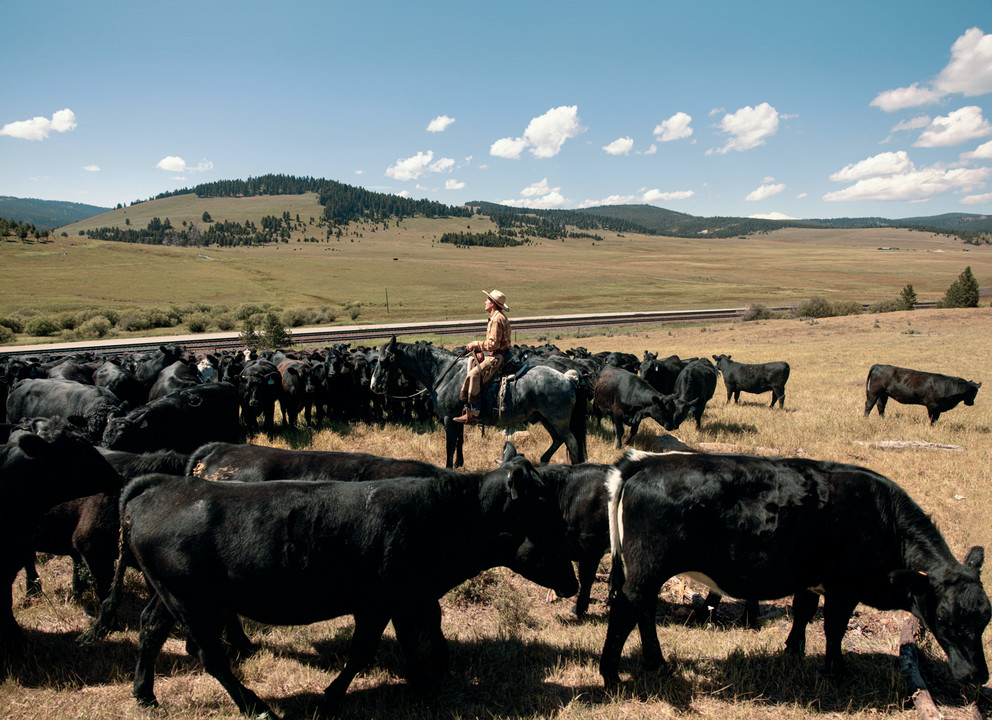
Hibbard drives cattle in his signature low-stress style on his ranch near Helena, Montana. Photograph by Rebecca Stumpf
The sun was getting high in the sky when we left the log-cabin-turned-office and headed to the barn, just downslope. In the cool shade of the rafters, Hibbard grabbed a few rope halters and began walking toward a nearby field, dotted with yellow wildflowers. He needed to fetch a few horses and get them saddled up for moving cows between pastures that afternoon.
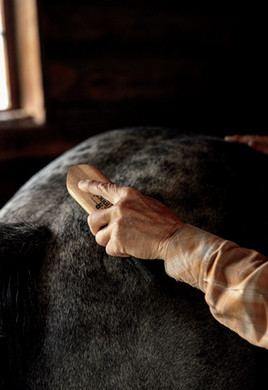
Hibbard brushes Teddy. Photograph by Rebecca Stumpf
Five horses, hiding in the shady bottom of Dog Creek, saw us coming. (The main ranch, affectionately called “Adel,” is home to twenty-five more.) Ears forward, tails swishing off flies, they watched with curiosity as Hibbard opened a gate and stepped through it. He cupped his hands to his mouth and uttered a short, hoarse whistle. They happily came right over.
Hibbard talked while he bridled Teddy, a big blue roan with a dark steely gray coat, and Mojo, a smaller black quarter horse. Hibbard has a long history with Teddy, a nineteen-year-old who lived his first year of life as a feral mustang in the badlands, buttes, and grasslands of Theodore Roosevelt National Park. After Hibbard rounded up Teddy, who is named for the park where he was found, and his herd, a public auction was held for the animals. Teddy, a wild yearling, walked right up to Hibbard on the side of the pen. “I like to say he wanted me,” Hibbard says.
Hibbard led Mojo and Teddy back to the barn, where they geared up for a ride later in the afternoon. Today, there’s nothing apparently feral about Teddy, who leaned into Hibbard’s hands as he stroked the horse’s coat and scratched his muzzle. “He’s one of the top three cow horses I’ve ever had,” Hibbard says, back in the barn as he cleaned Teddy’s horseshoes, brushed him, and combed his tail before swinging a leather saddle over his haunches. “He just has this natural instinct and a lot of energy.” Teddy happily munched away on his oats, oblivious to the high praise. Like his rider, it appeared that the horse contained multitudes.
Kylie Mohr is a freelance journalist and editor based in Montana. Her work focuses on wildfire, recreation, conservation, and climate change in the West.
Rebecca Stumpf is an editorial and commercial photographer whose passion is telling visual stories about the connection between humans and nature.
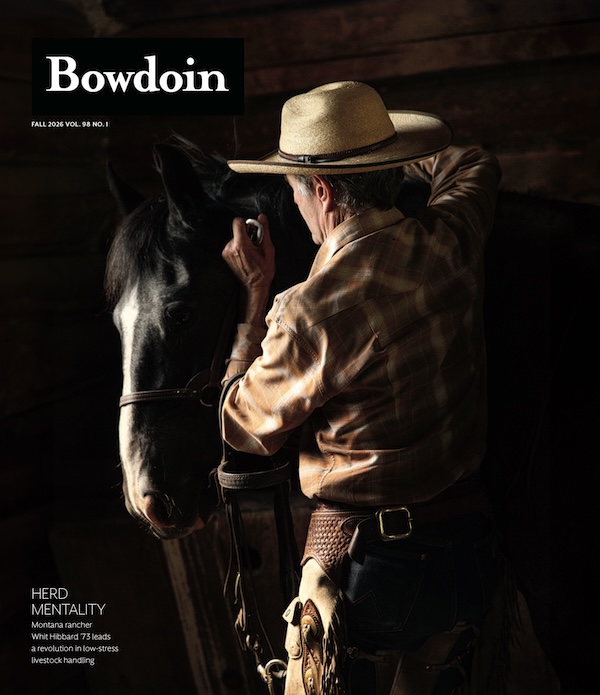
This story first appeared in the Fall 2026 issue of Bowdoin Magazine. Manage your subscription and see other stories from the magazine on the Bowdoin Magazine website.