Finding Ella
By Chris Ritter ’21 for Bowdoin MagazineWhen novelist Kelly Kerney ’02 wrote for Oxford American about how she discovered a horde of music recorded by her grandmother and over twelve years turned those recordings into an album released by the label Spinster, she said the story is one “with many beginnings.”
Let’s start with this one: a small theft.
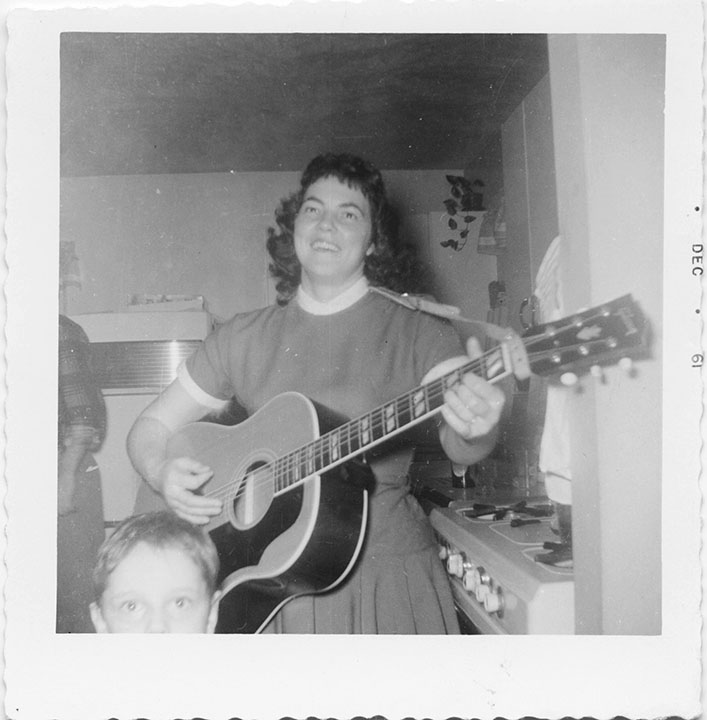
Ella Hanshaw playing a 1955 Gibson Country Western acoustic in her kitchen in Brunswick, Ohio, in 1961.
Sometime between 2006 and 2012, Kerney’s brother Scott stole a cassette tape from their grandmother’s house. It was gold, with a shimmering label that read, “Sounds of Emmanuel by The Hallelujah Hill Quartet,” dated 1985. It looked like a tape worth stealing, and it was. This was the quartet—the one that played to church congregations across West Virginia and was anchored by the voice of Scott and Kelly’s maternal grandmother, Ella Hanshaw, whose songwriting ability she believed was a gift anointed by God. Most who heard her agreed.
Still, Kerney’s brother didn’t think much of it. He stuffed the tape in his garage in Canton, Ohio, and never played it.
That is, until 2013, when his sister made a rare visit to Ohio for a funeral and brought her husband, Ethan Bullard ’03. Earlier that year, the two of them had been driving through West Virginia on the way home from a backpacking trip when they flipped to a radio station playing the folk trio the Myers Sisters. Kerney mused aloud that they sounded like her grandmother.
Mamaw sounded like this?” Bullard asked. Bullard, a chatterbox music lover from Georgia, appreciates Appalachian folk music like it’s his job—partly because it is, as a museum archivist in Richmond, Virginia. Bullard’s interest was piqued, and Kerney wanted to know if her grandmother’s music was as good as it sounded in her memory. But at that point, for Kerney, her memory was the only place that music existed.
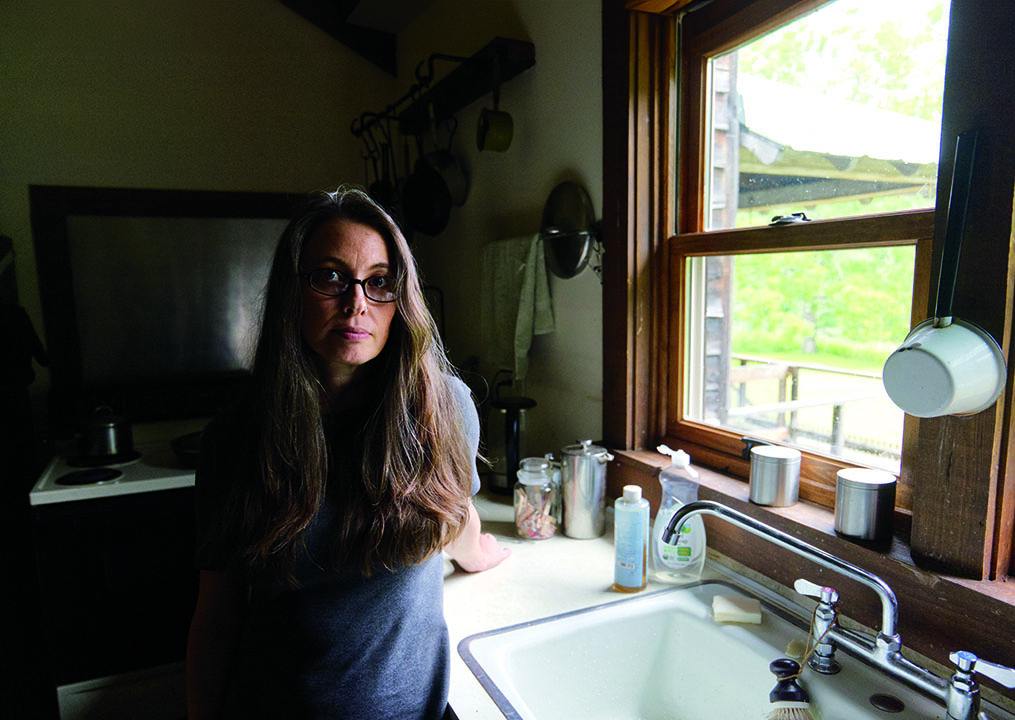
Kerney in the cabin’s kitchen. Photograph by Chris Ritter
So, when Scott brought out the purloined tape from his garage in Canton and told her that many more sat in boxes at Mamaw’s house, Kerney was flooded with joy.
They loaded the tape into a deck, pressed “play,” and listened to Ella Hanshaw sing.
I meet Kerney and Bullard on a moody July day in western Virginia. From their front porch, rain falls in short, roof-rattling spats between periods of sunshine. Over the mountain to the east, the valley I grew up in is yellow with drought, but here, higher up, the woods are thick and green, and fog lifts past the tightly packed Allegheny Mountains that cradle their property.
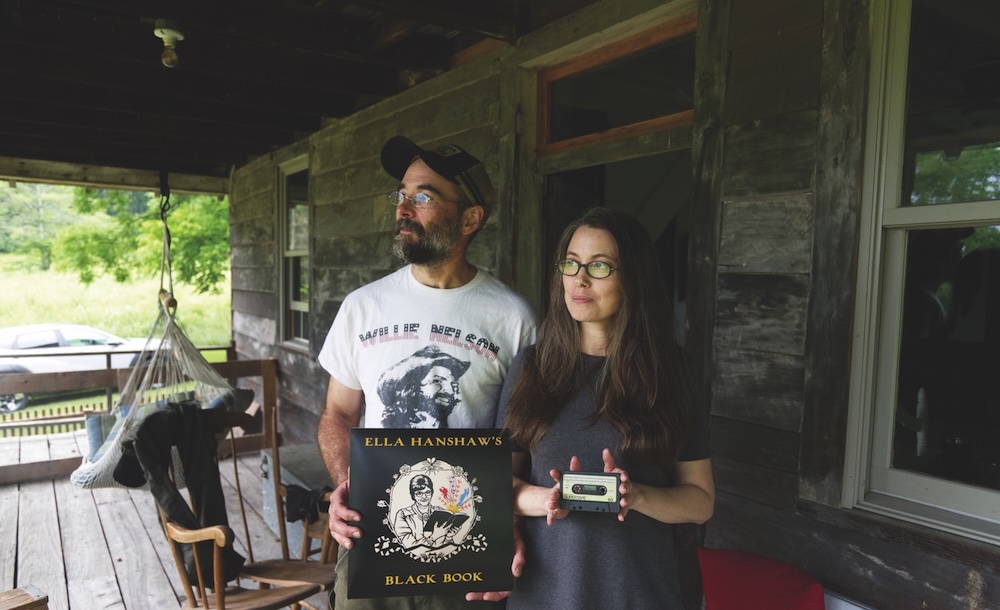
Kelly Kerney ’02 and Ethan Bullard ’03 hold a copy of the album of Kerney’s grandmother’s songs that they produced, Ella Hanshaw’s Black Book, and one of the original cassettes of her music. Photograph by Chris Ritter
Kerney and Bullard are based in Richmond but spend much of the year here, conserving native plants and fixing up a weatherworn cabin. I’ve come to ask them about Kerney’s grandmother and her new album, but it’s endearingly difficult to steer them away from talking about oyster mushrooms they’ve picked for dinner, or the invasive bittersweet that’s taking over their tulip poplars, or the fact that neither has sat in the one cushioned chair on the porch in weeks because a family of wrens is nesting in it.
We sit on a wooden bench, across from the wrens. I am the latest in a long line of Virginian journalists who want to talk to Kerney about her grandmother’s music—last year, the local press was interested in the story of Ella Hanshaw almost to the point of overwhelm.
“I wouldn’t say I’m a private person,” says Kerney, who wields a blunt sense of humor. “I’m fine talking to somebody about all sorts of weird stuff,” she says. “But publicity… I’m always so averse to it. I rallied for Mamaw.”
Music, Kerney says, was her grandmother’s life’s purpose. There was always a part of Ella Hanshaw that wanted her music to go far and wide. For Kerney, telling her story means helping it get there. It also means showing a side of her grandmother that she didn’t know about until she and her brother played that golden tape.
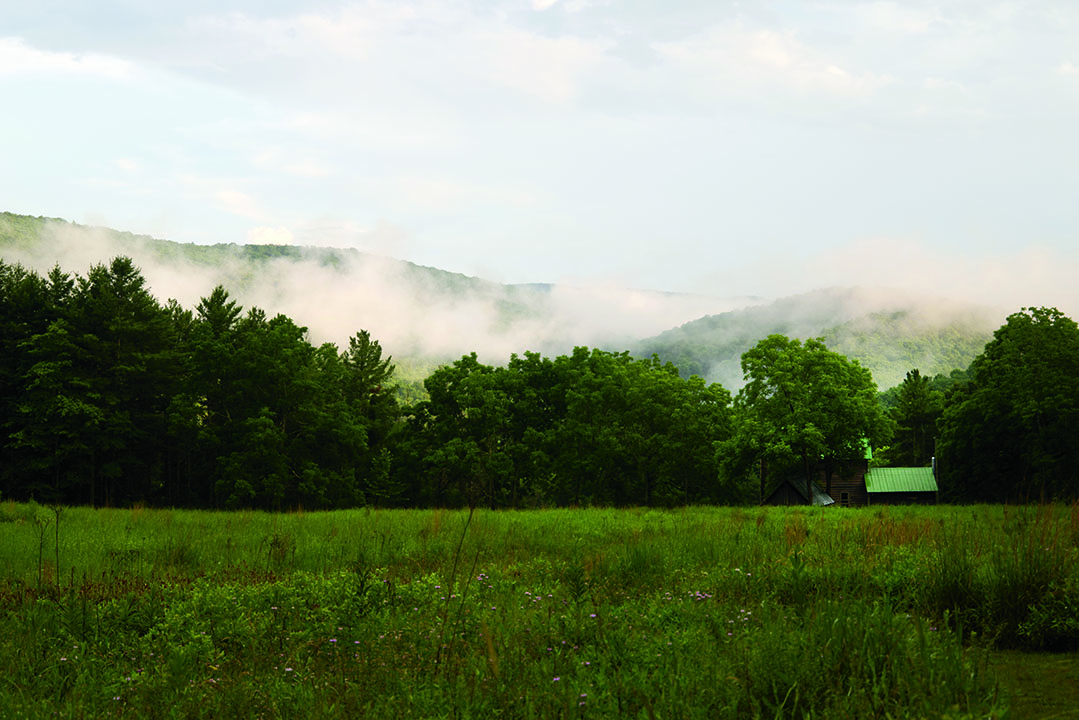
The cabin sits on National Forest land, where Kerney and Bullard do official work to help the Forest Service conserve native flora and fauna. Photograph by Chris Ritter
Ella Hanshaw, born Ella Samples, first picked up a guitar at age twelve. She was born to a family of farmers in Procious, West Virginia, who made time for music in between raising chickens and hogs. They played banjo and guitar and sang country classics like “Going Up Cripple Creek” together. Ella could learn to play songs by ear in a snap and was quickly writing her own—melodies and lyrics that stuck in the ears of anyone who heard them. Her whole family was talented, but it was clear Ella had a gift. She dreamed of playing her songs onstage to big crowds.
It wasn’t long before she got a chance. In the mid 1950s, when Ella was still a young woman, a friend with industry connections landed Ella an offer to join Midwestern Hayride, the first nationally televised country music show.
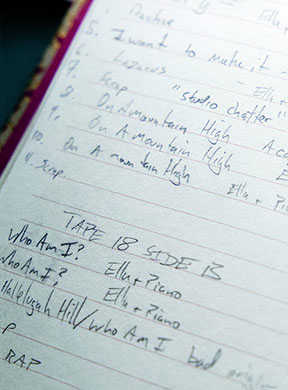
Kerney and Bullard made notes for all the songs they listened to for the album. Photograph by Chris Ritter
Ella turned it down. By this time, she had moved to Ohio and was married with children to take care of, as well as a jealous husband she knew wouldn’t approve of her having a life on the road. Ella didn’t quite approve of it herself, fearing that singing in bars and clubs would pull her away from her religious life as a devout Baptist. Still, she loved music by people who had chosen that other life, and she took songwriting cues from her favorites—people like Merle Haggard, George Jones, Kitty Wells, and Wanda Jackson.
“Wanda Jackson! I mean, that is a spicy woman,” says Kerney. “She never shared this stuff when I was growing up. But once I became interested in the music and was asking about the tapes, we started to talk more and more about what she had dreamed of doing.”
At the time Kerney was born, Ella had sworn off secular music and only wrote spiritual songs. She played in the Hallelujah Hill Quartet, which she and her husband had started to celebrate the opening of a church nearby in 1983.
There was another reason Ella repeatedly turned down offers to begin a career in music: fear of how it could change her. Throughout her life, she watched some of her idols crack under the pressure of performing, falling into nervous breakdowns and addiction. She wouldn’t let the magic of music fade away for her by making it her job. She chose to sing instead at home and in church, for her family and her God.
This is the Ella Hanshaw that Kelly Kerney knew growing up—a devoted maternal figure who put her family before all else. For one week every autumn, the Kerney family would visit Mamaw and Papaw on their land in Maysel, West Virginia. It was Kerney’s favorite week of the year.
In her essay for Oxford American, she described her weeks with Mamaw:
For one week each year in West Virginia, I felt like I had a home. Mamaw’s frequent hugs felt as encompassing as the surrounding mountain views. Everything she did for me was special: hot rice and raisins for breakfast, earnest questions and eternal patience…
Often, during these visits, Kerney would sit through rehearsals of the quartet in their living room. She watched and listened, aware that her grandmother was gifted. But really, Kerney was annoyed. The Hallelujah Hill Quartet rehearsal time was cutting into the precious time she got to spend with Mamaw.
In Kerney’s childhood, that week was a stark contrast to the rest of the year. Back in Ohio, Kerney’s parents were Pentecostal. Considered radical by more mainstream sects of Christianity, Pentecostals believe in physical manifestations of the Holy Spirit: it isn’t just all around you—it can appear to you, speak to you, speak through you, and heal the sick.
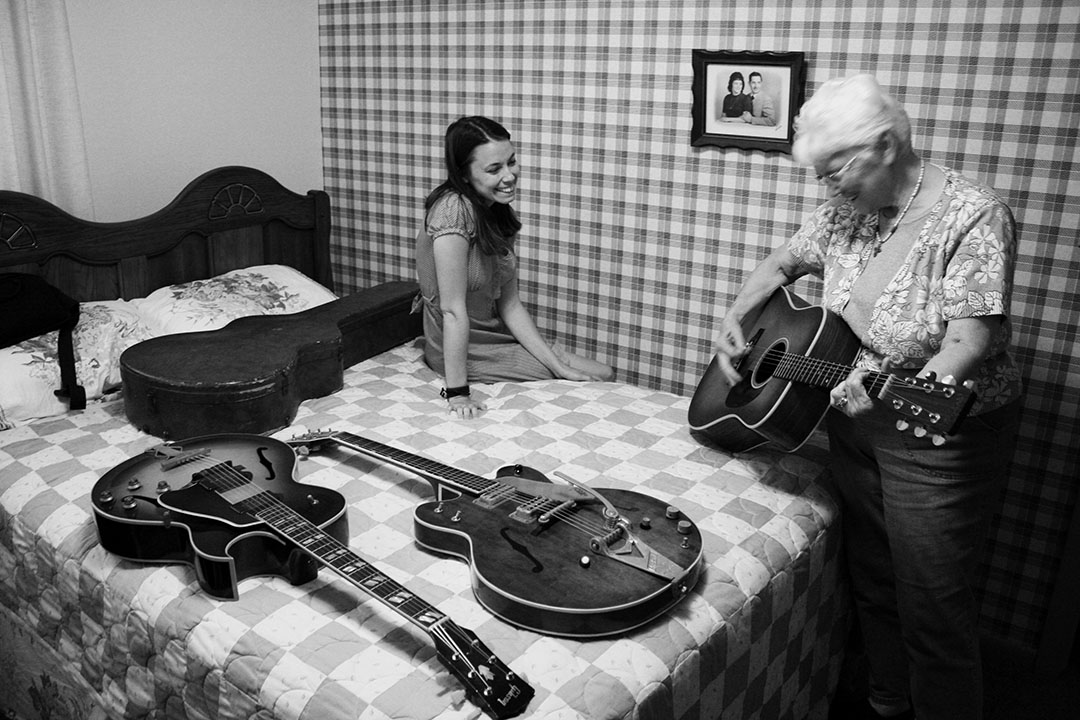
Kerney and her grandmother at Ella’s home in Seville, Ohio, in 2014. Ella is playing a 1958 Martin D-28.
“A lot of people in my family have visions and voices and talk to God,” says Kerney.
Those voices alerted them to demons that surrounded them, making for a fear-ridden childhood. “My mother would warn me: ‘There’s demons in the house, they’re coming after us, be careful. Good night!’” Kerney says.
It hadn’t always been that way—Kerney’s grandmother was Baptist, but her mother found Pentecostalism later in life. Her parents strictly monitored or banned altogether secular music and entertainment. When non-Christian music made it into the house, it did not go over well. In a particularly infamous incident, Kerney’s older sister brought home a cassette tape by Oakland rap group Digital Underground, famous for their hit “Humpty Dance,” from their debut album, Sex Packets. Their parents found the tape, listened to five seconds, and returned it to the sisters’ shared bedroom in shreds.
Kerney found her escape in books—and in public school. She and her older siblings had attended a Pentecostal school, but when that school closed before Kelly’s fourth-grade year, she was forced to go to public school. Kerney says that saved her.
“I was warned, ‘Oh, you have to go to public school now, and if they say anything bad, you have to let us know!’” says Kerney. “I was scared. I was made to believe that I was going to be corrupted by this.”
In a way, she was. The first nonreligious chapter book Kerney was exposed to was Roald Dahl’s The Witches. Kerney’s teacher read thirty minutes to the class each day, and Kerney sat enrapt.
"I loved it, it was so incredible,” Kerney recalls. “It was my first foray into literature. I thought the floor was going to open up and swallow us all into hell, and I didn’t care, and I didn’t tell. Wow, oh my gosh, I lapped it up. I was like, ‘This is amazing. I need more stuff like this.’”
Kerney found it in Beverly Cleary’s Ramona novels and other children’s literature. Later on, her parents were upset when she brought home Bram Stoker’s Dracula. Meanwhile, in class, Kerney made straight A's. She joined the tennis team. She joined model UN, history club, and the science olympiad. She was in every play. She made her first non-Pentecostal friends and learned from the kind of schooling her parents had never intended to expose her to.
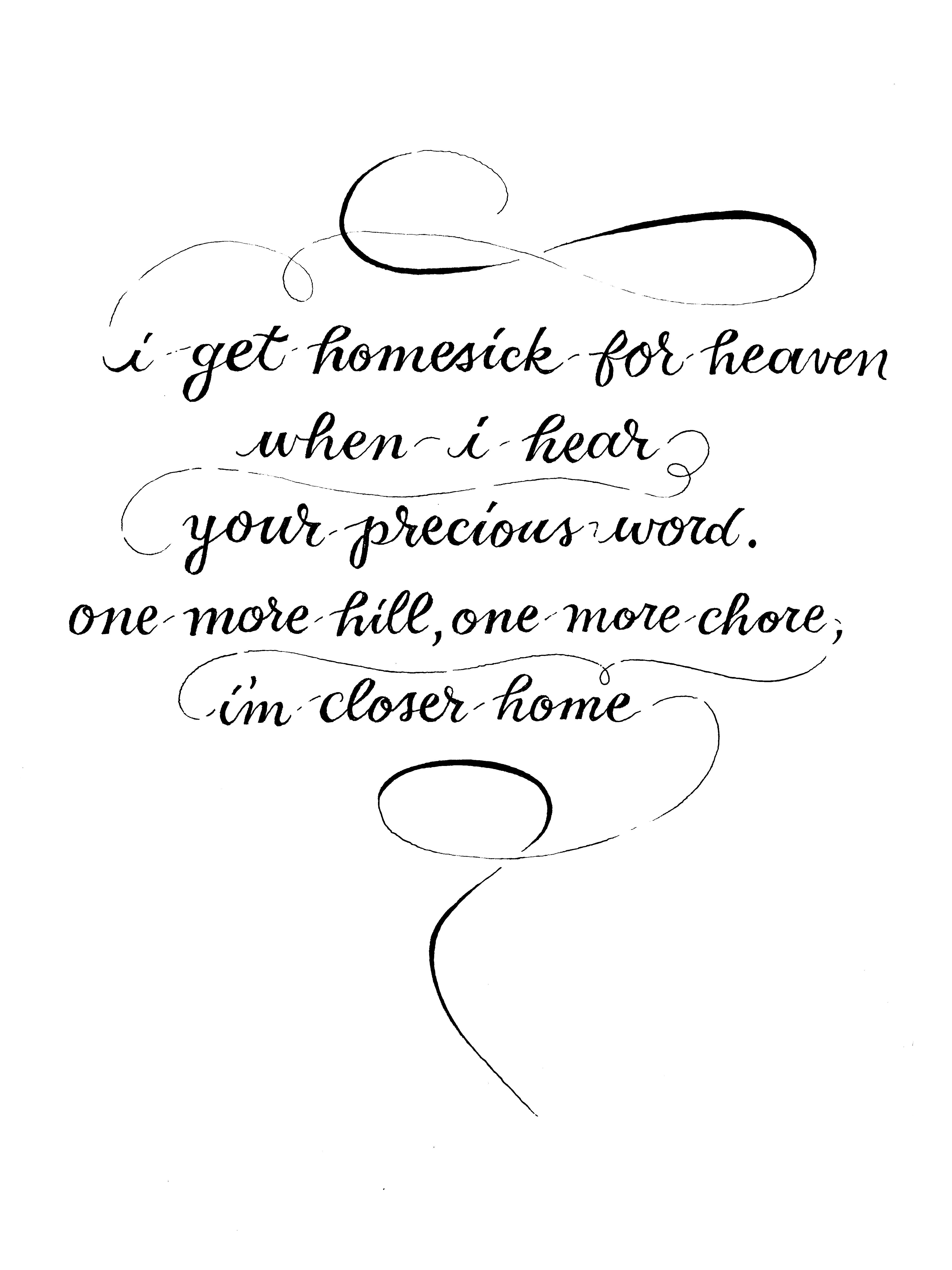
Lyrics, "I get homesick for heaven when I hear your precious word. One more hill, one more chore; I'm closer to home," from “One More Hill,” by Ella Hanshaw. Illustration by Sarah Sampson
It was around then that the image of her family’s devout religious life started to crack.
“Probably around the sixth and seventh grade, I started to see the emotional and financial manipulation going on within the church. It was just sad,” says Kerney.
Kerney found her way to college through another book. None of her family had gone to college, and her main guidance in the application process was a college encyclopedia she found in her school’s library. She applied to one school, Bowdoin, and got in early decision.
What did Kerney’s parents think of her going to a liberal arts college up north?
“There became a point where they just didn’t know what to do with me,” says Kerney. “No one else in my family was like this. They thought, ‘Oh, she’s going to be rich and become a doctor or lawyer, so she wants to go to a good school.’ That was their thinking: if you’re smart, you become a doctor or a lawyer.”
So, in the fall of 1998, Kerney’s parents took her to Brunswick, Maine, to move her in to start college. For years, she didn’t go back. She made good friends at Bowdoin. She stayed each summer and winter break with Liz Shesko ’02 in Shesko’s hometown of Needham, Massachusetts, where her friend’s family took her in like one of their own. She had her first writing mentor in English professor Anthony Walton. She had Bullard, who was just a good friend during their college years (the two reconnected in classic 2000s fashion via MySpace years later). Despite feeling out of place among her peers at first because her background was so different, Kerney found a chosen family at Bowdoin that has lasted her a lifetime.
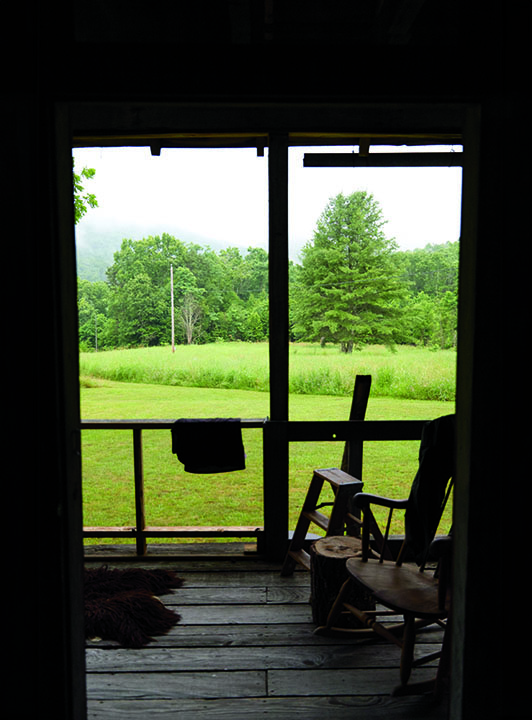
Looking out from Kerney and Bullard’s cabin, which sits on the eastern slope of the Allegheny Mountains—the same range found in Maysel, West Virginia, where Kerney visited her grandmother when she was a child. Photograph by Chris Ritter
When Kerney called Mamaw in 2013, it had been many years since they had spoken. Conversations could feel awkward and tense.
Until, of course, the tapes, which are now spread out across the table on the porch where Bullard, Kerney, and I are talking.
“This one ended up being one of our best,” says Bullard, grabbing a tape from the pile. The 1985 Hallelujah Hill tape—the original one Kerney’s brother had stolen—made the cut.
When Kerney finally did call her grandmother, Ella Hanshaw was thrilled to talk about the tapes. The fact that her grandson had stolen one from her hardly registered, as did any questions she had about her granddaughter’s faith. This was her music—her God-given gift, her life’s purpose—and someone wanted to hear about it.
“We were really into folk music, and still are,” says Bullard. “And not just that, but archival recordings and gospel, too. I think [Ella] was excited by this notion of us having some sort of fresh enthusiasm for it that I don’t think the rest of the family had or, if they ever had, they had lost it.” Mamaw, Bullard said, was an anomaly—as she had been in so many positive, nonmusical ways for Kerney throughout her life.
Mamaw sent them the tapes. Kerney and Bullard painstakingly sorted through all one hundred, looking for the sharpest recordings, and digitized them with some borrowed equipment. In a way, they were a perfect duo for a job like this—Bullard is a professional archivist for the National Parks Service in Richmond, while Kerney was at the time helping to manage archival materials at a museum in Richmond while working on her second novel.
The songs on the tapes painted a picture of Mamaw that Kerney had never seen before, at least not fully. There were the traditional gospel standards and Ella-written spirituals about conquering demons that she expected. And there were children’s songs. But then, hidden on a few of the tapes, there were secular songs of jealousy, longing, and quiet heartbreak—“Nobody’s Fool” sticks it to an unfaithful partner, while “Little Black Book” laments an unbalanced relationship:
I know I’m not listed in your little black book,
But I’m always in your kitchen when it’s time to cook.
In these songs, Kerney noticed the split in her grandmother’s music, and in her life. There was her big black book—the Bible—which Ella devoted so much of her life’s energy to. There was also, though, the little black book—the internal, personal life she kept tucked away for so many years in service of her faith and family.
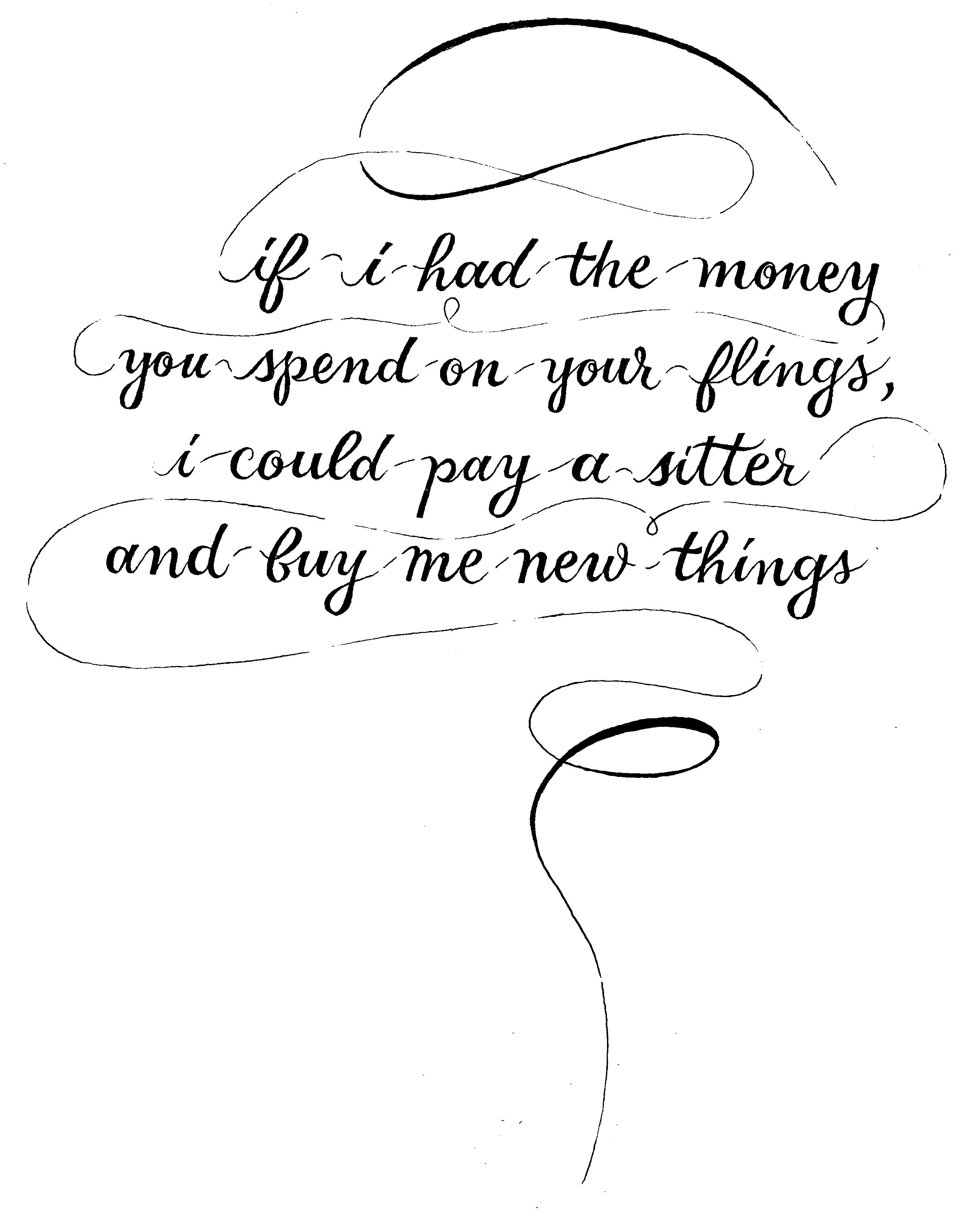
Lyrics, "If I had the money you spend on flings, I could pay a sitter and buy me new things," from “Little Black Book,” by Ella Hanshaw. Illustration by Sarah Sampson
These are the songs that made Kerney start asking questions. This is how she found out about Midwestern Hayride, about “Cripple Creek,” about Merle Haggard and Wanda Jackson, about the dreams her grandmother set aside.
“As a kid, you don’t ask those questions,” says Kerney. “But this was her purpose in life, and just because it went away and she thought it was dead, that didn’t mean that it had disappeared.”
Once they digitized the best recordings, they set out to make a CD to send to family. Ella didn’t want any of the secular music on it—the spiritual songs were her purpose, while the secular songs were a bit “silly,” as Kerney puts it. But when it came time to release Mamaw’s music commercially via Spinster records—a radical feminist label—Kerney wanted the secular music to stay.
“It’s her whole story,” says Kerney. “No radical feminist label would want to not tell her whole story, right? Especially conflicting stuff—the stuff that maybe doesn’t make sense that expresses her individuality the most, and her contradictions.”
There is a view uphill from the cabin that reminds Kerney of the view from her grandparent’s land in Maysel. It makes sense—these are the same mountains, and as the crow flies, we aren’t far from Maysel. From this view, you cannot directly see the sunset, but as Kerney and Bullard fix dinner (burgers, with those oyster mushrooms) you can see its effects, draping the land in orange, rain still spitting, a rainbow rising from the cloud-hugged hills.
Ella Hanshaw always believed she would return to West Virginia. So much so that in 2020, she got one of her daughters to drive her, cancer-ridden, from her home in Seville, Ohio, to the house where she used to live in Maysel, to knock on the door and ask its current occupants when they were moving out.
“She was convinced that Jesus was going to heal her,” says Kerney. A few months later, she was gone. In her final days, Kerney remembers her grandmother mouthing lyrics to an unfinished song called “Victory Mountain.” She also mumbled something about Merle Haggard. Five years later, Spinster released her album.
“I am so sad we couldn’t get her a deal before she died,” says Kerney.
Bullard puts a more positive spin. “[Ella and her husband] were so happy when we delivered [the CDs] to them,” Bullard says. “To them, maybe that was the pinnacle—this thing that they recorded thirty, forty years ago that was otherwise degrading in an attic now is preserved forever, you know, in a CDR, and handed out to friends at church. Maybe that was enough.
Kerney appreciates archival work as much as anyone. But she also knows her grandmother—the woman who spent her last walking years handing out CDs of her music until Kerney and Bullard were left wondering how she knew that many people in Seville, Ohio.
“She didn’t want to be in a library, she wanted to be in record stores,” says Kerney. “She wanted the Midwestern Hayride.”
In 2026, Ella Hanshaw is in record stores. She is also here, in the mountains where she was raised, in a house her granddaughter is working to make new again. As Ella sings on the album Kerney and Bullard produced,
Beyond the beauty of the rainbow,
a land of love is waiting there.
Chris Ritter ’21 is a writer, photographer, and musician from Lexington, Virginia. His work has been featured on NPR and in Condé Nast Traveler and more. He records music under the name Nodding Terms.
Sarah Sampson is a hand-lettering designer and illustrator at 2communiqué. She earned her BFA in graphic design at The College of Saint Rose.
Find Ella Hanshaw’s Black Book on spinstersounds.com or on music streaming sites like Bandcamp or Tidal.
This story first appeared in the Fall 2026 issue of Bowdoin Magazine. Manage your subscription and see other stories from the magazine on the Bowdoin Magazine website.