2026 Convocation: Bowdoin Opens Its 225th Academic Year
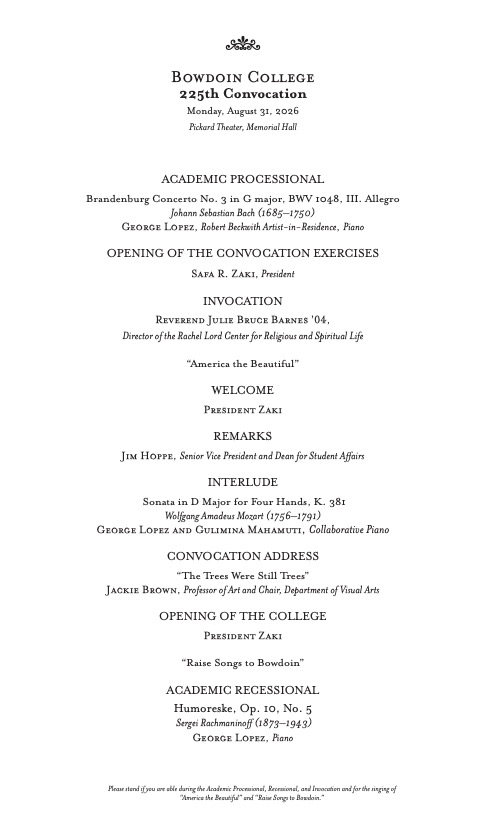
By Rebecca GoldfineProfessor of Art Jackie Brown addressed the audience of new students at this year’s Convocation by drawing parallels between the creative process and a liberal arts education.




“Both thrive on curiosity and invite us to be transformed by what we encounter,” Brown said. “Both ask us to loosen our grip on certainty and remain open to possibility. And both challenge us to reconsider how we perceive the world and how we understand our place within it.”
Keeping with tradition, she directed her remarks to the Class of 2030, who filled Pickard Theater on August 31.
“If you give yourself fully to this place, you may discover that the world looks different when you leave than it did when you arrived. Not because the world changed (although it is, and it will), but because you changed,” she said.
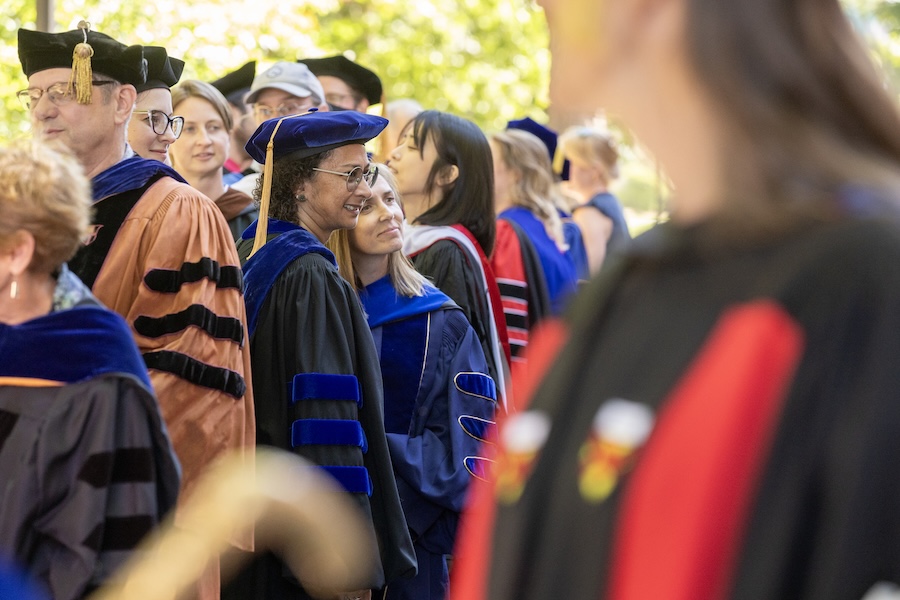
Presided over by the president of the College, Convocation marks the start of the academic year. Classes begin the following day.
Brown's talk, "The Trees Were Still Trees," was inspired, she said, by her approach to making sculpture. “A sculpture takes shape through trial and error, through staying with a process whose outcome you can't predict.”
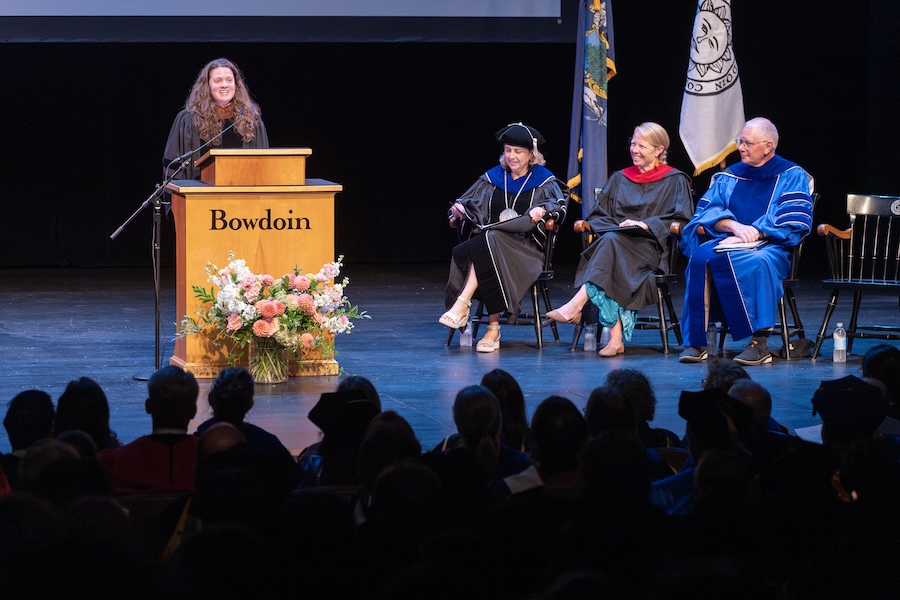
“Making things has taught me that we don't come to understand the world just by thinking about it,” she continued. “We have to touch it, test it, experience it firsthand. How we perceive the world, and what we might overlook, feels especially important now, at a moment when so much of what we encounter is generated, filtered, or mediated for us. Students are beginning four years that can fundamentally change how they see. I wanted to talk about what that change actually feels like, and where it comes from.”
Brown said she hoped students would realize they don’t need to have everything figured out—and that uncertainty isn’t a problem to solve, especially at this early stage of their college education.
Instead, she said, “It’s the raw material of it.”
“I invite students to pay closer attention to the world around them, to one another, and to the quieter moments that gradually shape who they become.”
Invocation: An Invitation to Build Community
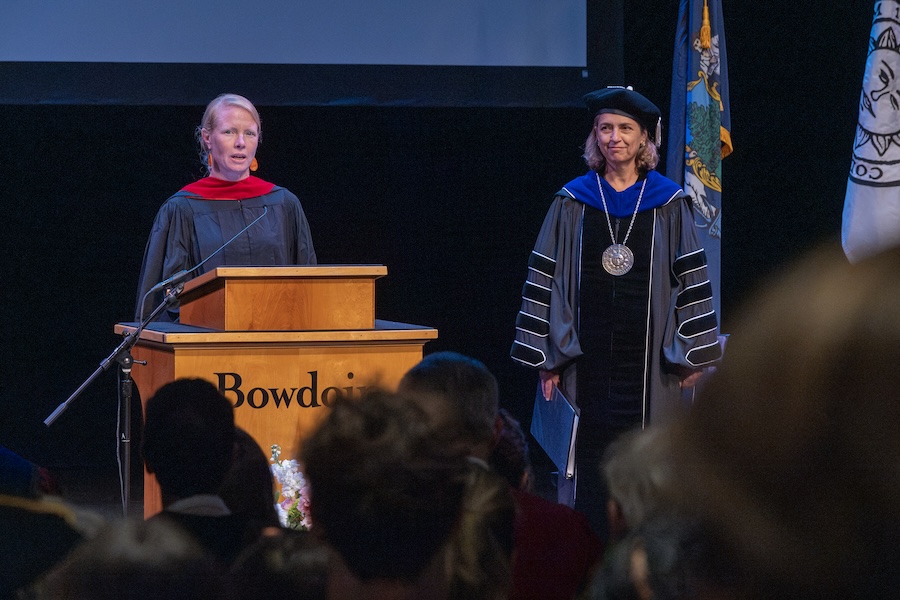
Reverend Julie Bruce Barnes ’04, director of the Rachel Lord Center for Religious and Spiritual Life, delivered the invocation.
She urged students at the cusp of this new experience to be generous with their talents and abilities as they build a community at Bowdoin.
“As we step into this new landscape, I encourage you to take care of [your] gifts, to tend them, to share them, to grow them, and to remember...we are here together—and oh, how our gifts multiply and deepen when we combine them with others.”
“We have a chance to build community—to weave these experiences, gifts, and questions we each bring with the resources of place, wisdom, and potential that Bowdoin offers,” she continued.
“What an opportunity we have to create good, to navigate challenge, and to live in community together.”
At the Pace of Pines
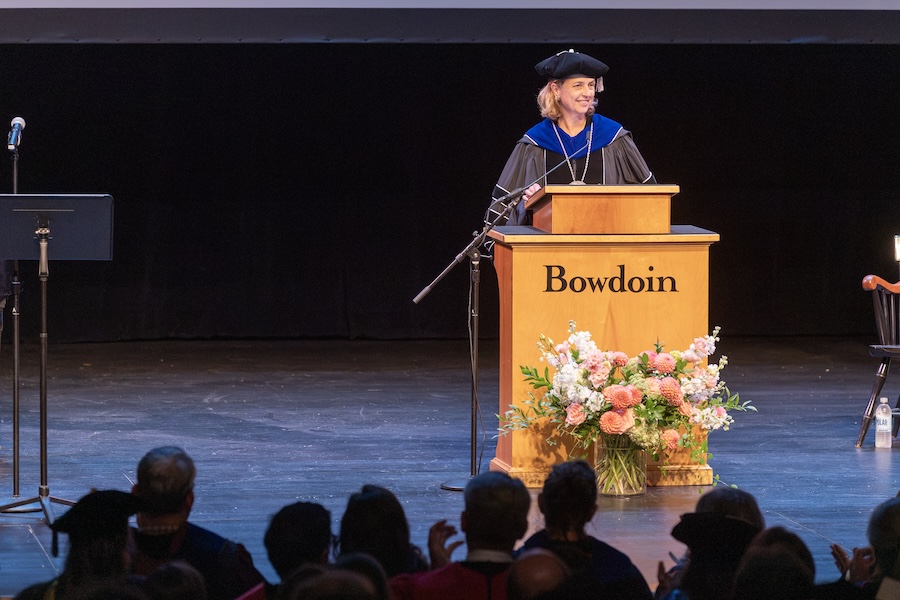
In her address, President Safa Zaki welcomed the new students and shared some of the thoughts about time that have occupied her as she walks a favorite path through the Bowdoin Pines.
The Pines were planted a century ago by Austin Cary, Class of 1887, who wrote at the turn of the century that he hoped future generations would enjoy the woods “more deeply and more intelligently.”
Zaki said the towering white pines represent a slower version of time, one she hoped students might emulate. “The pines have a different clock. They aren’t busy. They aren’t overscheduled. They’re not in a hurry. They’re just being themselves, putting on their growth a season at a time.”
“Their slowness stands in stark contrast to what we’re all subject to: the forces of ever-increasing busyness and speed. Class of 2030, I hope you will resist the urge to speed, resist the impulse to rush, resist the pressure to make your four years here a checklist.”
Instead, she urged students to “embrace the opportunity to read a book twice, sit with a proof for hours, run an experiment a second time, seek the space to sit between two competing arguments without collapsing into either one, follow a footnote, really look at a painting. … This is the difference between passing through your education and finding within it a place to dwell.”
Zaki then referenced one of her favorite lines from the Offer of the College, the promise that students will learn to be “at home in all lands and all ages.”
“To be at home is nothing dramatic,” she said. “It simply means you’ve stayed long enough to stop being a stranger.”
A Class of Possibility
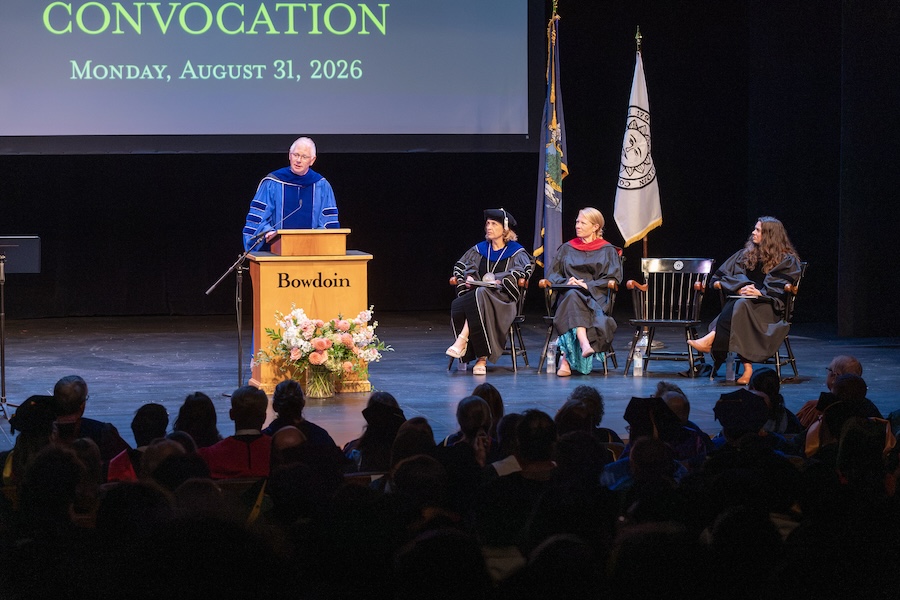
Jim Hoppe, senior vice president and dean for student affairs, then took to the podium to share some facts about the Class of 2030.
“What makes Bowdoin truly special is you, the students, and your group right here is pretty extraordinary,” he began.
Six students began their higher education at community colleges. Members of the class come from forty-seven states, the District of Columbia, Puerto Rico, and fifty-four countries.
Forty percent of the class speaks more than one language, and 12 percent have an international background. Nineteen percent are the first in their generation to attend college, while 6 percent have family members who also attended Bowdoin.
The class includes sixty-two students who led their high schools as student body president, a nationally ranked competitive climber, and a student who taught themself four languages. One student has logged 1,700 hours of community service; another collects ancient Greek coins; another holds a patent on a medical device.
“But you’re not here because of statistics. You’re here because we saw something in you—a spark, a sense of possibility, a commitment to learning from and with others,” Hoppe said.
Once the speeches concluded, Zaki declared the College formally open for its 225th academic year. “May it be a year of discovery, inspiration, and achievement.”
Photos by Andrew Estey.