“Taiwan is the most important issue to the Chinese, and that's why President Xi highlighted it at the beginning of the visit,” explained Heurlin, an expert in Chinese politics.
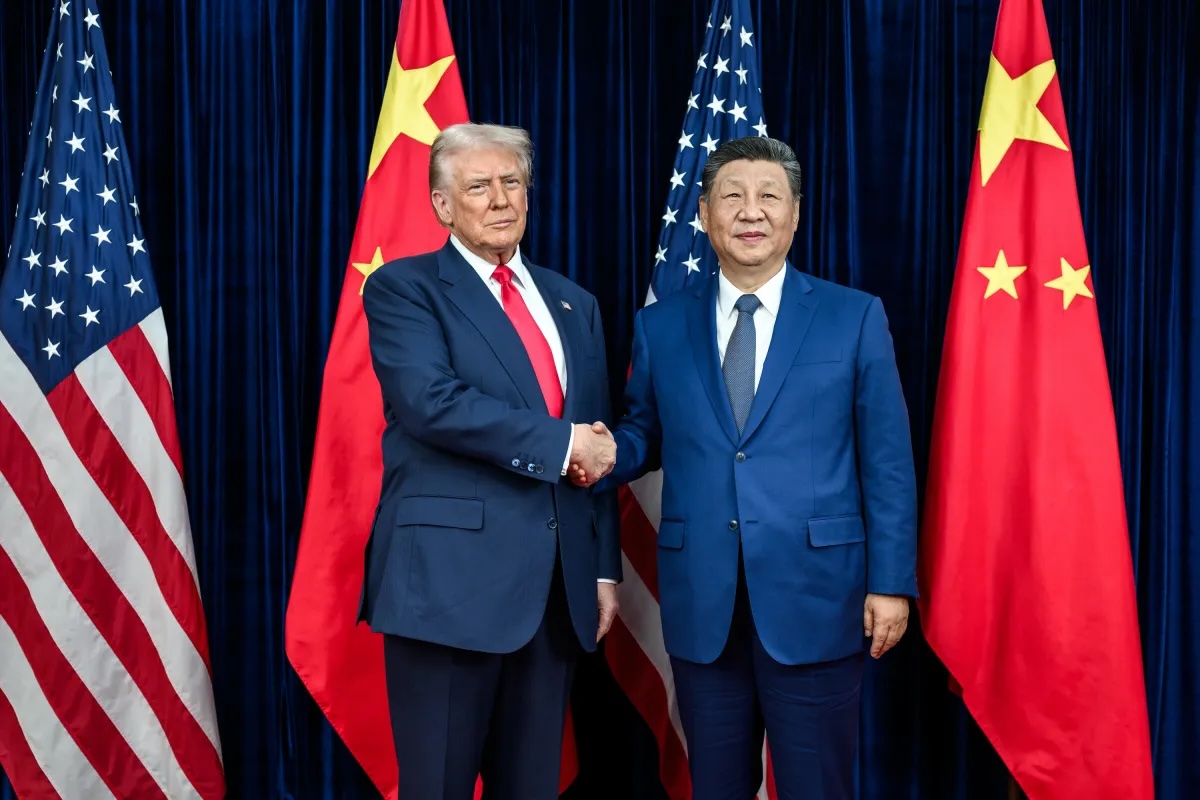
Presidents Trump and Xi at the White House, October 2025. Image: https://www.whitehouse.gov
“I think domestically the Taiwan portion of the visit is going to be regarded as President Xi giving President Trump a very tough talking-to and laying out the Chinese terms.” These terms, said Heurlin, include a demand that the US does not interfere with the self-governed east Asian island, which China claims ownership of. “From the Chinese perspective, they delivered a message, and Trump was, I think, cautious in how he treated it. On the flight back to the US, he was getting questions from reporters on what the US would do if China attacked Taiwan, and he was essentially refusing to say, which is consistent with the long held American policy of strategic ambiguity—the idea that the US will not make clear how it would react to a Chinese invasion of Taiwan.”
Hanging over the talks, added Heurlin, was the $14 billion US arms package to Taiwan approved by Congress but yet to be signed by Trump. “It's essentially sitting on President Trump's desk,” observed Heurlin. “One possibility is that he did not push this arms sale through before the summit because he didn't want to antagonize the Chinese, and now it's possible that in the coming weeks we might see this sale be finalized.” In this case, he said, Beijing would complain, sometimes loudly, and then both sides would likely “carry on as before.”

The other major geopolitical issue on the table was the war in Iran and the volatile situation in the Persian Gulf, where a blockade of the Strait of Hormuz has sent oil prices surging. Again, said Heurlin, there was little meaningful movement on the issue during the US-China summit. “From the American side, we're hearing that there's agreement between the US and China on the broad strokes of the conflict, that there should be no ‘toll booth’ charging for passage through the strait by the Iranians, that the Iranians shouldn't have a nuclear weapon, and that the war to be brought to an end.” Meanwhile, Beijing, which relies heavily on Iranian oil, continues to press for a peaceful solution to the conflict. Essentially, explained Heurlin, the position of both parties is the same as it was before the summit. “So, I think any hope that the Chinese would bring pressure to bear on Iran to end the conflict is going to be for nought—I think that's maybe a little bit of wishful thinking.”
On the trade front, there was also little to shout about. “The main announcement was that China would buy 200 Boeing commercial aircraft, which frankly is not a lot,” said Heurlin, pointing out that shares in Boeing fell nearly 5 percent on the news. “In the days before the summit, China lifted some restrictions on US beef exports to China, so that may help a little bit.” There's also been of talk of increased purchases by China of US soybeans, he added, although this may not amount to much as Beijing does not always follow through on announced deals. “I think some of this is diplomatic positioning and maneuvering rather than concrete deals.”
The issue of human rights, meanwhile, was off the agenda completely at the summit, which was not surprising, said Heurlin. “President Trump has a long-standing admiration for strongman-type dictators, and he certainly has those kinds of feelings toward President Xi.” Before the summit, he commented, there had been talk that Trump might raise the issue of Jimmy Lai, the imprisoned Hong Kong businessman and political activist, but this did not occur.
Christopher Heurlin’s latest book, The Enduring Power of Communism: The International Origins of Authoritarian Consolidation, was recently published by Oxford University Press.
Check out Heurlin’s recent media appearances: