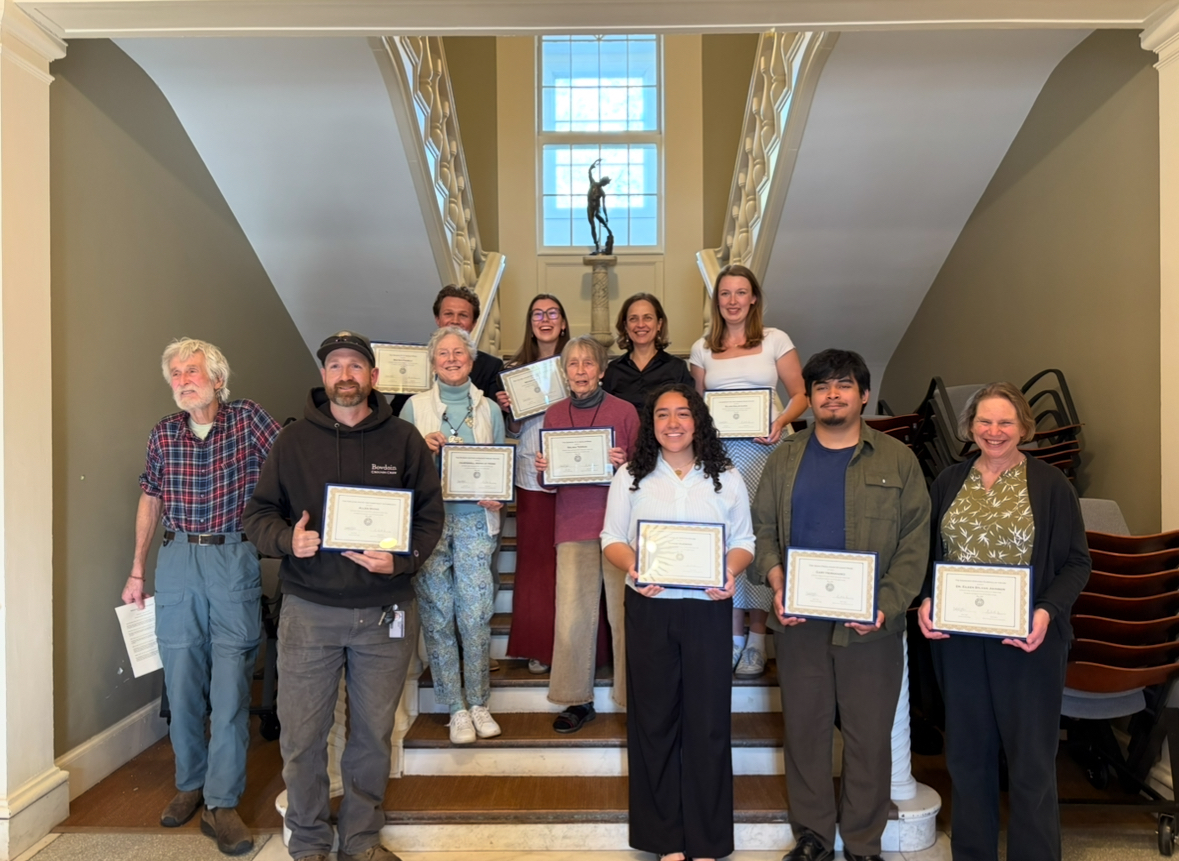
In early May, the McKeen Center held its eighteenth annual Bowdoin and the Common Good Symposium to spotlight the many ways people at Bowdoin have contributed to, supported, and learned from communities both near and far over the past year.
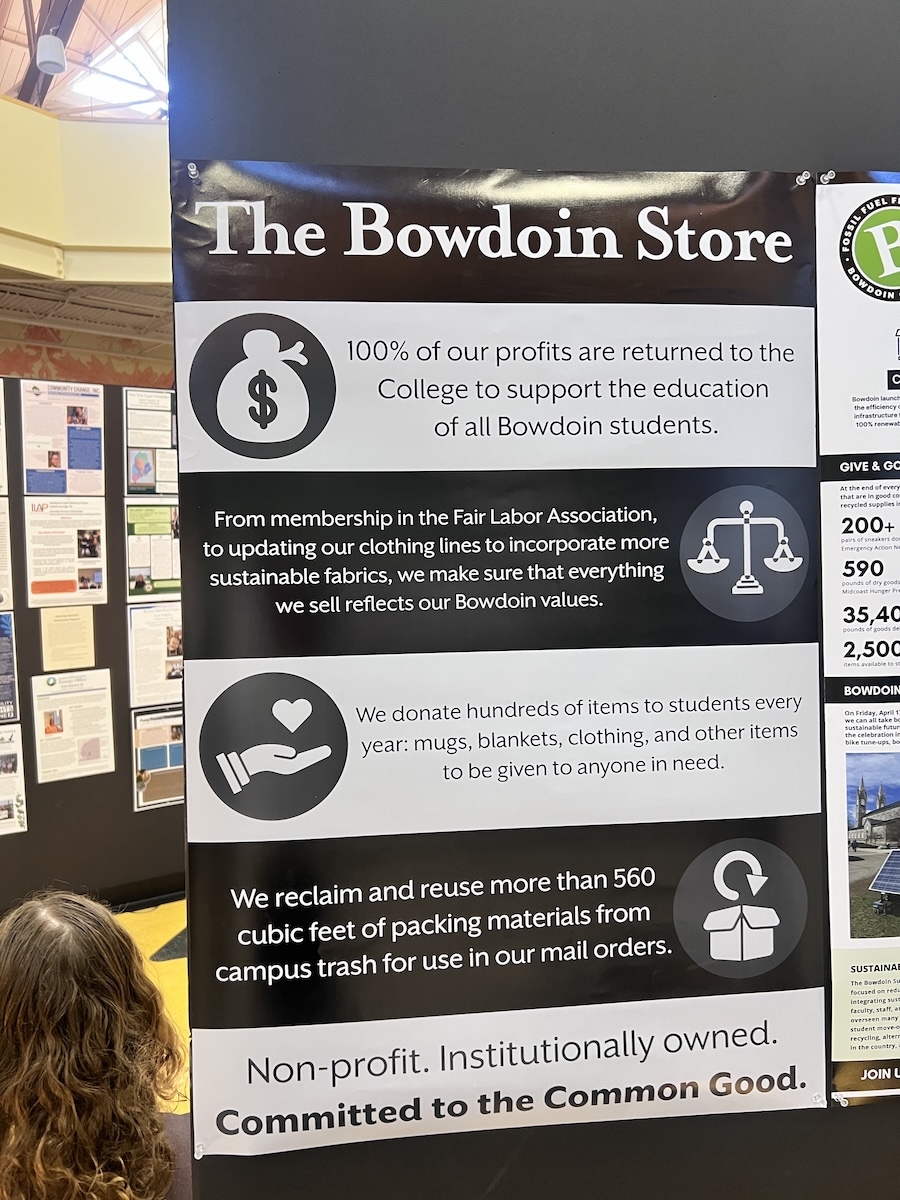
Posters displayed in Morrell Lounge illustrated the stories of students engaging with a range of issues, people, and places. Many were McKeen Center for the Common Good initiatives, including summertime Maine Community Fellowships, mentoring and tutoring programs, civic involvement through Bowdoin Votes and Bowdoin Public Service, Alternative Spring Break and Community Immersion Orientation trips, and the dialogues that students foster through What Matters conversations.
Other posters highlighted public-spirited efforts by offices and departments across campus. Dining, the Bowdoin Store, Sustainability, Athletics, Upward Bound, and several classes were featured.
“At the end of each year, we know it’s important to celebrate all the ways the Bowdoin community has explored and contributed to the common good,” said McKeen Center Director Sarah Seames, who added that the symposium also demonstrates the breadth and complexity of that work. “This is a way to think broadly about what the common good means to our community.”
“We always invite the rest of campus to the symposium,” added McKeen Center Associate Director Tom Ancona. “More than any other event, this highlights the real scope of community-engagement activity happening at the College.”
Below are some of the symposium stories.
“This is a way to think broadly about what the common good means to the community.”
—Sarah Seames, McKeen Center director
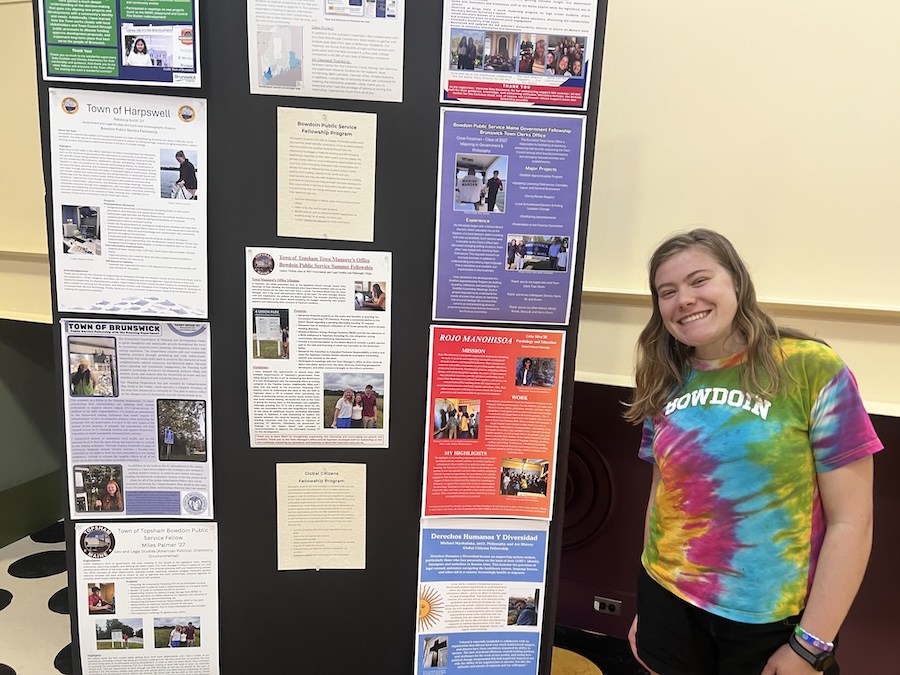
Global Citizens
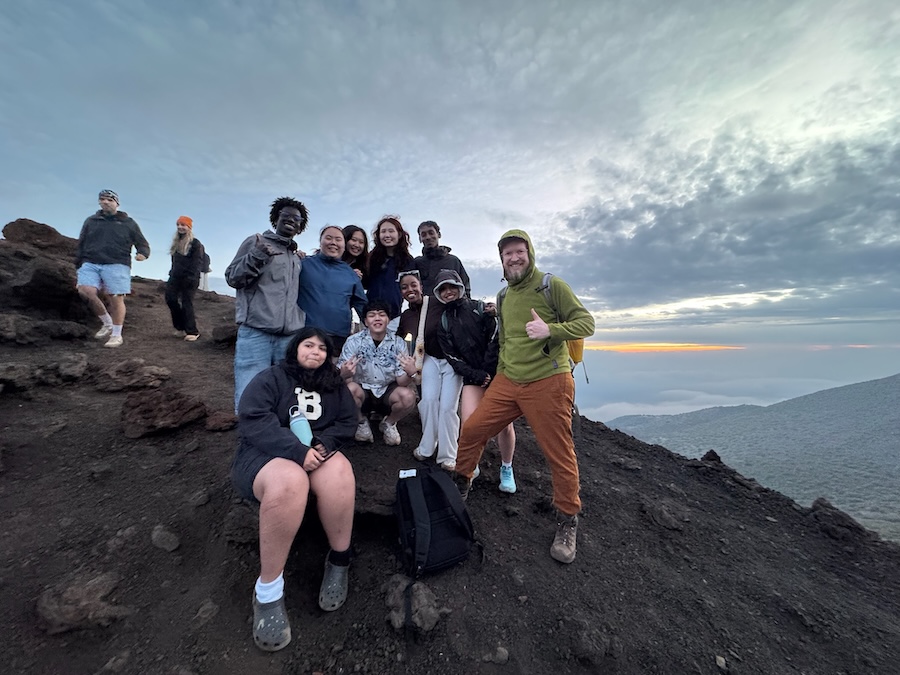
The McKeen Center’s Global Citizens Fellowship supports students pursuing community-oriented projects abroad during the summer in partnership with local organizations.
As the program's coordinator, Lex Davis ’26 helped lead a four-week pre-departure seminar for fellows about how to create lasting impact and grapple with the questions of agency, responsibility, and identity that come up in these international contexts. Before she worked for the program, she received a Global Citizens fellowship to spend a summer in Cuzco, Peru, to volunteer with Helping Hands.
“It’s important to be connected to places and communities that have different practices and ways of being,” Davis said. “The world is so much bigger than Bowdoin and Maine!”
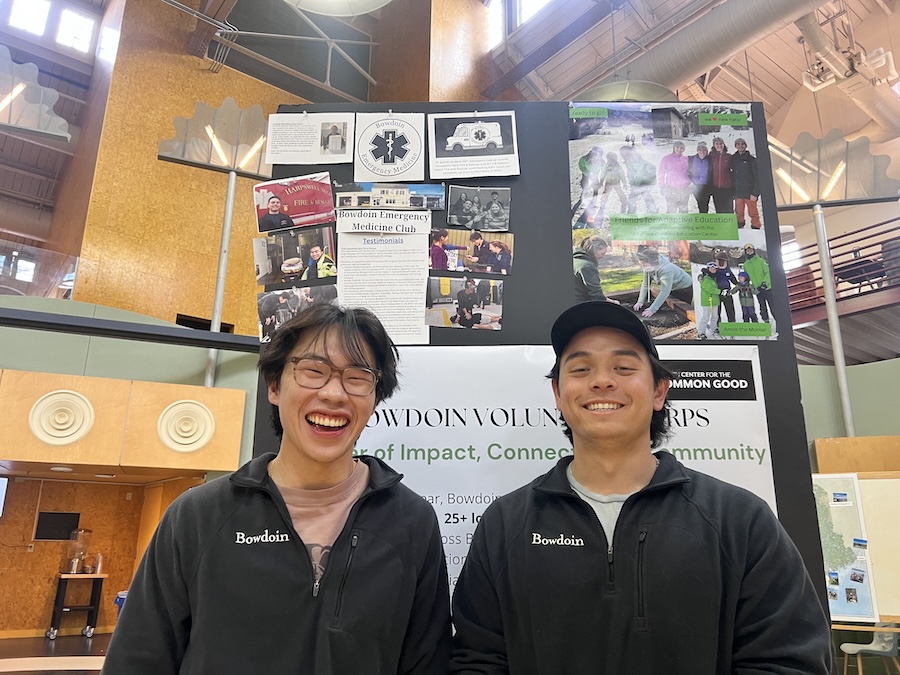
Bowdoin Volunteer Corps
The Bowdoin Volunteer Corps is made up of student-led organizations that address many different community needs. Each group works with local agencies, placing Bowdoin students in volunteer roles to support their missions.
At the symposium, Edward Fontaine ’28 and Conner Lee ’27 stood near a poster for the Bowdoin Emergency Medicine Club, one of twenty-eight student groups in the Volunteer Corps. The club’s 200-plus members—including twenty-one certified EMTs—assist the volunteer emergency medical service in the neighboring town of Harpswell.
“It’s a satisfying way to volunteer,” said Fontaine, one of the club’s certified EMTs. “They appreciate us and rely on us to cover shifts.”
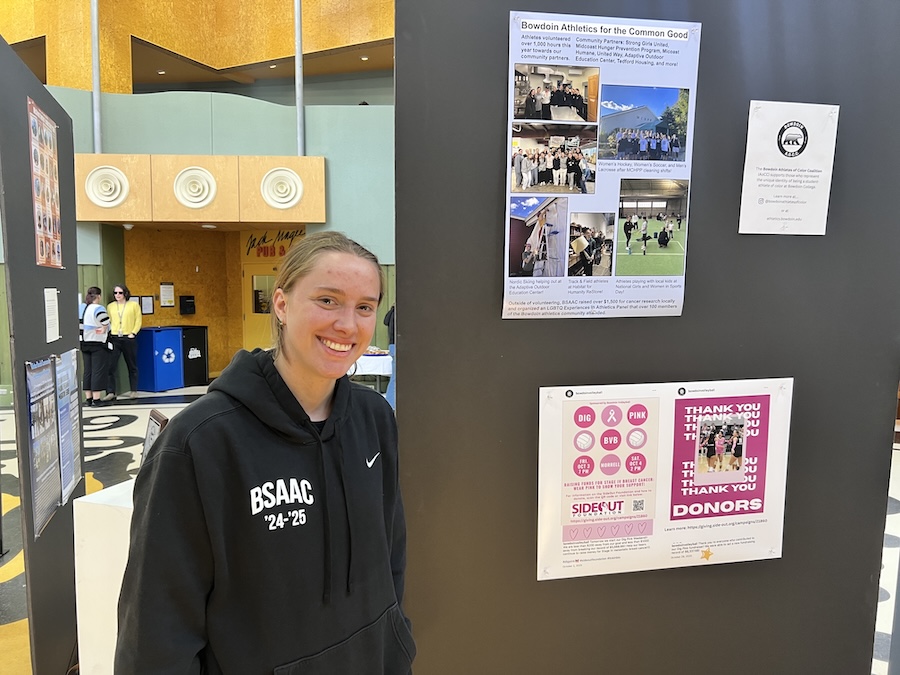
Bowdoin Athletics
Nina Fearon ’26—a swimmer, the vice president of the Bowdoin Student Athlete Advisory Council, and a student worker for the Sustainability Office—was on hand at the symposium to talk about athletics and the common good.
A highlight for her, she said, was the vintage sale and flea market she helped organize last spring. Students collected used sports jerseys and other Bowdoin items to sell for charity, while also inviting others to sell personal items. The event raised $500 for Tedford Housing, a Brunswick nonprofit that supports people experiencing homelessness.
“I care a lot about the environment and the community,” Fearon said. “Those two interests have motivated me to do a lot and have been a big part of my education.”
Beyond the flea market, Bowdoin athletes volunteered more than 1,000 hours this past year with organizations such as Strong Girls United, Midcoast Hunger Prevention, United Way, the Adaptive Outdoor Education Center, Habitat for Humanity, and Midcoast Humane.
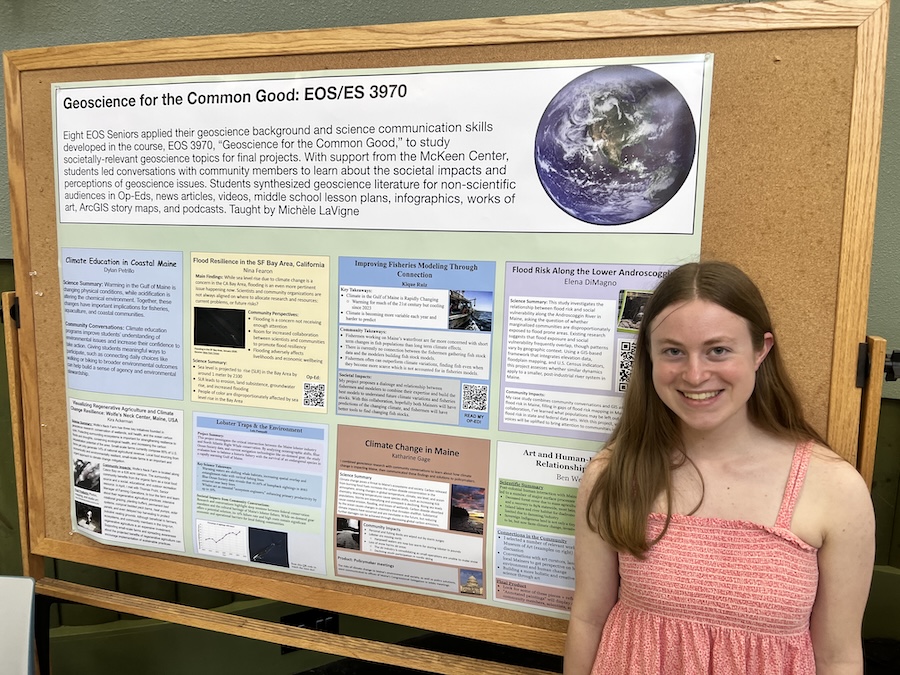
Geoscience for the Common Good
Among the class posters was EOS/ES 3970: Geoscience for the Common Good, taught by Michèle LaVigne, associate professor of earth and oceanographic science (EOS).
After studying social issues in geoscience and speaking with community members affected by them, students synthesized their findings into public-facing projects such as op-eds, middle school lesson plans, artwork, podcasts, and policy briefs.
Some of the students were at the symposium, including Katharine Gage ’26. “This was a cool way to combine my EOS major and my longtime interest in climate advocacy,” she said. “We talked a lot about science communication and how to make scientific ideas understandable to non-scientific audiences, including the public and policymakers.”
For her final project, Gage researched climate change impacts in Maine, interviewing residents and business owners about increasingly fierce storms, diminishing snowpack, ocean acidification, coastal erosion, and the plague of ticks.
She also met with members of Senator Angus King’s office to share her findings and advocate for a carbon fee and dividend bill aimed at reducing greenhouse gas emissions. The McKeen Center also funded a trip for her to Washington, DC, where she lobbied Congress with the American Geophysical Union.
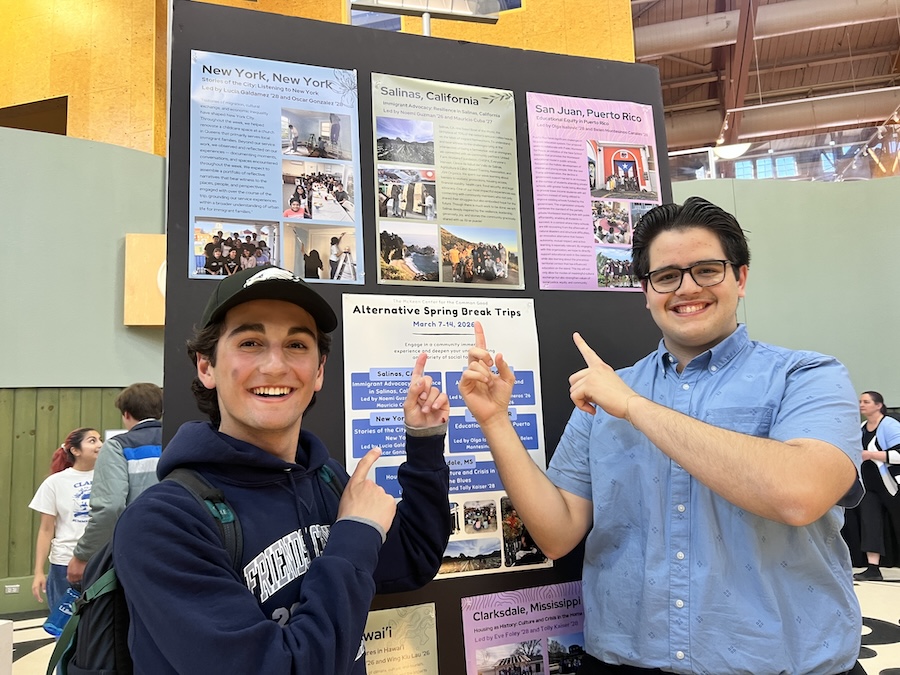
Alternative Spring Break to Salinas, California
Mauricio Cuba Almeida ’27, coleader of one of this year’s five Alternative Spring Break trips, reunited at the symposium with participant Mico Carpiniello ’29.
Cuba Almeida and coleader Noemi Guzman ’26 brought their group to Salinas, California, to examine “the intersection of issues facing immigrants and farmworkers,” he said. Farmworkers, Cuba Almeida noted, are especially vulnerable to exploitation because many lack legal protections, despite “being responsible for feeding all of us.”
Alternative Spring Break trips (ASB) take place during the first week of March vacation and are entirely student-planned and led. This year’s ASB trips traveled to Hawai'i, Mississippi, Puerto Rico, California, and New York to explore a variety of issues.
Cuba Almeida said his own Alternative Spring Break experience the previous year—when he traveled to Immokalee, Florida, to study farmworkers’ rights—was transformative. “I wished more students knew about this issue,” he said. “We may learn about it in class, but it’s a different experience seeing the housing conditions and challenges people face.”
During the weeklong trip in Salinas, students met with nonprofit leaders helping immigrant communities become self-sufficient farmers and gain access to affordable health care. Carpiniello said the experience strengthened his interest in nonprofit work. “These are the kinds of people I want to work with,” he said. “You could tell the work was so meaningful to them.”
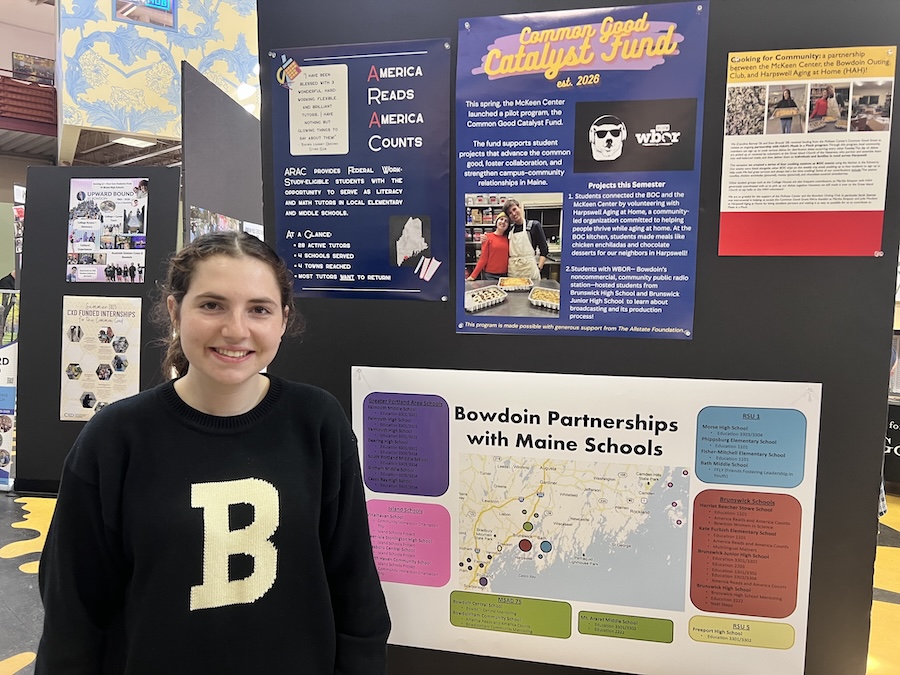
Good Cooking
Evan Braude ’27 and Caroline Berney ’26 received a special grant from the McKeen Center this spring to prepare meals for for Harpswell residents of Harpswell through the Harpswell Aging at Home.
Braude credited Berney with the original idea. “She wanted to expand connections between the Bowdoin Outing Club and the McKeen Center,” Braude said. “We wanted to use the BOC kitchen for the common good.”
The pair recruited student volunteers to prepare four meals every two weeks for Harpswell recipients. Next year, the initiative will become part of the Bowdoin Volunteer Corps.
“The outing club does such a good job getting students off campus to connect with the natural world, but connecting students with communities off campus is equally important. I’m grateful to help link both of these things that mean a lot to me.”