Bowdoin has been entrusted to hold the archive for Wabanaki REACH's second “truth-telling initiative,” a collection of personal stories about the decade leading up to the 1980 Maine Indian Claims Settlement Act.
“Making Space for Truth and Healing”
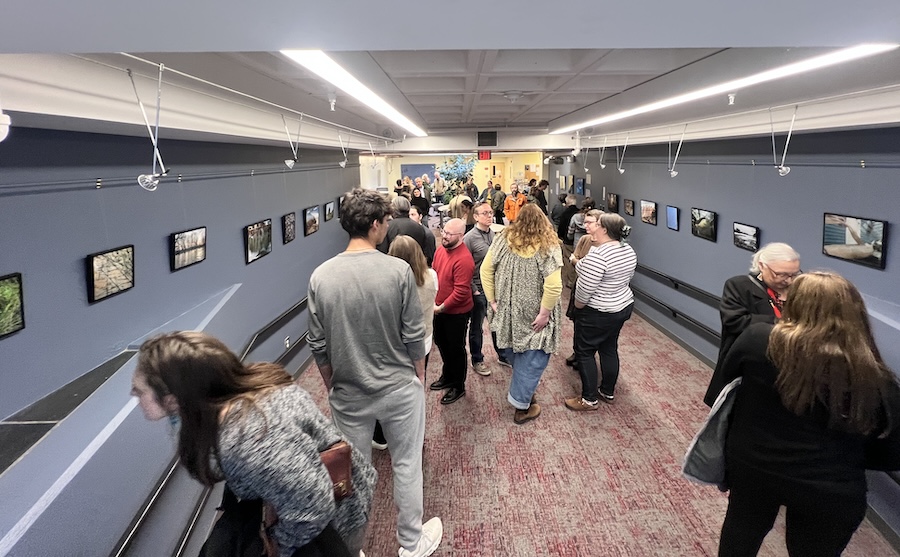
On a recent weekday evening, the Hawthorne-Longfellow Library Ramp Gallery was filled with visitors looking at a series of photographs and listening, at an interactive kiosk, to recorded interviews.
The photographs in the exhibit don't immediately strike one as political or protest art. Many show scenes from nature: an owl perched on a branch, the slanting grain in a rock, shafts of sunlight through dense forest. A few depict people—in one image, a man holds a tuft of sweetgrass; in another, a group canoes down a river.
But they contain a political message: they represent an effort to “humanize those who have been affected by the Maine Indian Claims Settlement Act, amplify their voices, preserve their stories for cultural continuity, and make space for truth and healing to happen,” according to the organizers.
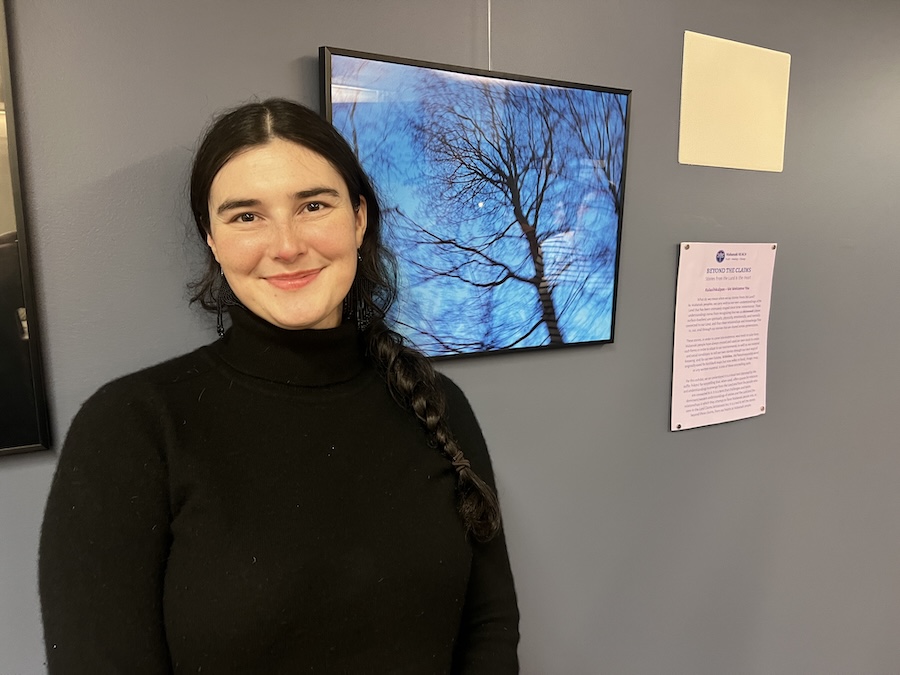
The opening of the Wikhikonol exhibit on April 22 was part of a celebration for a new archive at Bowdoin called “Beyond the Claims: Stories from the Land and the Heart.” A panel discussion and reception at Bowdoin followed.
“Beyond the Claims” is the second truth-telling initiative of Wabanaki REACH, a Native-led nonprofit that promotes Indigenous self-determination. The first led to the 2015 Maine-Wabanaki State Child Welfare Truth and Reconciliation Commission report, which revealed the devastating effects of Maine's child welfare policies on tribal families and communities. That archive of testimonies is also held by Bowdoin.
The latest initiative is a compilation of oral histories—as well as the photographs and a play—that convey the ways of life behind the complex politics and dry legal language of the settlement act.


The Claims Settlement Act: A Brief History
"Beyond the Claims" addresses a tumultuous decade in Maine's history that preceded the signing of the Maine Indian Claims Settlement Act.
In 1972, the Passamaquoddy tribe filed suit to compel the federal government to pursue land claims against the state of Maine on its behalf, with the Penobscot Nation joining the effort soon after. The tribes alleged the illegal sale and transfer of their aboriginal territories, beginning in the late eighteenth century, and sought the return of a substantial land base in Maine that would open economic and cultural opportunities for them.
Historian and community organizer Maria Girouard, a member of the Penobscot tribal council, explained during the panel discussion at Bowdoin that a settlement was negotiated to put an end to a difficult time. "Following a tense and hostile decade, Mainers were fearing for their property, tribal citizens were suffering overt racial hostilities, and there was enormous pressure exerted on both sides to reach an agreement, since it was causing economic chaos in the state," she said.
More than four decades later, the Wabanaki continue to try to loosen the Settlement Act's restrictions on their sovereignty. Many other federally recognized tribes in the US do not have such restrictions, allowing them broader powers to self-govern and manage their lands.
"Beyond the Claims" is a way to bring this struggle out of the political realm, to strip it of legalese, and to ground it in the people and the land where they live.
"As we witnessed our legislative efforts run up against barriers and lost progress…I thought the venue for change didn't rest in the legislature, but in the people," Girouard said. "We needed to move the conversation about the land claims from the head to the heart."
One of the stories in the collection is recounted by Matthew Dana II, a Passamaquoddy citizen. He describes being brought up with a spirituality that connected people to the environment, imbuing him with a sense of responsibility for his homeland. “We were thankful for having the opportunity to go out and be part of the environment, and look for a deer or moose even though we didn't harvest one. We were still out there engaging and bonding with everything that goes on.”
Stories from the Land and the Heart
More than eighty-five people turned out for the Wikhikonol art show opening, which features photographs by Maya Attean and Nolan Altvater. Attean, who attended the event, is a Penobscot and Passamaquoddy artist living in Pequawket territory in Maine. Her work is in the permanent collections of the Portland Museum of Art and the Abbe Museum.
In her remarks, Attean explained how she first got involved in "Beyond the Claims" as a story collector. She was trained to respectfully enter the homes of and to speak with Wabanaki elders, tribal chiefs, legislators, lawyers, poets, culture keepers, and families impacted by the act. "It was a great privilege to hear their words about their lives and to connect them to my sense of place in the community," she said.
“Photography is a great medium for this project because the visual language of photography is about connection to the world around you and how you interpret the space you live in. ”
—Maya Attean, Beyond the Claims photographer
She began photographing the people she spoke with, as well as where they lived—"the earth that is the connective tissue to this project," she said. After leaving an interview, she took photographs "with the history that they shared fresh in my mind."
The stories Attean helped to collect and illustrate are recollections from the divisive and bitter decade of the 1970s. But they are not explicitly about the conflict that raged between the state and the tribes, or about the fights that erupted among tribal members. Instead, they evoke personal memories of a different era—of seasons passing, of environmental changes, of being younger and learning from nature.
"We gathered stories of the connection people had to the land," Girouard said. "It returned the land to the conversation about the land claims settlement, because, strangely enough, this effort that began as an effort to reclaim stolen lands—in the end, the Maine Indian Claims Settlement Act doesn't even mention the land."
Beth Sockbeson, a Penobscot citizen who spoke with Attean in 2022, shared a memory of walking across the river when it froze in the winter. “When the ice would go out, there’d be big chunks of ice that would float downriver. [Ernest Gosselin] supposedly jumped on those chunks of ice to get back to Indian Island. That was funny.”
Stephanie Bailey, who is also quoted in the collection, told her story collector that what makes her a Passamaquoddy is her link to the ocean, trees, and land. “You can talk to the trees and they'll talk to you. You can talk to the water and they'll talk to you. They will. You can share. It's not like language you understand in your head, but you know it.”
Beyond the Claims at Bowdoin
Bowdoin's archivists have processed the complete interviews and transcripts of the project, making them available to the public via its digital collections.
Instead of transferring ownership of the “Beyond the Claims” collection to the College, Bowdoin has signed a memorandum of understanding with Wabanaki REACH, explained Kat Stefko, interim director of the Bowdoin library.
“We do not own this collection and will not own the collection,” she said. ”We have a formal partnership to provide for access to and preservation of this collection, which is incredibly meaningful, especially when you're talking about land claims. We didn't want that as a defining parameter for this relationship, and we're partnering in every aspect of managing the collection.”
Marieke Van Der Steenhoven, education and engagement librarian for special collections, called the “Beyond the Claims” archive “a generous and intimate way to learn about our history and the place we call Maine through individuals’ stories and lived experiences."
While the archive is an important collection on its own, it also broadens the library's holdings, which tend to be filled with the dominant voices of the day, with those who held power. "It is putting [the Wabanaki] in conversation with other materials, giving us a more accurate way to understand this place, its history, and its people,” she said.