Look to the Sky
By Rebecca Goldfine for Bowdoin MagazineFrom our earliest recorded histories, we have stories of humans looking up at the heavens—in awe, seeking meaning, rooting themselves in the galactic landscape.
The ways we have come to understand the stars and planets and our place in the universe have changed with scientific and mathematical discoveries and the exploration of space, but the sense of wonder we get when we contemplate the night sky does not diminish.
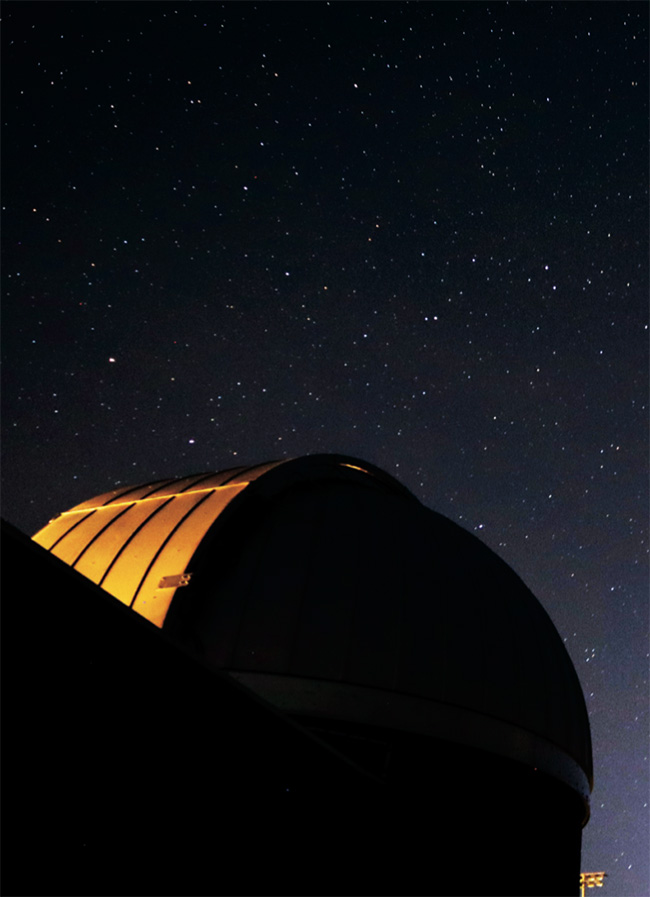
As the last soccer players trickle off the playing field and the floodlights finally click off, darkness settles over the nearby observatory. There, a handful of students and two professors huddle around an array of small telescopes.
After a minute scanning the sky, one of the telescopes pinpoints Saturn hanging almost due south. The night is so clear that Assistant Professor of Physics Fe McBride knows she can show the students two other spectacles besides Saturn’s rings of rock and ice: the fuzzy M13 globular cluster—25,000 light-years away and home to hundreds of thousands of stars—and the double star Albireo. In that duo, the cooler star glows a warm orange-red, while the hotter one flickers an icy blue.
Yet even as the students admire Saturn’s shining rings and Albireo’s delicate color contrast, a closer object begins to steal the show. The moon is rising in the east—the heavy globe gliding up from the horizon.
Through a scope, the lower half of its cratered surface looks scarred and rough, with deep shadows, and the smooth upper sphere gleams like silver. “Whoa, that is sooo cool,” one student says, peering through the eyepiece. “Check that out. Wow.”
This was only the second viewing session at the newly refurbished Benjamin Hill-Lam ’13 Observatory. After two years of painstaking renovations—including its relocation to Pickard Field—the observatory is now open, but its big telescope won’t be operational until spring. The effort to revive Bowdoin’s old observatory, built in 1891 and last functional in 1991, began when Seeyan Lam made a gift to the College to purchase a high-performance telescope and move and renovate the building in memory of his son, Benjamin, a physics major and engineer who worked on fuel for spaceships. Benjamin died in a rock-climbing accident in 2021.
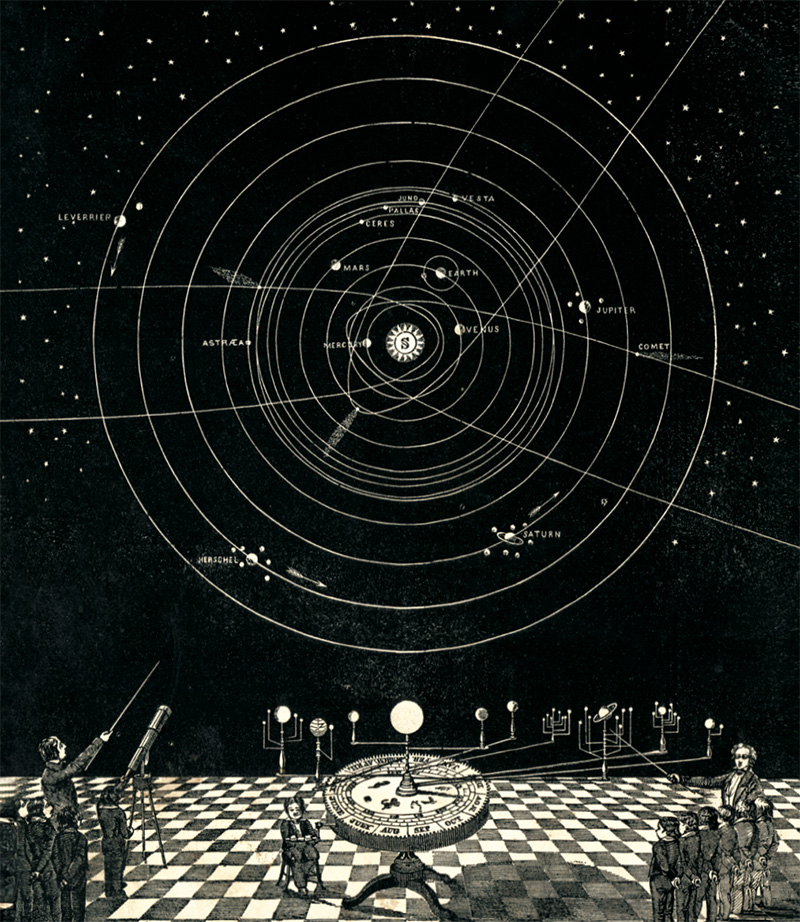
An illustration from Smith’s Illustrated Astronomy, Designed for the Use of the Public or Common Schools (Bazin & Ellsworth, 1848).
Written by Asa Smith, principal of Public High School No. 12 in New York City, the book includes lessons and charts for teaching, beginning with a lesson on the Ptolemaic system, the first question of which was “What is the body called upon which we live?”
In an interview last year, Seeyan said he sees the observatory as a window to the universe, a way to look into its vastness and seek meaning.
“Looking into the heavens—not in a religious sense—but looking into the heavens, you can see an infinite amount of stars. It’s hard to grasp the enormity of what the universe is, and you find yourself thinking about life, being lost in that view.”
Among its new attributes, the observatory has a refreshed dome that swivels and opens, allowing the telescope, with its 0.8-meter primary mirror, to point skyward and gather light from the far reaches of the observable universe. As light gathers and accumulates in its long optical tube, the scope will peer far into space, offering a glimpse of what is out there.
A Universe for the People
The Hill-Lam Observatory is a piece of the physics department’s plan to boost its observational astronomy program, an essential companion to its already strong theoretical and computational astronomy program.
McBride, an expert on black holes who joined Bowdoin in 2022 to steer the project, explains that observational astronomers collect and analyze data using instruments like telescopes, while theoretical astronomers use mathematical models and computer simulations to explain and predict phenomena that can’t be directly observed.
“Getting the chance to guide the entire program—that was just wonderful,” she says. Since McBride came on board, the astronomy offerings have expanded to include the courses Stars and Stellar Evolution, Galaxies and Cosmology, and The Physics of Black Holes. She’s hoping to launch a new minor in astronomy.
Once the main telescope is working, she foresees students confirming exoplanets orbiting other suns, collecting data about our own galaxy, and capturing long-exposure images of cosmic phenomena.
The observatory will also be a major force in propelling one of McBride’s priorities: she wants to make physics and astronomy more welcoming, less intimidating—to give everyone a chance to explore those worlds. Going forward, she plans to host community viewing nights at the observatory as well.
Physics, she laments, can put off would-be scientists with its reputation for demanding a Mensa-level intellect. The same goes for math. “These are the subjects people say, ‘Oh, that’s scary!’ and immediately react with ‘I’m bad at this,’” she says.
But astronomy, despite being a field firmly planted within physics and its universal laws, receives different treatment. Everyone relates to the night sky; everyone revels in its exquisite strangeness.
“If you’re sitting next to someone on a plane and you want them to talk to you,” she says, “you tell them you’re an astronomer. If you don’t want them to talk to you, you say you’re a physicist—though both are true.”
Because of this, the physics faculty call astronomy their on-ramp, or, with a guilty smile, they might say their “gateway drug.” “You get people hooked on astronomy and slowly introduce a bit of physics, and people say, ‘That’s not actually that bad. I can learn this,’” McBride explains.
Exposing students to the night sky is especially addictive. “I see students having this ‘aha moment’—a moment of awe for the universe and for nature,” says Professor Thomas Baumgarte, Bowdoin’s William R. Kenan Professor of Physics and an expert on relativistic astrophysics and numerical relativity. “It can be life-changing, truly. Different students are drawn to physics for different reasons. Some love the beautiful math, and others see the night sky and say, ‘Wow, this is it—this is what I want to do, it is gorgeous.’”
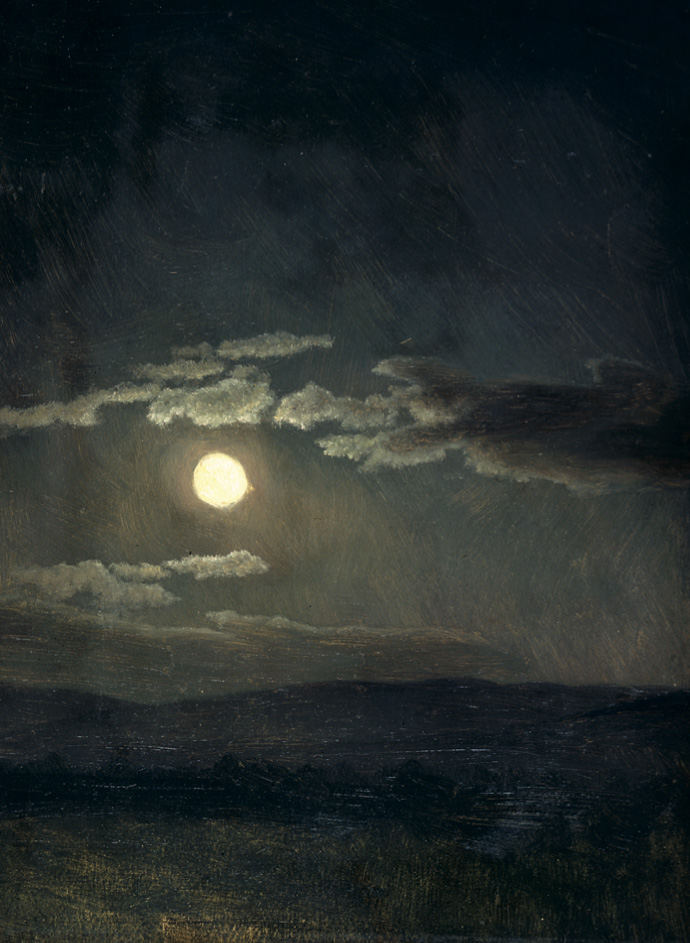
Cloud Study, Moonlight, ca. 1860, oil on paper by Albert Bierstadt. Bowdoin College Museum of Art (BCMA).
This painting was one of ninety works featured in the BCMA exhibition Night Vision: Nocturnes in American Art, a survey dedicated to scenes of the night in American art from 1860 to 1960, spanning an era not yet illuminated by electricity to the beginning of the Space Age.
The Eternal Night Sky
When they lose themselves in the enthusiasms of astronomy, students enter an age-old practice. The unending presence and ceaseless motion of celestial bodies have stirred human curiosity for millennia, inspiring religions, philosophies, and the beginnings of science. Among the earliest people to record the movements of stars and planets in a systematic way were the Babylonians of ancient Mesopotamia, around the second millennium BCE.
Bowdoin religion professor Robert Morrison, a world expert on the history of Islamic science, says “Just imagine it,” those early observers living in or near the desert thousands of years ago under dry, cloudless skies. “What’s compelling about the stars and planets,” he says, “is that they never seem to stop moving. They move in circles that are predictable. They are eternal. They don’t go away like we do; they never die.” (Today, of course, we know even stars have lifespans.)
Bowdoin professor Dallas Denery, an intellectual and religious historian, teaches ancient astronomy in two of his courses, The Good Life and Science, Magic, and Religion. In both, students read On the Nature of the Gods by Roman statesman Marcus Tullius Cicero around year zero.
In the book, written as a dialogue among philosophers wrestling with the nature of divinity, one of the sages notes the movement of stars through the heavens and asks, “What kinds of things move?” Denery explains the analysis that follows: “Well, rocks and dirt don’t move, but trees move—they grow up. And humans move.” The sage concludes that trees and humans move because they are alive, and if the stars also move, then the heavens, too, must be alive. “So, when you see the stars moving, you’re actually watching intelligent beings perform their daily motions—and you know they’re intelligent because their motion is so orderly.”
The study of the heavens would eventually lead to what we would call science today, though in ancient times, science bled easily into religion. “The universe was so attractive because it represented perfect knowledge. If God’s knowledge is perfect, then this must be a glimpse of what God is up to,” Morrison says. “Studying the stars set up intellectual life. Part of it drove what we now call science, and part of it drove religion—that is, figuring out what the gods want us to do.”
Early Islamic astronomers went on to create mathematical models of celestial motion with impressive precision—well before the telescope was invented. These scholars charted the movements of stars, planets, and uncanny phenomena such as comets, meteors, and supernovae to interpret how they were communicating and what they were saying.
“Astrology,” Denery says, “was considered a serious scientific pursuit. The idea was that things on Earth happen because they receive energy from the heavens. If you could understand how that energy is transmitted—its patterns—you might be able to predict events.”
For Cicero and other Stoic philosophers, the stars also offered inspiration for flawed humans. “It reflected a sense of order that you should model your own life on, because the gods are a model of existence,” Denery says. “As the stars move in a calm, orderly fashion and are not bothered by things, they are an ideal that we should follow.”
Following the Stars
Once they have gravitated to astronomy, physics majors have opportunities to collaborate with professors on advanced astrophysics research. As McBride has developed the astronomy program, she’s also been writing and publishing papers about active galaxies and the supermassive black holes at their centers and particle acceleration processes. Her student advisees have researched topics like ghost particles, black holes, and spitting blazars.
McBride offers a humanistic perspective on this work. “Astronomy participates in the deeper questions: we get to study our place in the universe, explore where we are coming from, what we are doing here, and if there is life out there that is not human—the big questions that drive a lot of fundamental science.”
Despite its otherworldly focus, this fundamental research in astronomy—and other fields—can result in tangible improvements in our lives, she noted. Astrophysics, for instance, gave us sophisticated camera chips and solar panels. She also alludes to the limitations of astronomy, a field that hits up against a reality that has a knack for slipping beyond our comprehension.
Though astrophysicists have made enormous advances in the past decades, they have not uncovered anything like all the secrets of the stars. “Physics can be frustrating because we can’t answer all the whys. Like, why do we have gravity? It just is,” McBride says. “But in the absence of answering the why questions, you can answer the how questions: How do black holes work? How do galaxies form? How did our Earth form? Is this a special planet? Is that why we have life, because it formed differently than other planets? We are starting to understand this, better than people two hundred years ago could have ever imagined.”
One of McBride’s advisees, Ava Biasotti ’26, is trying to determine the origins of high-energy cosmic rays by tracing the cosmic paths of their neutrinos or “ghost particles.” Since neutrinos have very low mass, they travel nearly at the speed of light, passing through everything—planets, stars, even human beings—without stopping, without being noticed at all (except by specialized instruments). Biasotti appreciates astronomy’s roots in the timeless human drive for knowledge. But she says it’s thrilling to be part of the field today because it’s picked up such momentum in the last century. “This is the one hundredth anniversary of officially knowing there are other galaxies in the universe,” she says. “It’s all very recent. One hundred years ago, people weren’t thinking about black holes. They had just realized the universe was larger than our galaxy. We’ve opened up this whole new world to explore.”
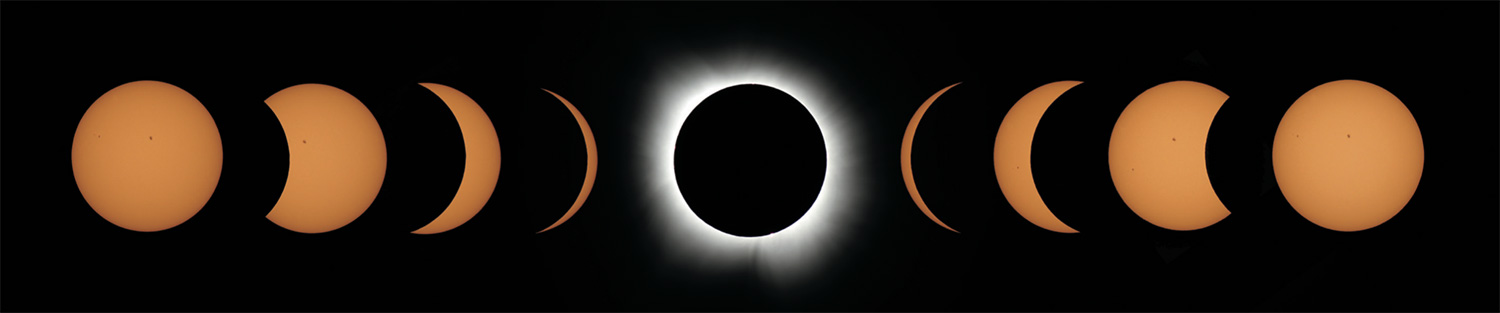
A series of photos of the April 2025 solar eclipse, by Nathan Bukowski-Thall ’26. The photos were taken in Jackman, Maine, in roughly twenty-minute intervals, beginning at 2:25 p.m., showing totality at 3:30 p.m., and ending at 4:30 p.m., and Bukowski-Thall stitched them together in Photoshop.
He used a Canon EOS M50 Mark II attached to an Evostar 72ED ApoRefractor telescope, tracking the sky with an iOptron SkyGuider mount. “I also built and 3D-printed my own solar filter, which was a ton of fun,” he says.
Wilder Mae Harwood ’24, now a second-year graduate student in observational astronomy at Brown University, worked with McBride to research the ultrafast particles and light outflows of black holes, called jets. “By studying black hole jets, you can learn a lot about what is the most efficient engine in the universe,” she says. “They accelerate particles, and make stuff move very, very fast. The question about how that happens gets people very interested, since you’re working with a high degree of energy and speed.”
Harwood views astronomy as a collective undertaking stretching across centuries. She likened it to the building of a medieval cathedral involving generations of workers. Quoting a barista she chatted with, she recalls, “He said astronomy reminded him of the cathedrals built in the 1300s, when generations of people worked on it. Physics is like that: A lot of people add to it, and you can watch it grow, even if you won’t see your part being completed.”
After finishing her degree at Brown, Harwood will decide whether to pursue a PhD or take another path. One possible road is writing—she’s already completed nine books, including science fiction novels that blend her physics background with questions on existence and humanity. “If you put a bunch of researchers in a room, you can usually spot the astro people,” she says. “They’re always looking for something beyond themselves.”
Nathan Bukowski-Thall ’26, a physics major, is seeking to publish research with McBride that introduces a new method for measuring the mass of supermassive black holes. The senior is also known for his astrophotography: he has captured the Eagle Nebula’s glimmering pink dust and gas cloud, the translucent green puddle of the Lagoon Nebula, and the lavender-tinted Triangulum Galaxy. One of his photos shows Orion, the great starry huntsman, and the dark Horsehead Nebula adorning his belt.
Bukowski-Thall first got hooked on stargazing when he was a kid, spending his summers on Cliff Island in Portland’s Casco Bay, away from the city’s lights. He says marveling at the stars has always made him feel connected to our ancestors.
“This is something we all have in common. We could never understand one another, but we all share this experience of sitting around a campfire and looking up at the stars.” Though Bukowski-Thall feels the tug of astronomy to the deep past, he’s geared toward its distant future. “I see it as if the whole purpose of humanity is to learn and understand the universe,” he says.
“Carl Sagan once said that humans are the way the universe tries to understand itself. I think about that a lot. Because of that, astronomy feels like the true and final purpose of humans. It makes me feel like I am playing a part in the progression of the world and society. A little bit.”
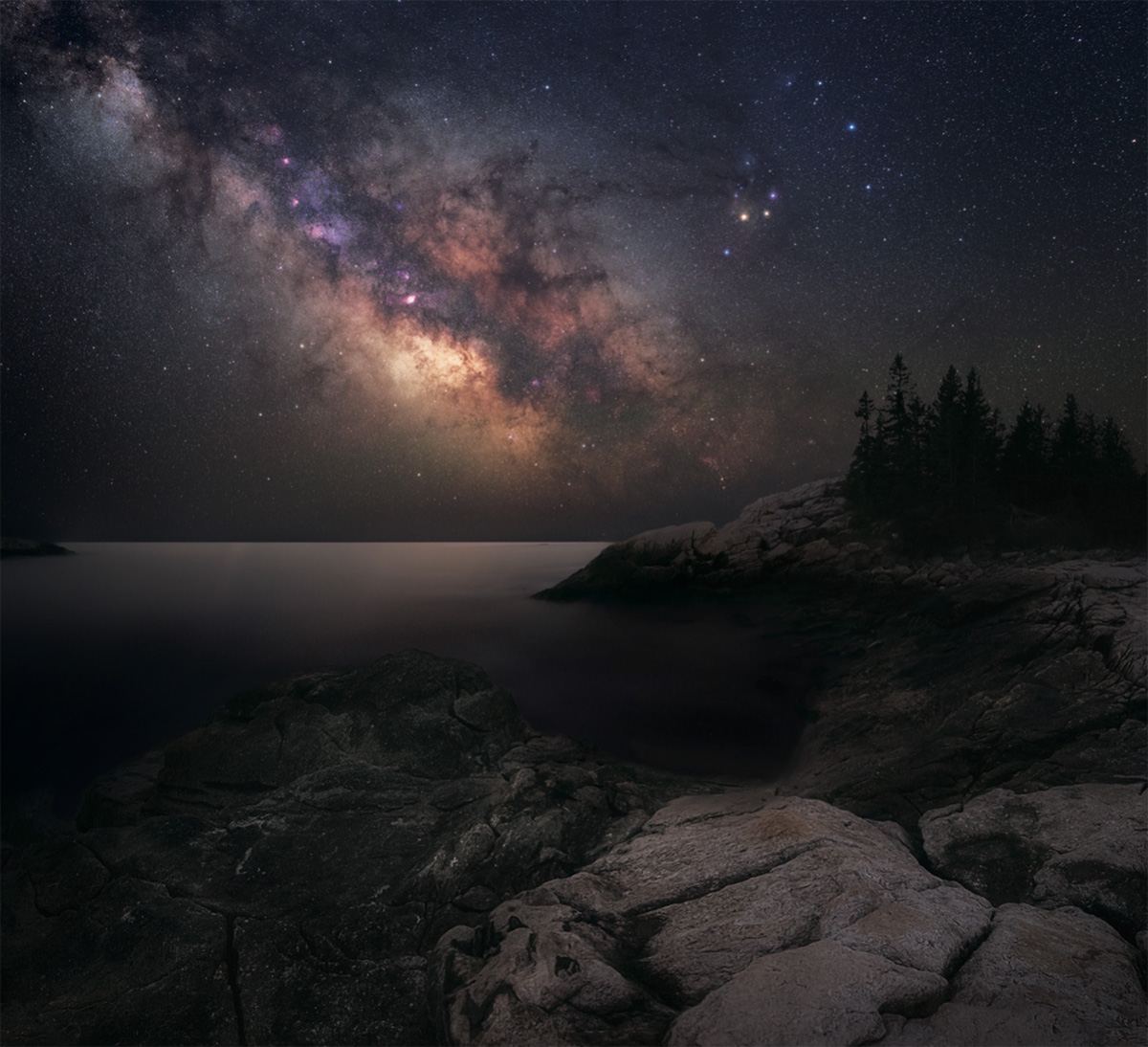
Seeing the Light
To keep people entranced by the universe, we need to be able to see it, which requires truly dark spaces. McBride is collaborating with recently retired physics lab instructor Paul Howell—an expert in telescopes—to help calibrate the new observatory telescope. Since he left Bowdoin, Howell has dedicated much of his time to the Southern Maine Astronomers club, which he cofounded with Brunswick resident Rob Burgess in 2004. One of the club’s central missions is to fight light pollution and restore the dark skies that once united the human experience.
“As we’ve learned more about light pollution, we’ve realized how serious a loss it is,” Howell says. “Humans have, until a blink of an eye, gone to bed outside or sat with their kids and pointed to the sky and created myths to connect us and retell our stories. It is a global asset. Different cultures create their own mythologies, but all of this is endangered.” Today, 99 percent of Americans live under moderately or severely light-polluted skies. Beyond cultural loss, light pollution disrupts circadian rhythms and harms wildlife adapted to the natural cycles of light and darkness.
“Every living thing on Earth evolved on a planet with no light pollution,” Howell says. Burgess, who serves on Brunswick’s planning board, credits Bowdoin for installing star-friendly lighting at its athletic fields that earned it a Dark Sky International certificate. He compares light pollution to earlier environmental crises. “People thought the rivers and streams were dumping grounds—nobody owned them and you could recklessly discharge things into that medium and it went away somewhere,” he says. “I think light is very similar in the public consciousness. It’s out there; it doesn’t seem to harm anything if it’s there or not there, but we are now learning how much it does affect everything.”
Including our ability to be awed. Nur Schettino ’24 says it’s critical to tap into our sense of wonder, especially “when so much of our work on a day-to-day basis is sitting at our desk and looking at a monitor.” He completed research with McBride at Bowdoin and is now a second-year graduate student studying neutron stars—or “stellar zombies,” the dense, magnetic remains of stars that sometimes consume their companions—at Friedrich-Alexander University in Germany.
Schettino recalls the story of a friend who spent time at the Paranal Observatory in Chile, where she got so absorbed in her computer simulations that she barely ventured outside. But one night she stepped out into the Atacama Desert and saw what she thought was a long cloud. It took a beat or two before she remembered: it was the Milky Way.
“We have our faces in screens, and we’re focused on the details of our work, and we forget what it is we’re doing on a grander scale,” Schettino says. But when you take a moment to look up, “it becomes easier to see the ways in which investing in science and the enrichment of our collective human culture and our understanding of the universe has a goal—it makes for a happier and more harmonious world.”
Happier? More harmonious? “Space is gorgeous, awe-inspiring, and evokes a sense of grandeur, but it is also remote, inhuman, and empty—and, perhaps, also scary,” Schettino says. “Scarily not us, not like us, not anthropomorphic, and I think that reminds us to decenter the human experience, which is humbling.”
When astronomy or any scientific pursuit, or even one’s own life “is approached with humility and a genuine desire for discovery,” he adds, “you can improve the world.”
Rebecca Goldfine, senior writer, works in the communications office doing research, writing, editing, photography, and video for the College.
This story first appeared in the Winter 2026 issue of Bowdoin Magazine. Manage your subscription and see other stories from the magazine on the Bowdoin Magazine website.