I Found a Theater
By Savannah Horton ’17 for Bowdoin MagazineEveryone knows the tropes about theater kids: they emote constantly, elbow others out of any spotlight, belt out Broadway tunes at the slightest provocation. It’s funny, and some self-proclaimed theater kids even cop to parts of it. But is it the actual story?
We reached out to Savannah Horton ’17, who had written for the Orient her senior year about “life as a washed-up theater kid” to see what she thought. What we heard was more about strength in vulnerability, the emotion that runs between an actor and an audience, and the way theater can serve as a hearth for humanity.
In my late twenties, I spent two years driving a dog and three duffel bags between eighteen cities across the US. Surrounding myself with strangers every month was an amusing challenge—learning the contours of a place, identifiying the common personality types—but finding a sense of belonging didn't get easier as I traveled further.
Bowdoin sets you up with a certain comfort when it comes to socialization. Extroversion is pretty much baked into our mission (see “To lose yourself in generous enthusiasms and cooperate with others for common ends”). But I struggled in Florida, then in Texas, then in Colorado to feel that I was “cooperating” with anyone. I attended paint nights alone, where I worked up the courage to exchange a few sentences with the women who had signed up together. I lingered with my laptop in rural coffee shops so I could get to know—read: bother—kind baristas.
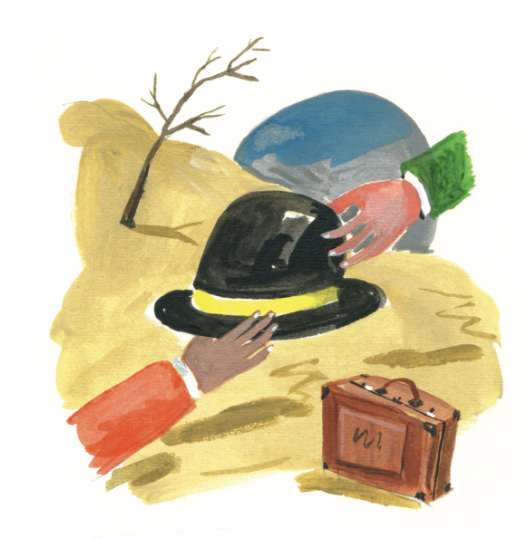
Despite my efforts, I couldn’t shake that angsty, teenaged feeling I thought Bowdoin had successfully trampled out of me: that I was up against the entire world. This is a gloomy way to feel when you are nearing thirty.
I should add I didn’t have to be traveling. No one was forcing an itinerant lifestyle upon me. I was restless and curious and felt coddled by New England. I felt I didn’t know my own country.
I mostly adored the freewheeling nature of life on the road, the luxury that I could leave a place, and it would instantly forget me. I worked remotely and could sustain myself while sightseeing in Joshua Tree or the Garden of the Gods. In every way but one, it was a complete privilege—I hadn't thought of myself as a solitary person and still didn't, but that was exactly what I'd become.
I was renting an apartment in Las Cruces, and I was, as I’ve said, lonely. Las Cruces hugs the heart of the Mesilla Valley. Thick-walled adobe bakes in the vast Chihuahuan Desert at the base of the ragged Organ Mountains. The world around the little city is enormous. The sky is so empty. I knew one person in a thousand-mile radius, so I decided to do what I’d done as a child whenever I wanted to experience a sense of belonging.
I found a theater.
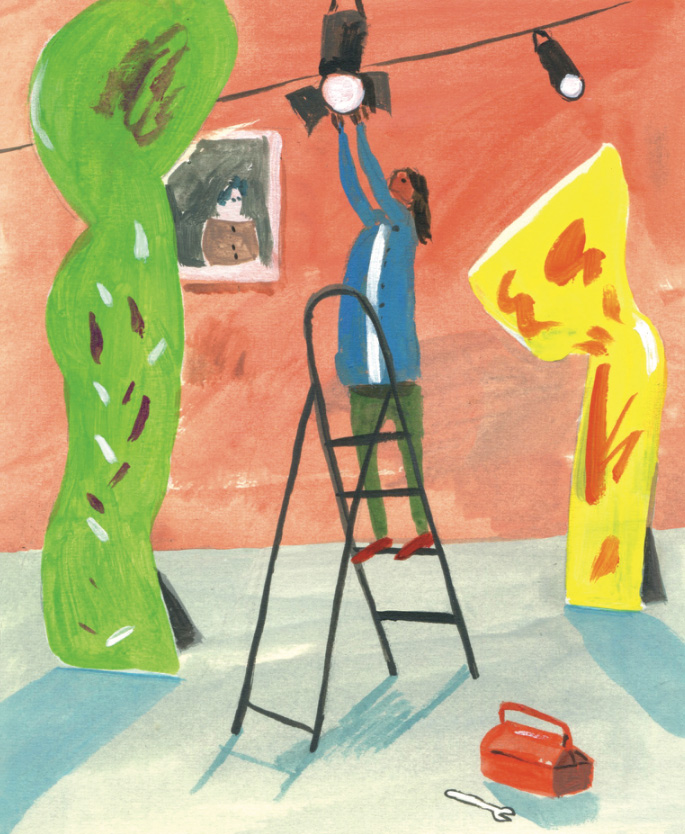
Every community theater smells the same.
See a musical in El Paso or Fort Collins, and you’ll catch a whiff of open paint cans and sawdust. That pervading mustiness of heavy curtains unfurling. Thick, faded carpets—all of it like the building just pushed open its doors for the first time in ten years. Cooling coffee. Sometimes, if you’re lucky, red wine.
When I stepped into the Las Cruces Community Theater, the smell sent me back two decades to the Fiddlehead Theater and my first audition, for Annie. (Pretty much everyone’s first audition is for Annie.)
The scene lived right behind my eyes. See the line of girls across the neon-taped stage. Narrow rows of crimson red seats. A mint-colored dungeon that is the frigid greenroom. A mini loaf of cornbread from Boston Market to scarf down before the callback. I was seven and squawking through an animated rendition of a song I was a decade and a half too young for—“All That Jazz”—with the confidence of a goose.
Smell is our most nostalgic sense, apparently. Smells don’t require emotional processing. They’ve got a central line straight to our brains.
When I smelled that theater smell in Las Cruces, I wasn’t auditioning. All I was doing was sitting in the audience of Merrily We Roll Along. But a few feet into the building, I was already tearing up. During the overture, my eyes were streaming. By curtain call, I was trying to suppress my sniffles so my neighbors wouldn’t smirk about me later in their cars.
My reaction was visceral, automatic, and strange. I didn’t think about theater in my day-to-day life. At Bowdoin, I’d participated in one small-scale musical production, where I managed to scar my poor family for years to come (don’t do Spring Awakening unless you want your parents mentally connecting you forever to the idea of sexual frustration). But watching Merrily We Roll Along, alive and alone, I felt a wave of transformative nostalgia.
For the rest of my travels, I made a point to see a community theater production wherever I stopped. It was the closest I’d felt, in a long time, to fitting in.
Some people find community theater kind of embarrassing.
I get it. Coming to terms with a love of theater is coming to terms with one’s inner dork. Some people outgrow that inner dork in middle school. Some people weren’t eight-year-olds sniffling in the backseat of a minivan to “Goodbye Love” from Rent. Some people didn’t spend their teenage summers playing Zip Zap Zop and dressing in group costumes every time they left the cabin at theater camp.
But many have experienced the kind of glee I felt as a theater kid when they are at a Bowdoin lobster bake. Or at Ivies. Or at Reunion. Did you want to laugh and cry at the same time? That’s collective effervescence—the physical reaction to heightened emotion during a shared experience.
Theater kids learn about collective effervescence early. They understand what it’s like to build worlds together from words on paper. It’s easy to mock these enthusiastic rascals, but they develop a rare earnestness. Another artistic community almost drained that from me.
I need to back up.
Before embarking on my cross-country tour, I obtained an MFA in creative writing. Over the course of the program, I felt confidence flee my body like a startled deer. I was familiar with rejection, but I was less prepared for the morbid, halting isolation that was novel writing. At Bowdoin, my fiction workshop was the highlight of my week—three hours of discovering new favorite short story writers in the wood-paneled warmth of Massachusetts Hall.
Now, in graduate school, I was drafting, querying, submitting, and, ultimately, shelving a project I’d spent years on. Writing was no longer adjacent to book club, where we gushed over sentences we loved. Writing was publishing.
My cynicism grew to an all-time high when my program ended. I felt as though anyone else’s success—which I rarely saw as deserved—directly impeded my own. It was easy, then, to convince myself I was living as the most authentic version of myself because I was unhappy.
It can be fun to be sardonic. Cynicism makes you feel that you understand the grooves of the world more deeply than everyone else simply because you dislike it. The literary community I’d entrenched myself in seemed just as jaded, cynical, and condescending as I was.
Ultimately, I came away from this creative outlet wanting absolutely nothing to do with it. My ideas no longer felt valuable; my perspective wasn’t interesting. I second-guessed everything I said or wrote.
Stepping inside a theater had the opposite effect. All I wanted to do, after seeing a show, was find a group of enthusiastic thespians and try what I hadn’t wanted to try in a very long time: to have fun, to tell a story.
Last September, I finally settled—in Rhode Island. It’s the real deal. I own furniture. I transferred the title of my car.
When I first arrived, I understood that to make this place a home, I had to thoughtfully build a life. I knew no one in the area except for family, and I refused to let my circle solely contain blood relatives. I gave myself two months to procrastinate before committing to auditioning for a musical. It was pathetically terrifying. I made the nauseating trip to Staples to print out sheet music. I YouTubed vocal warm-ups whenever I drove somewhere.
Then, I auditioned.
It went poorly, and I called my mom. Still, I felt so giddily proud for putting myself out there.
Miracles happen, apparently. I was offered an ensemble part—a made-up role for Into the Woods, let’s be clear. I might have been the most excited person in history to accept a chorus role. I cried as soon as I hung up the phone.
As was the case when I auditioned for BOKA while at Bowdoin, I assumed I was a personality hire—which I recognize is being generous to my personality—but when I got that call, I cared less about being on stage than about what the casting granted me: a community.
Returning to theater has softened the cage my body and brain built around my emotions in the name of maturation. When I walk into an auditorium, I feel the relief of being unmoored, of working with people who are fully present.
Theater is helping me defrost. I’m learning to talk to people again without wondering whether they find me unintelligent or dull. I’m learning to collaborate, to not take myself too seriously.
There simply isn’t time. A performance is ephemeral and distinctive. You can’t agonize. You’re on a schedule. You’re important, but you’re not the most important. On stage, everyone is essential, but no one is the center of the world. That’s a pretty crucial lesson.
People have this idea that kids who do theater believe they’re Earth’s protagonists. Maybe that’s a little bit true, especially if you’re snagging lead roles left and right—Young Cosette, Baby June, Gavroche—but for most former theater kids, performing was more shame spiral than ego boost. The only time theater kids actively need to be stopped is at theater camp, where everyone is as concerned with kissing as they are with bowing last at curtain call. Otherwise, they deal with more than enough humiliation. I once played the role of Sugar Cube, during which I wore a silver morph suit (hood and all), a three-by-three-foot cardboard box with arm and leg holes, and tap shoes.
Theater shakes your confidence as much as it builds it up. It can breed irritating preteens (the singing my mother endured in the car after Wicked came out in 2004 was objectively torture), but it can also create adults comfortable showcasing themselves despite fears of failure and rejection. It can foster empathy through storytelling; it can shape people willing to see all sides of a conflict. To be a theater kid is to understand the importance of sincerity. Of being goofy. Of embarrassing yourself. Of screwing up and moving on without dwelling on how things could have gone differently.
The irony, of course, is that my own contributions to theater have never been talent-based. In elementary school, if you’re motivated enough to climb on stage and belt out sixteen bars of “Castle on a Cloud,” congrats, you’re in the cast! Even better if you have an overbite, so far the only time in my life where this feature has benefited me. As an adult, my singing is mediocre, and my dancing is worse. I’m not fishing here. My mom can confirm.
But from the beginning, theater people have made me feel necessary. For the simple reason that I wanted to be there.
It's easy to feel the same type of spirit at Bowdoin, where everyone is curious and candid and cooperative, no matter their area of interest. You can say that’s because the safety net of Bowdoin is coddling. But Bowdoin nurtured in me a desire to pursue art for art’s sake. It reassured me that I mattered within a community and that I could benefit from being vulnerable.
Four years out of my MFA program, and I still barely trust myself to organize words, on paper or aloud. My creative confidence took such a dip post-Bowdoin that even my tepid forays into Dungeons and Dragons every Monday make me nauseous—what if I can’t think of anything funny or useful to say?
But my confidence is growing. And I have community theater to thank, as cheesy as that sounds. Performing has reminded me why I was drawn to writing in the first place. Theater is one of the oldest forms of storytelling. It exists to share an understanding. It holds up a mirror to an audience and makes them feel something.
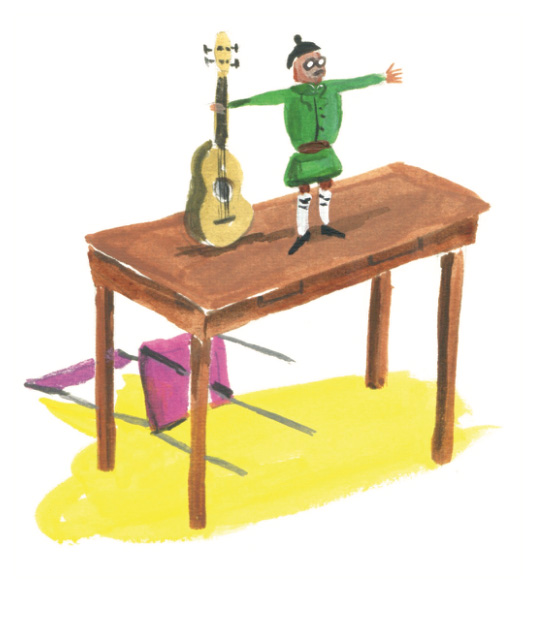
It’s been freeing to jump onto a stage where every person has just worked a day job. No one is expecting to get famous or even to get paid. It’s just a group of grown-up theater kids pulling their weight, committing themselves to telling a story just for the sake of it. Like I said, maybe that’s lame. But I tear up even thinking about it.
To the possible dismay of my future spouse, I will encourage my children to try theater.
Sending a child to an acting camp or dance class is like throwing them simultaneously to the wolves and the teddy bears. And that’s important, I think. Theater is risk and reward. It’s playing pretend. And playing pretend takes a human being out of their innately egocentric mindset.
Children deserve access to these communal, creative spaces. They should learn the discomfort of collaboration that comes before the euphoria of it. They need a steady spout of encouragement. They need theater, because theater ensures there are people still carrying the fire when the human spirit is dim (thank you, Cormac McCarthy, for that killer line).
What more can you ask for, at the end of the day, than a hopeful child?
I guess maybe a hopeful child who grows into a hopeful adult. Like me.
Savannah Horton ’17 is a content editor and writer who majored in English at Bowdoin and earned an MFA at the University of Florida. Her work has been published in The Metropolitan Review, The Rejoinder, and The Drift, among other publications.
Robert Nicol is an artist, educator, and illustrator based in Norfolk, England. He is a graduate of the Glasgow School of Art and the Royal College of Art.
This story first appeared in the Winter 2026 issue of Bowdoin Magazine. Manage your subscription and see other stories from the magazine on the Bowdoin Magazine website.