For Willi Lempert, the story began when he studied abroad for a semester in Australia as an undergraduate back in 2006. He was there to pursue ethnographic fieldwork about Aboriginal communities and was struck by the important role filmmaking has within those communities.
“I went to this small town in northwestern Australia called Broome, where I had initially planned to focus on Indigenous songs and music, and I was amazed by the amount of other media being produced, particularly in film and television,” said Bowdoin’s Osterweis Family Associate Professor of Anthropology.

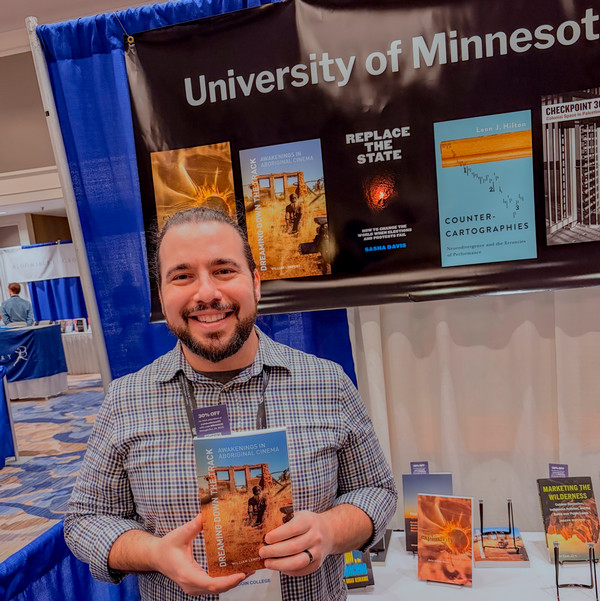
Lempert’s first full-length book explores the world of Aboriginal filmmaking and its importance to Australia’s Indigenous communities. Dreaming Down the Track: Awakenings in Aboriginal Cinema (University of Minnesota Press, 2025) asks “What can Aboriginal filmmaking reveal about Indigenous presence and futures?”
“Over the last four or five decades,” explained Lempert, “Aboriginal communities have used the medium of filmmaking as a way of expressing themselves and telling their stories. Consequently, they have a strong presence on national television, plus a national satellite network showing video content specifically for Aboriginal communities,” he added.
As a postgraduate student, Lempert volunteered on various Aboriginal film projects and began learning the ropes. “I was a ‘floater,’ and volunteered on a number of different projects.” Lempert returned to Australia several times over the following years, spending a total of nearly three years in the country between 2012 and 2019, before the pandemic prevented any further visits until 2023. The longest he spent there was twenty months between 2014 and 2016, when he pursued his PhD at UC Boulder (his thesis title was “Palya Futures: The Social Life of Kimberley Aboriginal Media”).
Lempert developed his filmmaking skillset over those years, though he never went to film school. “I took one or two video production classes to acquire basic proficiency, but my film school was in the Western Desert of Australia under the guidance of Aboriginal media makers. I learned on the job.”
Dreaming Down the Track examines Aboriginal cinema as a transformative community process, following several projects throughout their production cycles, from planning and editing to screening and broadcasting. The book specifically examines the career of one filmmaker—Mark Moora, a Kukatja elder in the community of Balgo—as a way of showing the impact of filmmaking on Aboriginal communities and how they view themselves.
Moora, who died in 2020 in his seventies, took up filmmaking during the final several years of his life, using cinema as a process for catalyzing his struggles and those faced by many Aboriginal people, said Lempert. “He's one of those people whose life speaks to the broader scope of Aboriginal experiences: Born in the 1940s, Moora walked with his family into a mission.* After helping to build an Aboriginal community during the early years of the Aboriginal rights movement in the 1950s and ’60s, he traveled beyond his community. Moora went to live in other missions, becoming a very accomplished stockman [managing livestock] and a horse whisperer. He lived in various cities and towns.”
Moora then returned to his community, got married, and set up an outstation on his traditional homeland, said Lempert. This outstation was initially very successful, but ended up failing after the government began asserting control over the community. After this, Moora found himself at a low point. This is when he became involved in films, explained Lempert, both as a director and as an on-screen presence. “He's done so many things, and film was a final chapter in his life, where he went from a low point to being inspired. Moora was the voice and vision for many Aboriginal short films, some of which I had the privilege to work on.”
These films, Lempert said, have attracted a lot of interest born out of a fascination with traditional concepts such as Aboriginal Songlines—ancestral pathways across Australian landscapes encoded in songs, stories, and art—and Dreaming, the mythical realm and time when Aboriginal land was created, along with its plants and animals. The films engaged these and many more topics, remarked Lempert. “For example, Aboriginals have the world’s oldest sign language, and many of their films feature this hand signing.”
A final point Lempert wanted to stress, which is also emphasized in his book, is the sense of humor that comes across in the films. “There is so much sadness in Aboriginal history, which is largely a story of displacement, cultural suppression, and generational trauma. Consequently, you might expect their films to be dark and apocalyptic, but they have a lot of lightness in them.”
The process of filmmaking, Lempert explained, brings together the multidimensional elements of Aboriginal life. “I think there’s something about the medium that helps Aboriginal cinema not just to tell stories of people going through struggles—which can be flattening and one-dimensional—but also to tell stories containing laughter, joy, and all of the other aspects of being human. This is something I’ve tried to honor in my book.”
*Missions were set up by the Australian government after World War II to try to assimilate and control the Aboriginal population. Read more.

Tjawa Tjawa: A story from the Ngarti people in the Great Sandy Desert in Western Australia, spoken in Kukatja, recorded in 2015. (The above image is a screenshot from Tjawa Tjawa.)
Old Balgo Mission: Elder Mark Moora recalls his early years growing up on a mission in Western Australia.