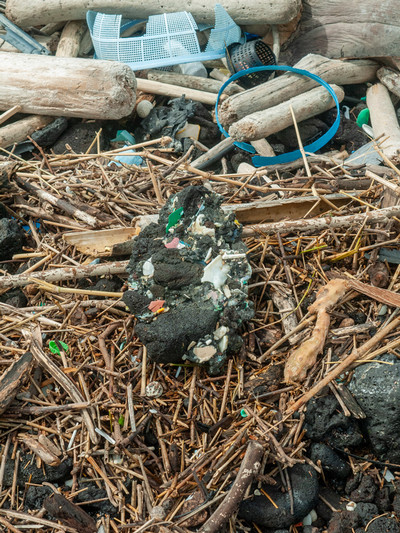
As humans make fires on the beach, far-flung plastic that has washed up there melts and fuses permanently with volcanic rocks and sand. Geologists believe these hybrids of human and natural activity will most likely enter the fossil record to serve as markers of a new geological age.
Professor of Art Michael Kolster suggests that these “mongrels” of the natural and man-made provoke us to rethink how we see ourselves, our planet, and ultimately, what we deem to be “natural.”
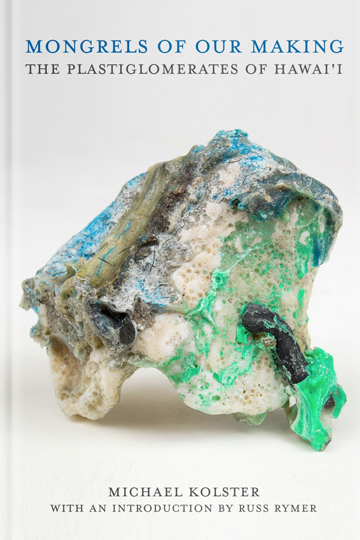
In his latest book, Mongrels of Our Making: The Plastiglomerates of Hawai‘i (George F. Thompson Publishing, 2025), Kolster takes us to Hawaiʻi’s “Big Island,” more specifically to Kamilo Point.
Thanks to its location near the southeastern tip of the island, Kamilo is ideally situated to receive plastic and other items floating in the ocean, as they are washed ashore by a system of currents called the North Pacific Gyre (part of which includes the so-called Great Pacific Garbage Patch), one of five ocean gyres in the world.
The debris that has accumulated and, despite ongoing cleanup efforts, continues to accumulate here, has earned Kamilo the moniker “Junk Beach.” It is also where horizon markers of what is likely a new geological age are being forged, explains Kolster.
“Due largely to campfires set by beach visitors, much of this plastic has melted and fused with the volcanic rock and sand on the beach to form what some geologists term ‘plastiglomerates.’ These same geologists believe the plastiglomerates might eventually enter the fossil record to mark the beginning of what's possibly a new geological age.”
Kolster is referring here to the Anthropocene, a term increasingly used by scientists to describe a possible new era distinguished by the permanent alteration of the planet due to human activities.
“I can imagine these plastiglomerates being exhumed millions of years from now by extraterrestrial archaeologists!” Other places where plastiglomerates can be found include the beaches of Portugal, India, and the UK.
An acclaimed photographer, Kolster has visited Hawaiʻi a couple of times over the past decade to explore Kamilo beach and capture images of these hybrids. The resulting book features nearly 150 photographs and some 13,000 words of text by Kolster, plus an introduction by author and former Bowdoin faculty member Russ Rymer. Kolster also collected samples of plastiglomerates from Kamilo that he sent back to Maine to photograph in his studio upon his return.
Most of the photographs were made as stereos, where two images of the same subject, when placed side-by-side, can be viewed in 3D. Kolster hopes that seeing these objects with two eyes encourages viewers to know them better than if seen with only one. He hopes that others recognize them as profoundly complex and nuanced as “mongrels,” or hybrids, of the human and natural realms.


Mongrels of Our Making underscores the significance of where these “mongrels” are forged: “paradise” in the imaginations of most, according to Kolster. Flowing directly out of this image of the paradisial, he says, the plastiglomerates show us how it is increasingly difficult, and perhaps even pointless, to differentiate human activities from natural processes.
“We can't separate them anymore in our minds, which means this nature-culture divide we reflexively employ as we regard our surroundings, even in our so-called paradises, might not be accurate or useful—that we have to seek new ways to see the world and our place within it.”