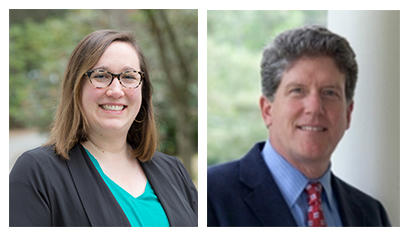
With a record $9.91 million in gifts from 7,832 alumni donors to close out the Alumni Fund’s 2020 fiscal year that ended June 30, Senior Vice President for Development and Alumni Relations Scott Meiklejohn and Director of Annual Giving Christi Lumiere provide their unique insights into the value of the 1794 Society’s contributions and where the College goes from here.
How did Bowdoin pivot its fundraising efforts amid the COVID-19 global pandemic?
Christi Lumiere: “Pivot” is the word of the year! In mid-March, when the College transitioned to remote learning, we decided to pause on all fundraising activities to allow time for everyone to adjust to all of the changes caused by the pandemic. Unfortunately, that meant canceling our annual day of giving, BowdoinOne Day, and pretty much everything else we had planned for March and April.
Scott Meiklejohn: As we thought about resuming our fundraising efforts, we wanted to give alumni the opportunity to direct their gifts in ways that would make a direct, immediate impact amid the pandemic. In addition to the Unrestricted Alumni Fund, we identified three key areas: maintaining our commitment to Financial Aid; establishing a COVID-19 Response Fund to address the specific needs of students during the transition to remote learning; and supporting the senior class and the president’s promise to hold Commencement on campus next year with a Class of 2020 Commencement Fund.
On May 12, we launched our Spring Priorities project to highlight those four areas and how funds would be used to support students, faculty, and staff. This approach was new and different for us, and the feedback from alumni was very positive.
Christi Lumiere: We really missed the personal contact that is normally such a big part of our work. There’s something magical that happens when you are face-to-face—whether it’s a meeting over coffee with some volunteer class agents, relaxing on the Quad during Reunion, or enjoying an alumni dinner hosted by a fund director. The conversations, ideas, support, and feedback—all of it informs and energizes the work we do in the Alumni Fund. While we held a lot of Zoom gatherings and phone calls, I know the team and I are looking forward to the days when we can all be face-to-face, safely, again.
Why is the 1794 membership such a vital part of the Alumni Fund?
CL: Alumni who support the College at this level are investing in the Offer of the College. They’re sustaining Bowdoin’s promises to remain need blind and no-loan, to provide an extraordinary academic experience, and to support students in their career development. The nearly $8 million received from 1794 Society members this past year enabled Bowdoin to react quickly and provide our students, faculty, and staff with the resources we needed to move to remote teaching and learning. We are so grateful to this loyal cohort of alumni donors.
What would the current financial picture look like without this generosity?
CL: In the 2019–2020 fundraising year, 78 percent of Alumni Fund revenue came from gifts from 1794 Society members. The Alumni Fund represents 6 percent of Bowdoin’s total operating budget each year. Six percent may sound low, but when you begin shaving off 6 percent of every student’s experience—financial aid, funded internships, academic resources, and all of the other opportunities at Bowdoin —you can see the impact of the Fund on the life of each and every student.
President Rose has predicted that the College will face its most significant deficit in its history in fiscal 2020–2021. How will this impact the student experience, the faculty, campus operations, and capital projects—and how can the 1794 Society help?
SM: Bowdoin has weathered other challenges, and we will emerge from this one. In the short term, we have the resources to navigate this next year—and to insulate financial aid and the academic program especially—from any impact. This is mostly through heavy use of our cash reserves. We also have enough resources to push ahead with new initiatives, such as our recent announcement that all students at Bowdoin will have an iPad Pro for the school year. We’ve adopted some expense reductions, and we are laser-focused on using resources to support students and to deliver an exceptional academic experience. I would guess that support of Career Exploration and Development (CXD) will be one area that will remain very important in the year ahead. If the economic recovery is slow or flat and the Class of 2021 faces challenges similar to this year’s seniors, we will need the Bowdoin community to help out.
What cost-saving measures are being implemented by the College?
SM: All major capital projects are on hold. Salaries are being kept level to last year except for our hourly staff, who are getting small raises as we keep our focus on supporting the lowest-paid members of the community. The senior officers are taking a 10 percent reduction in compensation, and retirement contributions for all employees were cut by half.
CL: In addition, every department has been challenged to find ways to reduce costs. In the Office of Annual Giving, we significantly reduced paper mailings; canceled all travel and in-person events; moved video production and editing in-house, and found creative ways to leverage existing technological resources. We’re most proud that we built our entire spring campaign using our systems, rather than investing in a crowd-sourcing giving platform, and that we held a three-week staff “phonathon" to remind alumni about year-end by stitching together three technologies, rather than committing to an expensive calling platform.
What are the College’s plans for the comprehensive From Here campaign during Fiscal Year 2021—and will its priorities, timelines, or other aspects be affected by the pandemic?
SM: We haven’t made any adjustments to the campaign goals or timetable. We finished the year with more than $344 million in gifts and pledges toward the $500 million goal, and the campaign total grows every day. Campaign activity since March has been slower, obviously, but still we added about $40 million from the February kickoff through the end of June. The focus on access and opportunity, the strength of the academic experience, and exceptional choices driven by a world-class CXD program seemed right two years ago and even more right now. We are proud to keep telling that story, and we hope that alumni will continue to have confidence that our resources go to the heart of the Bowdoin experience.
How is Bowdoin’s fundraising effort adjusting to the many unknowns posed by the pandemic and an uncertain economy?
SM: One of Bowdoin’s strengths is our community of volunteers—the fund directors, 1794 Membership Committee, class agents, reunion chairs, and other alumni—who partner with us to generate support for the Alumni Fund and the College generally. That remains the foundation of fundraising at the College, and much of it is not affected by current events; although, like everyone else, we’re living on Zoom and Teams for the time being.
What is Bowdoin’s greatest financial need right now?
SM: The Alumni Fund has been a difference-maker for 150 years, so we hope that every conversation about giving to Bowdoin starts with sustained loyalty to annual gifts. Beyond that, and for those who can help with capital contributions, the From Here campaign is all about endowment for our central priorities—financial aid, our academic strength, and CXD. Bowdoin has a lot going on so, of course, there are always other projects, but if we do well with the Alumni Fund and with endowment for those three areas, the College will continue to be one of the best in the world.
CL: I would also add that never before has the purpose of the unrestricted Alumni Fund been clearer: these funds enable the College to remain flexible to the greatest needs of the moment. When the pandemic hit and we swiftly pivoted to remote learning, the unrestricted Alumni Fund was an important source of funds that helped to alleviate the financial burdens of sudden travel, shipping of personal items, and lost work-study wages.
What was the biggest lesson learned from all of this that will carry forward to Fiscal Year 2021?
CL: I’ve been at Bowdoin for two-and-a-half years and, prior to the pandemic, I had been continually moved by the generosity and support of our community—but the level of engagement, dialogue, financial support, and words of encouragement following our move to remote teaching, learning, and working further cemented for me just how special this community is. I enter the new fiscal year with so much gratitude.