Chlorophyll fluorescence emission: scaling from the leaf to satellite remote sensing 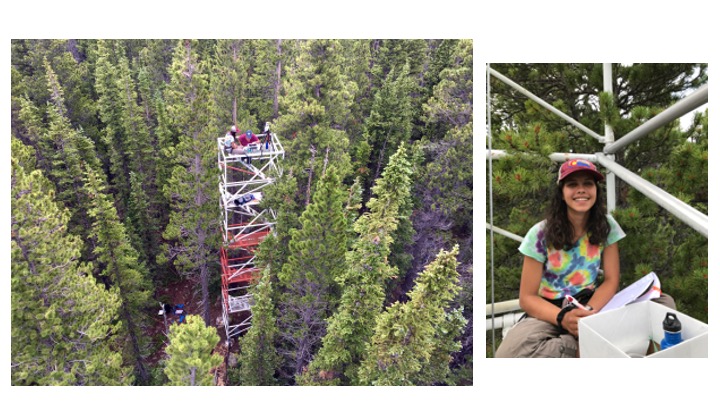 –Chlorophyll, the green pigment in leaves, exhibits the unusual feature of re-emitting a small fraction of the light it absorbs; that is, it fluoresces. For decades, physiologists examining individual leaves have used the strength of fluorescence emission to probe the inner workings of photosynthesis and leaf responses to environmental stress. Only recently, instruments capable of measuring chlorophyll fluorescence have been mounted on towers and satellites, allowing for remote sensing of the fluorescence of whole forests. We partner with collaborators at Oregon State University, Boston University, the University of Montana, the University of Utah, and elsewhere to understand how remotely sensed chlorophyll fluorescence might deepen our understanding of forests and their response to global climate change.
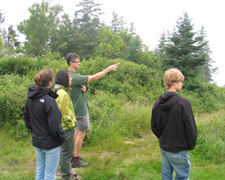
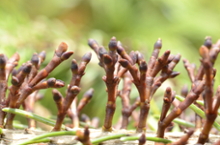 The ecophysiology of eastern dwarf mistletoe infection –Eastern dwarf mistletoe, a diminutive parasitic plant, can fell a mature white spruce in a matter of years. Curiously, a closely related host growing in adjacent forest stands, red spruce, tolerates infection and even succeeds in killing the parasite. Students, collaborators, and I seek to determine the causal chain of events leading to white spruce mortality and contrast it against the mechanism of red spruce tolerance, drawing upon observations at scales from gene expression and hormone metabolism through whole–tree growth and stand dynamics. The host-parasite interactions we study are shaped by 19th-century removal of red spruce/fir-dominated forests to create pastureland that was subsequently abandoned and recolonized by white spruce. We conduct this work at several sites along the Maine coast, including Monhegan Island.
Jaret Reblin, Associate Director of the Schiller Coastal Studies Center and Laboratory Instructor in Biology, is a close collaborator on many aspects of these and other projects.
Art, Ecology, and the Resilience of a Maine Island: The Monhegan Wildlands – Monhegan Island lies ten miles off the Maine coast, the outermost island of Muscongus Bay. The Monhegan Wildlands -the unbuilt ~80% of the island in conservation- experienced a dynamic history involving the felling of forest for pasture, pastureland abandonment, the introduction and eventual removal of deer, and the preservation of an ancient forest in the island interior. Monhegan Island has been a renowned artist colony for over a century. Painters and photographers have depicted this dynamic landscape since the middle of the 19th century. In a collaboration with Frank Goodyear (co-director of the Bowdoin College Museum of Art) and Jennifer Pye (director of the Monhegan Museum of Art & History) and numerous other contributors (including Bowdoin undergraduates), we describe the dynamic history of the Monhegan Wildlands and its stewardship by bringing together works of art, cartography, and illustrations of ecological phenomena. This culminated in exhibitions at the BCMA that opened in December, 2024 and the MMA&H in July 2025, and an accompanying catalogue published by Rizzoli. We actively pursue other opportunities to explore the intersections of art, ecology, and community relationships to natural spaces.