Bowdoin Graduate Offers Disability Program for Local Youth
By Rebecca Goldfine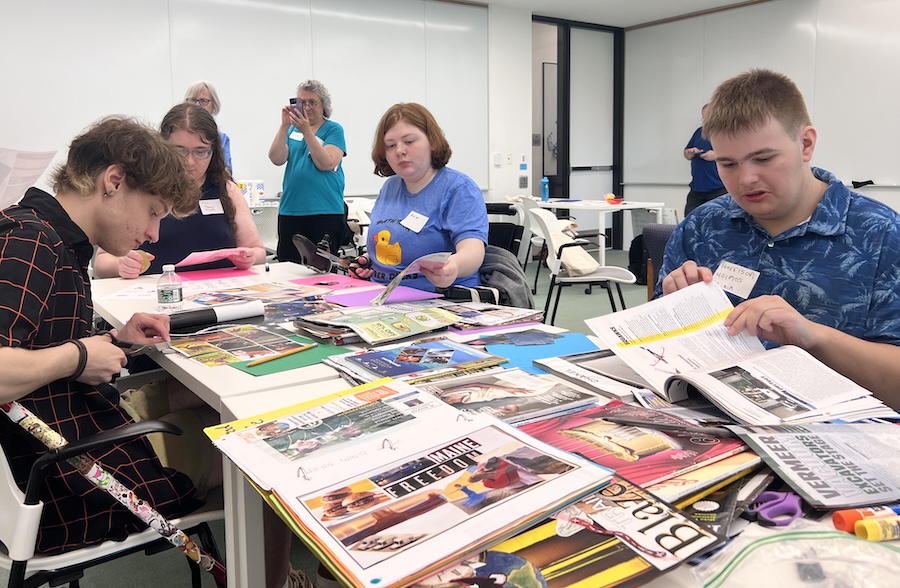
“It was the first time I could be me,” said Bea, a high schooler from Bath. Her words came after four days of making art, writing poetry, dancing, and talking with other teenagers about their lives. By that point, she added, the group felt like a family. “There's not a ton of people who relate to me. It was really nice to make friends and be with people who understand."
Creating that sense of belonging was what recent graduate Riggs had hoped to generate when she designed Telling Our Power: A Creative Self-Advocacy Program for Disabled Youth in Maine.
Supported by a $10,000 Projects for Peace grant, Riggs was able to offer her program for free. Any one in the nearby area with any kind of disability between the ages of fourteen and twenty-two was welcome.
Projects for Peace is a philanthropy based at Middlebury College that funds college students with grassroots solutions for fostering peace around the world.
Riggs said the kind of connections that Bea described are a path to a more peaceful world. “When disabled young people can express themselves authentically and build community with others, that’s a form of peacekeeping, because it reduces isolation and strengthens understanding and creates a community where people feel seen, heard, and valued.”
Envisioning Bright Futures
Riggs was motivated to offer the program after recognizing how essential creative writing had been to her as a child growing up with a physical disability. It helped her find her voice and gave her confidence, she said, allowing her to become the effective disability advocate she is today. At Bowdoin, she was co-president of the Disabled Student Association, a student delegate on the Accessibility Task Force, and a neurodiversity programming assistant at the Baldwin Center for Learning and Teaching. She pursued a self-designed major in disability studies and government. The College recognized her achievements this spring with the Michael F. Micciche III Award.
“I wanted to give that to the next group of young people,” Riggs said. “The arts have always been a powerful way to tell stories, and I wanted participants to recognize that their experiences have value and can lead to change.”
From July 7-10, Riggs scheduled workshops with local artists, writers, and staff from community nonprofits, both to tap into their expertise and also to broaden participants' awareness of who in Maine is working toward disability justice, she said.
“Through all of that,” she said before the week began, “I hope the program will foster creativity and leadership, and that participants won’t just learn artistic skills, but also explore disability culture and practice self-advocacy and connect with others with similar experiences. So they see themselves as creators and change-makers.”
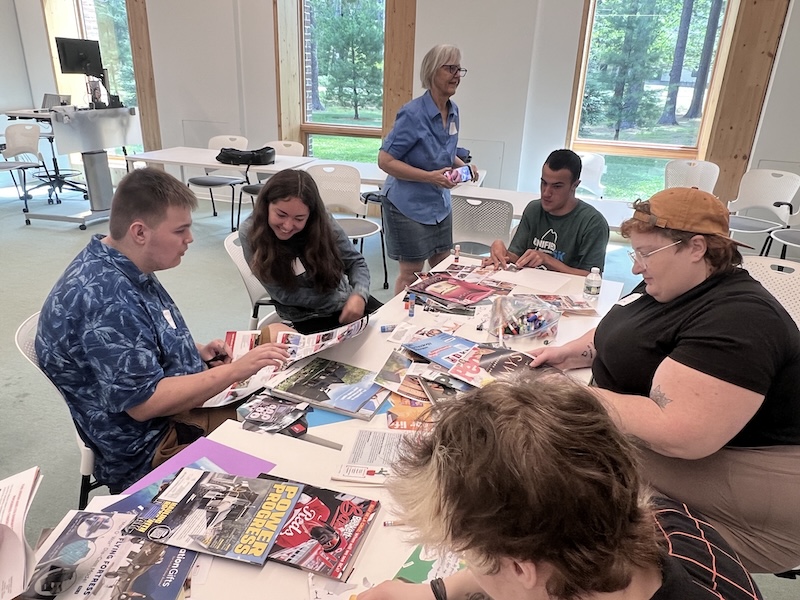
The first activity of the week was led by Kate Turpen, the youth self-advocacy project director for Disability Rights Maine. After spreading magazines, scissors, and glue across a table in Mills Hall, Turpen invited students to make collages that represent their hopes for the future.
Turpen had just finished giving a brief overview of the history of disability rights, so they noted: “In the past, you would never have been asked what you want.” Now they encouraged them to imagine every possibility. “Do you want a partner? A job? A house?”
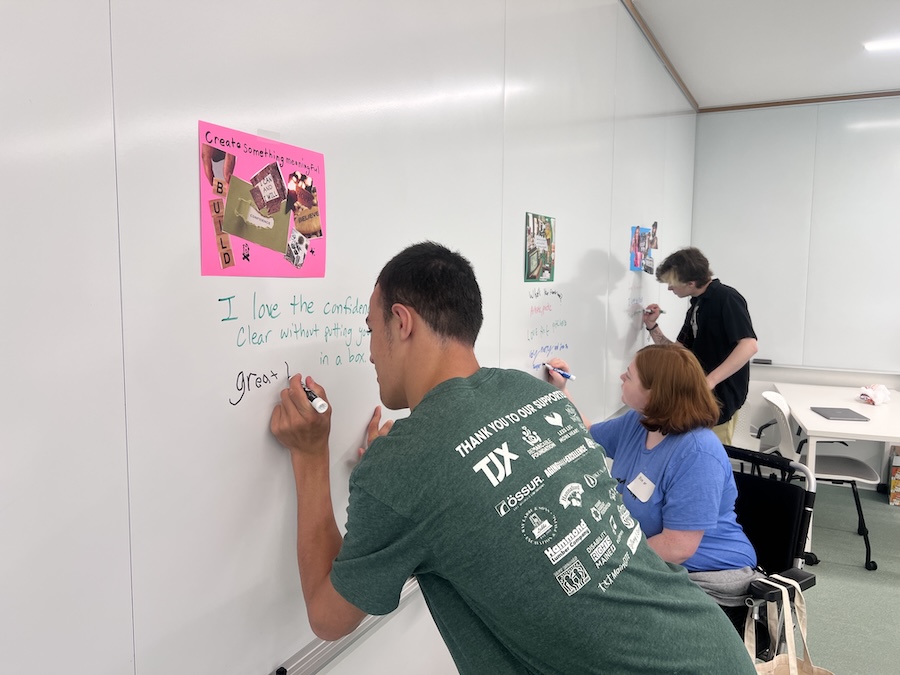
As students brainstormed, Turpen covered a whiteboard with their aspirations: to live independently, be in a relationship, have pets, drive, travel, learn a new skill, play sports, meet new people.
Leo Senecal, who developed cerebral palsy at birth, searched through the magazines while talking about his dream to one day manage a sports team—preferably baseball—and to become a motivational speaker. He said he had signed up for Riggs's program to meet new people and learn more about Disability Rights Maine. "I had never heard of them before," he said.
Fen Talbot, a high school student from Lewiston, said they had enrolled to build confidence. "I thought meeting new people would help my self-worth," they said, explaining that they have struggled with social anxiety.
Bea, who attends Morse High School and uses a wheelchair, was looking for images reflecting her hope to become a pediatric therapist and live in a city. She joined the Bowdoin program to learn more about disability rights and advocacy, she said, particularly for people with vision disabilities, including a close friend.
Oliver Willson, of Sabattus, was drawn by the program's emphasis on the arts. Before an injury led to a long period of being bedridden and in chronic pain, he had been a dancer. Today he runs a small business, Oliver Sproutz, crocheting plushies and gifts.
“Art has genuinely saved me,” he said.
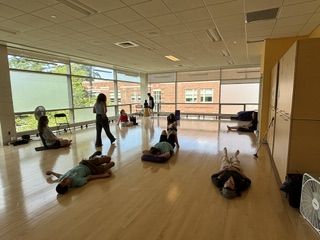
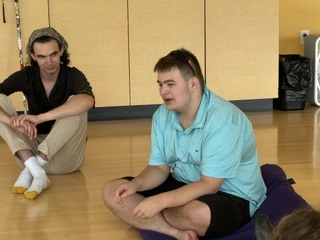
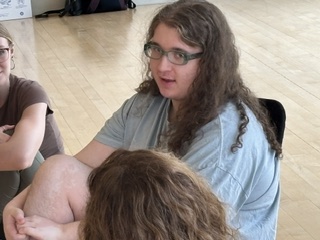
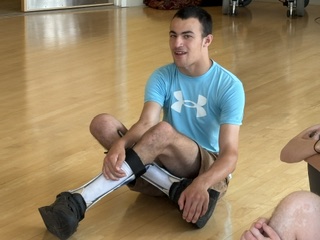
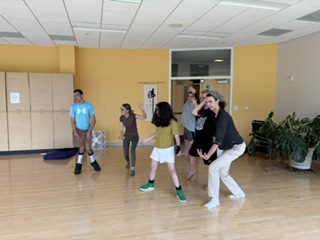
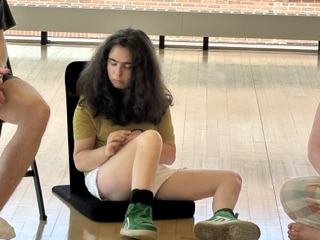
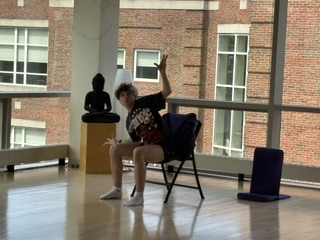
Spark Dance offered a movement class to participants. Photos by Lisa Wesel.
Celebrating Community
Riggs closed the week with a celebration in Mills Hall Friday evening, catered by Bowdoin Dining. She invited families, program volunteers, workshop teachers, and community partners to listen to participants reflect on their experiences. Bea and Riggs read poems, and Senecal shared an essay about living with cerebral palsy.
Senecal explained that when he was born not breathing, his brain went into survival mode, conserving blood flow to the most important organs—his heart and his lungs—and sacrificing his muscles. “It also knew to save the parts of my mind that are most important, the parts that make me kind,” he said.
Before the presentations began, Zoe Faveron, of Brunswick, said she had loved every day of the program. “I loved making new friends here. And I learned how to speak up for myself.”
Talbot said the experience had strengthened both their confidence and sense of belonging. “Honestly, coming here was a huge help,” they said. “I enjoyed building connections with other disabled people. It helped to teach me to speak up for myself, and to listen, too.”
Senecal's mother, who attended the celebration with her husband and daughter, said her son had participated in many disability-related programs over the years, but never one quite like this. “It was dedicated time to spend with others and talk about disabilities,” she said.
Willson said the week had been ”extremely positive.” “It's been incredible hanging out with these people, hearing their stories and connecting...It was a chance to decompress and talk about how the world is not shaped for disabled people.”
But one moment, in particular, was transformative for him—a movement class led by Spark Dance.
After his injury, he grieved the loss of dance in his life, and he worried the class might reopen old wounds. Instead, he discovered a different way of moving. “I was in a chair the whole time,” he said. “There was no 'do this' or 'do that.' It was all improvisation and connecting with your body.”
The experience convinced him that dance could once again be part of his life. "I can be connected to it differently,” he said.
After the celebration concluded, Riggs said the week had far exceeded her expectations. “The participants were incredible,” she said. “I couldn't even imagine or dream that I would get a group together like this.”