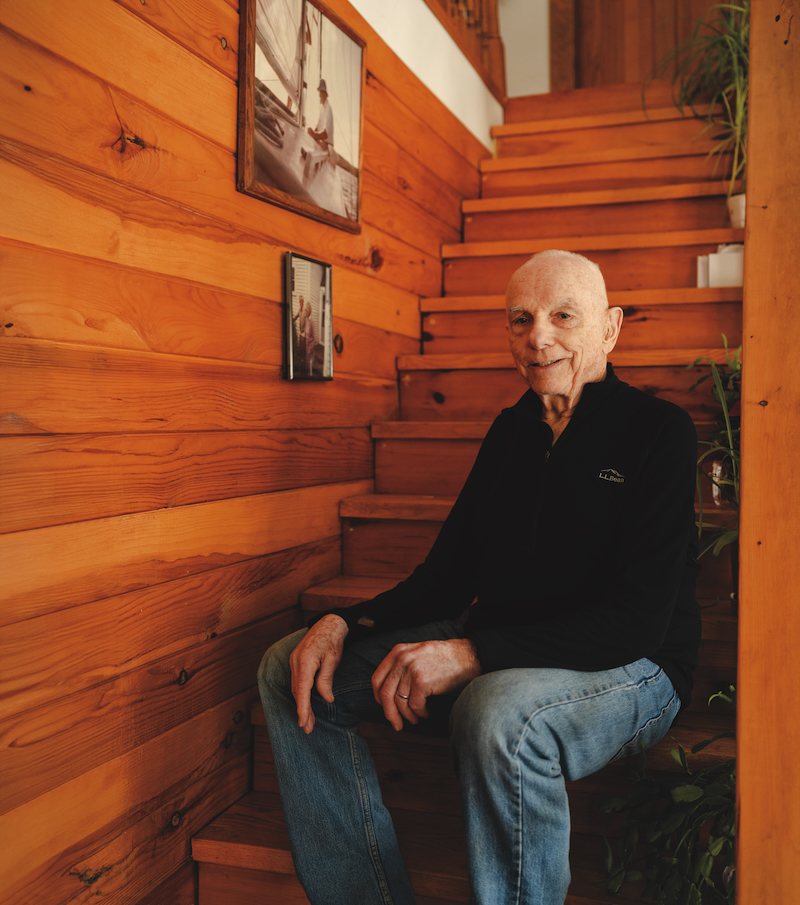
What drew you to teaching history? How did your career unfold?
I grew up in a reading family and early on loved reading history, particularly maritime history. John Paul Jones and Stephen Decatur were early heroes of mine. My US history teacher in prep school encouraged that interest and told me I should major in history in college, which I did. I got my MA in history at BU but didn’t have a clue what I would do with it until the end of the semester. I got my degree without writing a thesis, in one year.
Were you always a clammer as well? What makes that fun or interesting or rewarding?
Unlike my friends who started clamming when they were youngsters, I was a late bloomer. My dad was a poultry farmer, and I started on the farm payroll when I was twelve. By the time I got to college, I decided that maybe there was a better career. I went to talk to Ed Myers, the father of aquaculture in Maine who was shipping out lobsters and clams, and he got me digging clams for him. The first time I went, in my freshman year, I sold to Paul Creamer in Edgecomb, a wholesale dealer. No one at that time had showed me the ropes, and I never washed my clams. Paul saw them and started laughing and told me that I had to wash them before he’d buy them.
Tell me about the history of Maine clamming that you wrote. What got you interested in that aspect of Maine and Maine’s fisheries?
When I retired from clamming, I moved back to Pemaquid and I’m proud to have achieved number one on my bucket list by building my own house on the farm where I grew up, mostly with lumber I milled myself from the woodlot. From my deck I can see where I started clamming in 1958. I bought an old tractor to yard the trees out with and a portable sawmill to mill them. (There was a lot of trial and error using the sawmill.) I am a person who learns by doing, not out of a book, and I have strived to be self-sufficient. I’ve always had a big garden, and since the 1970s heated my houses entirely with firewood I processed myself—unfortunately I’m too old for that now.
Back home I immediately got involved in local history, writing articles for the Lincoln County News and doing many oral history interviews. I wrote eight books, mostly on the histories of Bristol communities. Pemaquid is just one of them. After I wrote the last one I had run out of ideas. Walking one day, I ran into a friend and mentioned this dilemma to him. The next time I saw him he said he had been thinking about this, and said, “How about the history of clamming?” He told me I’d be the perfect person to do that. This was an untold story about Maine’s number two fishery that always gets the short end of the stick, I thought. The only Maine fishermen less esteemed than clammers are worm diggers.
What’s the best thing you’ve learned so far, either in your work or some other aspect of your life?
You get out of something what you put into it. Work hard and you’ll get ahead.
Are there ways that your academic or extracurricular experience at Bowdoin has come into play in your life or career?
I met my wife on a blind date at my first homecoming. I had never had a drink before and couldn’t handle the house drink, a very potent sea breeze. Years later, my wife told me that we were sitting on the couch in the fraternity house, and I told her that I loved her, wanted to marry her, and live in Pemaquid. Forty-five years later we got married at the family farm.
What brought you to Bowdoin?
I got accepted, and my parents encouraged it. In those years I didn’t think for myself too much. I always wished I had gone to UMO with my friends.
Is there something about your work or life that others would find surprising?
Maybe that I became a semi-successful writer. People from my past, most of whom are now dead, would be amazed that I finally admitted to myself that clamming, fish and game, and driving laws applied to me as well as other people and that I stopped being a rebel without a cause.
Is there something about YOU that others might find surprising?
People who have only known me for the last twenty-five years or so would be surprised at my checkered past. People I taught with in 1996 would be amazed that I am now semi-proficient with the computer. My last year of teaching we had a new principal at Camden-Rockport High School who decreed that all communication be done by computer, including grades. Another teacher, Bill Curtis, and I were dinosaurs. I made a half-assed attempt at doing my grades by computer at the end of the first quarter, but then I proudly dropped out. Like my students said: “Mr. Hope, what are they going to do? Fire you?
What do you like to do in your spare time?
I have been an avid organic gardener since 1965, and my wife and I still are. We put up a lot of our food. I have been a lifelong firearms collector, shooter, and hunter. I gave up deer hunting around 2000 when I lost my hearing. I’ll always remember an old woodsman friend told me there would come a time when I decided I had shot enough deer, give it up, and never miss it. I didn’t believe it. He was right, but I would sure miss bird hunting with my best pal, my Brittany, Harrington.
You’ve said you’re not that “gung-ho” about Bowdoin—what causes you to feel that way?
I was never rah rah like my roomie, Bob Millar. I went there, did that, and never looked back after I graduated.
In spite of that, is there a best Bowdoin memory for you, or a lasting lesson from your Bowdoin days?
My major adviser, Professor [Ernst] Helmreich, wanted me to do an honors thesis on the Balkans. I declined but said I would do one on seventeenth-century Pemaquid. He eventually gave in, and I did some great research that has stood the test of time. It was the first time I had ever used primary documents.

This story first appeared in the Spring/Summer 2026 issue of Bowdoin Magazine. Manage your subscription and see other stories from the magazine on the Bowdoin Magazine website.