Bloom
By Michael Colbert ’16 for Bowdoin MagazineAcross time and space, flowers communicate our deepest feelings, at times unknown to us.
The first time somebody asked me what I wanted to be when I grew up, I said, “A florist.”
This is a story I often forget, reinterpreting my own history to occlude my early affinity for plant life. But, growing up in the suburbs of Massachusetts, I would go on daily walks with my mom, pointing at weeds along the road, and ask, “Can we pick this one?” I always felt proud of our bouquet of dandelions, displayed cheerfully on the kitchen counter.
Though I, for a handful of reasons, might omit my first professional dream from my personal history, people like me have been enchanted by the colors and contours of the world’s flora for centuries.
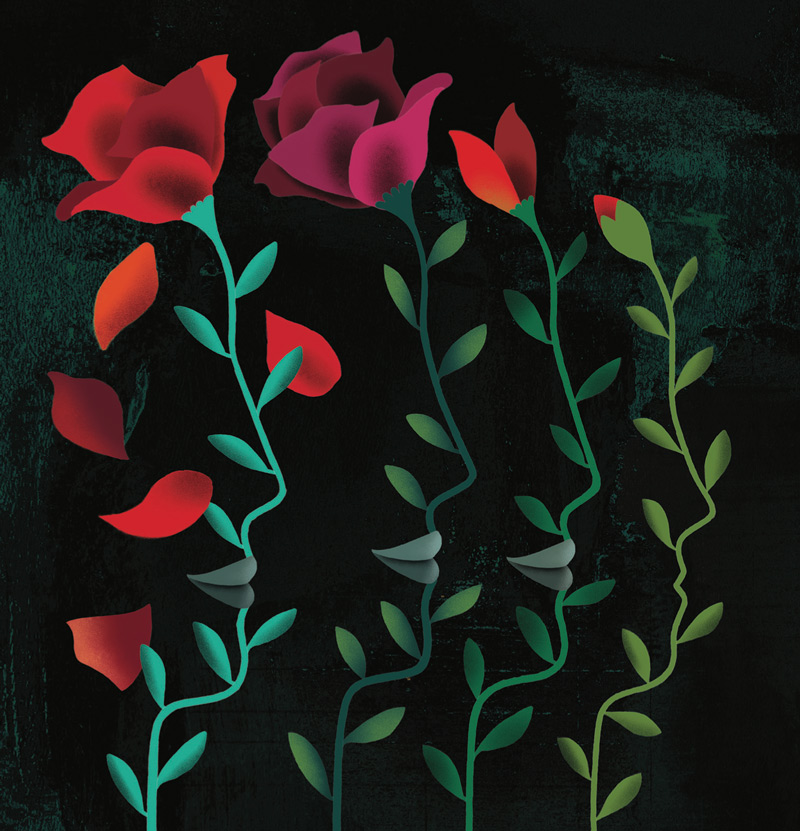
“Flowers, and plants more generally, have been used since the Paleolithic to decorate, to provide color and fragrance; and they’re early subjects of representations in art,” says James Higginbotham, associate professor of classics. Higginbotham studies ancient Greek and Roman colonies and traces humankind’s floral fascination back centuries.
“Going back to the Neolithic, and afterward, we see plants like the crocus or the rose frequently represented in art in the Aegean world.”
After life on the Greek island of Santorini was destroyed by a volcano in the Bronze Age, scholars were unable to translate the writings its people left behind. However, they can look to frescoes preserved on the walls of Santorini homes and make sense of pictures of women collecting crocuses in the field and laying them at the feet of a goddess. The island of Rhodes takes its name from the rose—rhodos in Greek—and the flower adorned the coins they used beginning in the fourth or fifth century BCE.
Across the Ionian Sea in southern Italy, roses bloomed twice a year in Paestum, enchanting the Romans into cultivating the flower for use in perfumes, wines, and garlands, and their cultural cache then blossomed into yet another life in art. The roses still bloom twice annually in Paestum, and Higginbotham has a statue fragment of a female bronze arm holding a lotus blossom in her hand.
“Flowers were used on funerary monuments,” Higginbotham says. “They could decorate a home. They were part of everyday use, and they could be manufactured or manipulated into perfumes and pigments that people would use to decorate clothes and their bodies.”
As crocuses and roses ascended in the cultural imagination of ancient civilizations, they attained a certain gravity, and within that a kind of divinity. As beacons of the ecosystem, they could augur the future.
“If ancient peoples like the Minoans or the Mycenaeans saw in a flower a manifestation of divinity, then when those did not grow at the right times, that would be a bad omen,” Higginbotham says.
Making concrete the connection between flowers and divinity is the story of Persephone, one of the most famous tales from Greek and Roman mythology. While picking flowers with companions on the hillside, Persephone was abducted by the god of the underworld, bringing desolation to the earth. Demeter, goddess of agriculture and the harvest, combs the earth searching for her daughter, finding that she’s fatefully eaten pomegranate seeds while in the underworld. Persephone must split the year between the worlds above and below, and the Greeks and Romans had their story of the seasons. “Just as the sun, hidden, before, by clouds of rain, wins through and leaves the clouds,” writes Ovid.
“To a degree, we still rely on those cycles,” Higginbotham says. “Flowers wither and die, then disappear. The appearance of a blossom is the expectation of something to come and the vivid and colorful bloom. There is something that is evocative in that particular cycle.”
The whole of life is contained in a flower’s blooming. In their emergence and decay, they remind us of the fragility of beauty and life, a dance that has seduced humanity into this artistic and cultural symbiosis.
“You look at wall decorations at houses of Pompeii, and flowers are everywhere,” Higginbotham says.
Empress Livia’s villa at Prima Porta outside of Rome has an entire room adorned with garden frescoes depicting flora at their peak bloom, seeking to capture and preserve each flower’s beauty at its best moment. As a source of dye, plants provided a delicate channel to beauty. “A plant pigment is often not as durable,” Higginbotham says. “It was something that you would apply knowing it would fade. You would understand that you would have to renew it or retouch it at certain times.”
In Flora et Fauna: Nature in Ancient Mediterranean Art and Culture, an exhibit he curated for the Bowdoin College Museum of Art, Higginbotham invites visitors to bring deep attention to flowers as essential to each work of art.
“They’re ubiquitous,” he says. “Flowers and plants are ever-present in ancient art but almost completely overlooked, because they’re used as background. They are things to frame. They’re festoons and wreaths.”
Yet their abundance reveals that removing them from the composition would mean that something would irrevocably change. Flowers are fundamental to the essence of the whole.
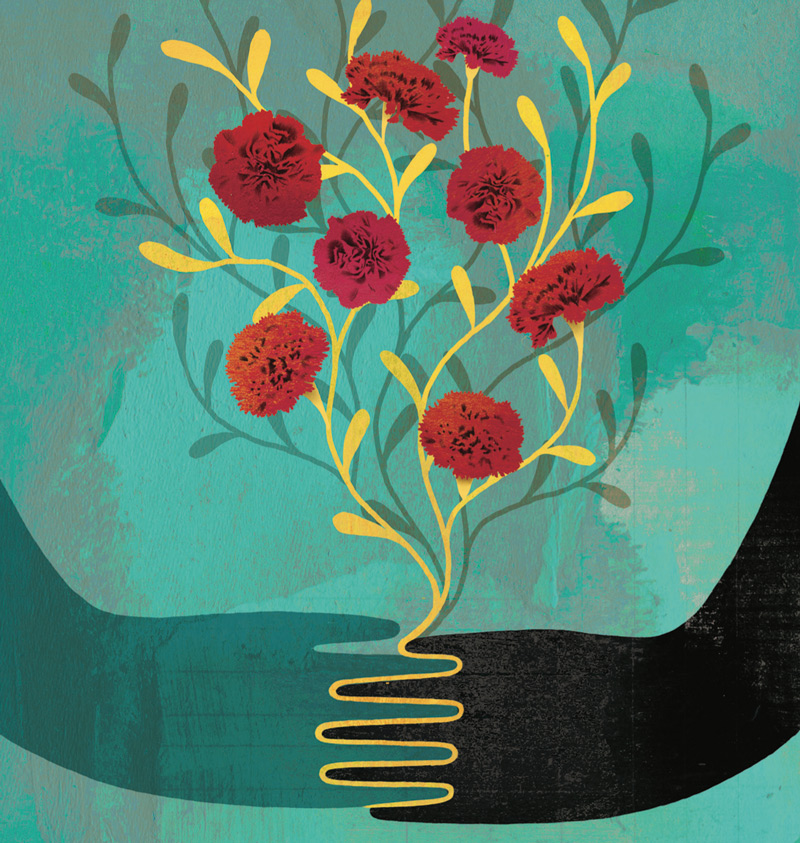
A Sense of Peace
Flowers can cause our protagonists to transcend, from Virginia Woolf’s Clarissa Dalloway to Super Mario. Or take the opening of Toni Morrison’s The Bluest Eye: “Quiet as it’s kept, there were no marigolds in the fall of 1941.” What feels like nature’s affront to humanity is explicated in the following sentences as an affront to nature, then as a phenomenon beyond our control: “We thought, at the time, that it was because Pecola was having her father’s baby that the marigolds did not grow. A little examination and much less melancholy would have proved to us that our seeds were not the only ones that did not sprout; nobody’s did.”
In Akira Kurosawa’s 1990 film, Dreams, a young boy follows the specter of a girl into his family’s former peach orchard. When he pursues her, the dolls of Hinamatsuri—a Japanese holiday to celebrate the health of young girls—come to life, scolding him for the disappearance of the trees. The dolls respect his tears at the culling of the orchard and resurrect the trees for him for but a moment, in a shower of petals.
Thirteen years later, flowers find a less favorable treatment in Sex and the City when Charlotte famously calls carnations “filler flowers.”
Regardless of which side you take in the carnation debate, one thing is clear: flowers are a potent vessel for projection and expression.
Higginbotham’s Flora et Fauna explores how central flowers were to the fabric of ancient life, and they still are, as anyone who attends a wedding or a funeral today is likely to see.
During her tenure on the style team at Martha Stewart Weddings, Erin Furey ’07 worked on gorgeous events that were featured in the magazine, meeting some of the best florists from around the world. As her team saw how powerfully flowers could transform a couple’s day, they began to think about ways they could share their expertise in alternate settings.
“We had this idea to find a place that feels meaningful in a different way, where we could apply the skills we used for weddings,” Furey says.
“And flowers are one of the components that we bring to celebrations of life and memorials.”
Thus was born Going Out in Style, her funeral and memorial styling business. Furey and her collaborators, Colleen Banks, Naomi DeManana, and Cassidy Iwersen, launched their business around the idea that “one’s final celebration should be an expression of their individuality and honor all that they held sacred and loved in life.” Going Out in Style, which was featured in Business Insider and Harper’s Bazaar, partners with clients to plan bespoke ceremonies complete with invitations, catering, party favors, and, of course, personally significant floral arrangements. Making funerals more personal responds to a gap that Furey and her partners identified in how these celebrations are typically planned.
“When I talk with people about this, every single person comes with their own tale of a memorial or a celebration of a person they loved that doesn’t reflect the person,” Furey says. “‘This isn’t what they would have wanted. This is not them.’ And they wish that they could have done something different to honor and celebrate that person.
“We believe that we can help people to celebrate their families and loved ones in a way that’s more reflective of them,” she adds. “It doesn’t necessarily have to cost more money. It doesn’t have to be harder if you have someone there to help you, asking questions about who they were and what they would have wanted.”
Though many people might find the idea of planning their final party, well, morbid, Furey finds the taboo softens when they begin talking about it.
“A lot of people say, ‘Oh no, I would never want to preplan my own funeral,’ and then they start talking about what their funeral should be like. It’s amazing.”
Conversations with individuals or their families about what they would like can ease the weight of what comes next. Furey recounts a meeting with a woman who had a terminal illness. They sat down at a restaurant and began discussing what she envisioned.
“I wrote down all the things she wanted, including her favorite flowers, what she loved, and what they meant to her because they grew in her grandma’s garden and she played with them as a kid, or they were at her wedding,” Furey says. “It was such a warm, beautiful conversation. Of course, there were tears, but I think it gave her some peace to think and talk about it.”
When a friend’s mother passed away at a young age, Furey found that discussion about what her mother would have wanted similarly became a source of comfort.
“No one knows what to do when somebody dies,” she says. “Everyone says, ‘I don’t know how to respond. I don’t know what to do.’ Giving people a job or focus can be therapeutic and occupy their brains in a way that, I think, feels productive, rather than swirling or avoiding all of those things.”
When asked about her own affective associations with flowers, Furey recollects summer days in her grandmother’s backyard, hiding out in the cool dirt beneath a canopy of hydrangeas, or watching colonies of ants work by her peony bushes.
“Like food, flowers bring such a sensory and emotional element everywhere they are,” Furey says. “When you ask people about moments in their lives or their family traditions, they so often discuss the smells and tactile experiences—the beautiful sunsets, the smell of a tomato growing in the garden, the flower crowns they used to make with their siblings as a kid. Food and flowers are so deeply associated with those memories. Those sensorial elements last in our memories.”
Like Higginbotham, Furey also finds that flowers’ encapsulation of life and death deepens our attraction to them.
“A flower changes and evolves and then dies, and it’s just such a poignant, symbolic thing to incorporate into these life moments,” she says. “One thing that I’ve learned from some of my floral mentors is that, in a beautiful arrangement, representing the entire life cycle of a specific bloom inevitably makes it more beautiful—from bud to just about to open to fully open, and one that might even be overly open and fully exposed—it gives so much more depth and life to an arrangement.”
Against Efficiency, Toward Community
The floral industry today looks much different than it did two thousand years ago. In a global agricultural system, folks can now go to the grocery store in winter and buy sunflowers grown in the opposite hemisphere. Nevertheless, Furey sees a movement in the floral industry toward locally sourced and seasonal products. Just as people support local farms or join community supported agriculture (CSA) programs, more folks are starting to take stock of the flora available to them at different times of year.
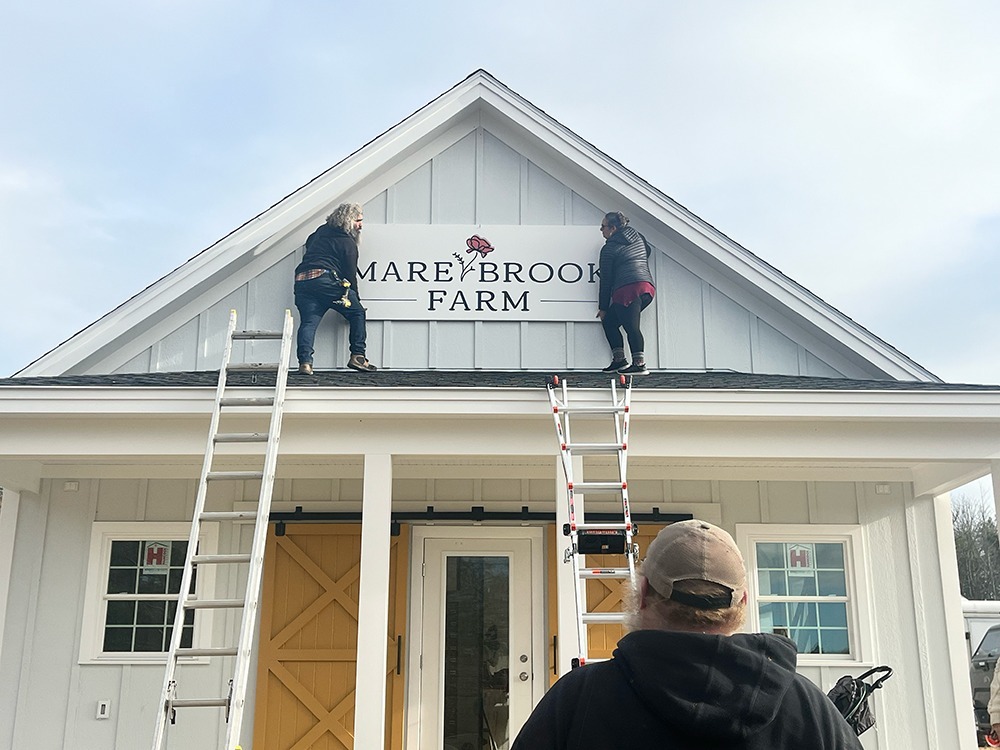
About four miles down Harpswell Road from campus, Bowdoin couple Courtney Mongell ’01 and Ryan Ravenscroft ’99 founded Mare Brook Farm as a community-minded endeavor. The couple had followed the corporate grind in Boston and relocated to Brunswick in 2017 in pursuit of a different life. Growing up involved in his family’s farm in western Pennsylvania, Ravenscroft had long dreamed of working in sustainable and local agriculture.
While at Bowdoin, Brunswick truly felt like home for both Mongell and Ravenscroft, and they spent their time getting out to Land’s End and Pott’s Point. When they found the land on Harpswell Road, they started growing vegetables and flowers on a modest scale. While working at Mid Coast Hunger Prevention Program (MCHPP), Ravenscroft took a master gardener class through the University of Maine’s extension program.
At the onset of the COVID-19 pandemic, Ravenscroft saw an opportunity for MCHPP to purchase food directly from local farms and launched the Farm to Pantry program. Their support was twofold, sustaining farms through economic uncertainty and providing food to Mainers in need.
“Nobody knew what was going to happen to the farms that year,” Ravenscroft says. “At the food bank, we were able to raise funds to buy directly instead of depending on those farmers to donate.”
Meanwhile, at Mare Brook Farm, they started beta testing with different perennials and annuals. He and Mongell both saw another opportunity for community engagement.
“We bundled up bunches of flowers and started delivering to all of the police stations, fire stations, and hospitals,” Mongell says. “We would leave them outside with little messages, or our son would draw a picture.”
“We’re not lawyers, or doctors, or veterinarians,” she adds. “We couldn’t do anything that we felt was going to make a tangible impact, beyond trying to spread a little joy or comfort through flowers.”
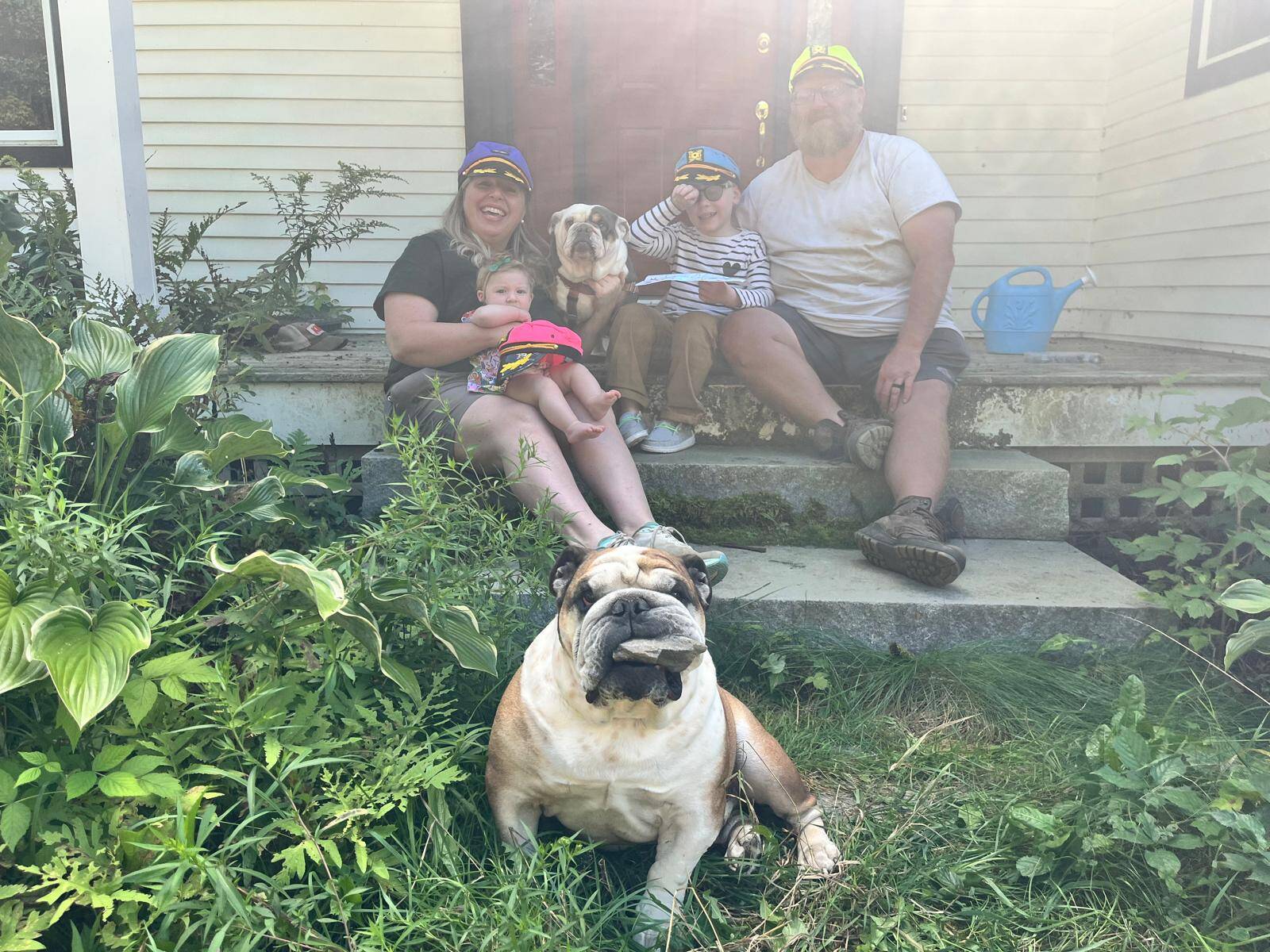
This potential for connection motivated them to commit to their flower-growing enterprise. The expressive capacity of a daisy or a sunflower feels instinctual, universal. In Minnesota’s Twin Cities, Furey runs another venture, Bud Buds, which sources seasonal flowers and styles weddings. In their wreath-making workshops, Furey sees a real hunger for togetherness.
“People are craving connection, community, and making things with their hands,” she says. “The workshops are just a joy and a wonderful break from staring at Zoom screens all day.”
This appetite for community is central to Mare Brook’s story. On a gray March day, I meet with Mongell and Ravenscroft inside the farm store, a few weeks before the season begins. They sell specialty cut flowers, holiday products, and seedlings in a space with a Bowdoin touch—old mailboxes from Smith Union that they found at Portland Architectural Salvage decorate the wall behind their counter. Mare Brook is still closed for the season, but a couple walks in during our conversation, hoping to buy a gift for a friend.
“Two or three people have been stopping by a day for the last week and a half,” Ravenscroft says. “It’s great.”
Beyond crafting specialty arrangements for weddings and supplying local restaurants with vegetables and edible flowers, one of their largest programs is their CSA. Many people buy CSAs as gifts, and they select a certain number of bouquets for pickup throughout the year. Mare Brook came up with their own spin on the program model.
“Since we’ve started, we’ve had a buy-one-give-one option,” Mongell says. “If they buy a CSA through us, we donate companion bouquets to people of their choice. It’s always been first responders, veterinarians, teachers, nurses, and frontline health care. It was this idea that you get to enjoy flowers, let’s honor someone else by giving them some flowers too, and then let them know who they’re coming from and why, if they want to.”
“Flowers are transcendent,” she adds. “They give you a sense of time and place. They can communicate tangible emotions or memories, and they can take the intangible and make it tangible. Flowers have an ability to say things without you having to say much. If it’s a condolence flower, if it’s a joyful flower, for a lot of people, it breaks the ice and makes people comfortable because it’s natural, there’s texture, fragrance, color, and vibrancy.”
Both Ravenscroft and Mongell have their personal favorites, too.
“I really like daffodils,” Ravenscroft says. “They’re so bright at that point when the winter is ending. People see them, and they’re so hopeful. This winter was whatever it was, but the daffodils have come out.”
Mongell finds hope in her favorite as well. “Peony tulips break through the gray. They break through the cold,” she says. “No matter what’s happening in February or March, seeing colors and knowing that everything came from a bulb that was shipped from Holland, planted by our family or team, grew in our house or tulip shed, and then was able to work its magic across thousands of miles—it’s really, really cool.”
View this post on Instagram
That local magic is a source of profound inspiration for the team at Mare Brook. While a global floral industry can create the illusion of beauty and ease, Ravenscroft sees a new, solid foundation growing today built upon less conventionally rewarded principles.
“The world had built itself on increasing efficiency and reducing redundancy,” Ravenscroft says.
“That takes all the neat stuff out. It takes the fun out of the world, and it’s not a great move when things go sideways.”
Mare Brook is one of the founding members of the Maine Flower Collective, which connects buyers and growers throughout the state and simplifies logistics and distribution for smaller farms. And working in tandem with other growers brings Mare Brook back to its core mission—to connect in a community with other people. They tour me around two greenhouses. By the end of next week, about 35,000 tulips will bloom.
Courtney and Ryan send me home with a half dozen tulips, their stalks bundled tightly in wet paper towels. I’m visiting Portland from New York, where I moved after living in Maine for years—both eagerly and with a deep sense of loss—finding a particular sadness in that I’d no longer see my four-year-old niece on a weekly basis.
When I get back to my sister’s house, I rifle around in their kitchen cabinets, find a mason jar, and pour warm water into the glass. By the time they get home, and before I leave, the tulips start to yawn open in pink, yellow, peach, red, and white. I feel proud the way I did when I was a kid with my dandelions. These I didn’t pick, but they’re something I can leave behind.
Michael Colbert ’16 is a writer and editor based in Brooklyn, New York. He earned his MFA at UNC Wilmington.
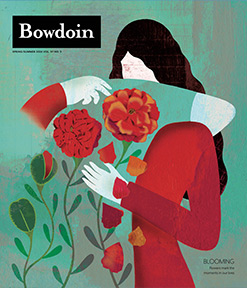
Anna Godeassi is an Italian illustrator and artist. See more of her work at annagodeassi.it.
This story first appeared in the Spring/Summer 2026 issue of Bowdoin Magazine. Manage your subscription and see other stories from the magazine on the Bowdoin Magazine website.