A Gift of Views
By Carl Little for Bowdoin MagazineIn 1937, Roger Strout of the Class of 1923 and his two sisters were clearing out their father’s apartment at 200 Maine Street in Brunswick, and the task facing them was daunting.
Leon B. Strout had been a studio and commercial photographer in Brunswick for five decades, and he had left mountains of negatives and prints behind. Some were of the College, so Roger thought Bowdoin would be a good home for it all. And it was—safe and secure, but also dark and nearly inaccessible. Now, thanks to the family’s generosity and two years of focused work, Strout’s views and vision have fully come to light.
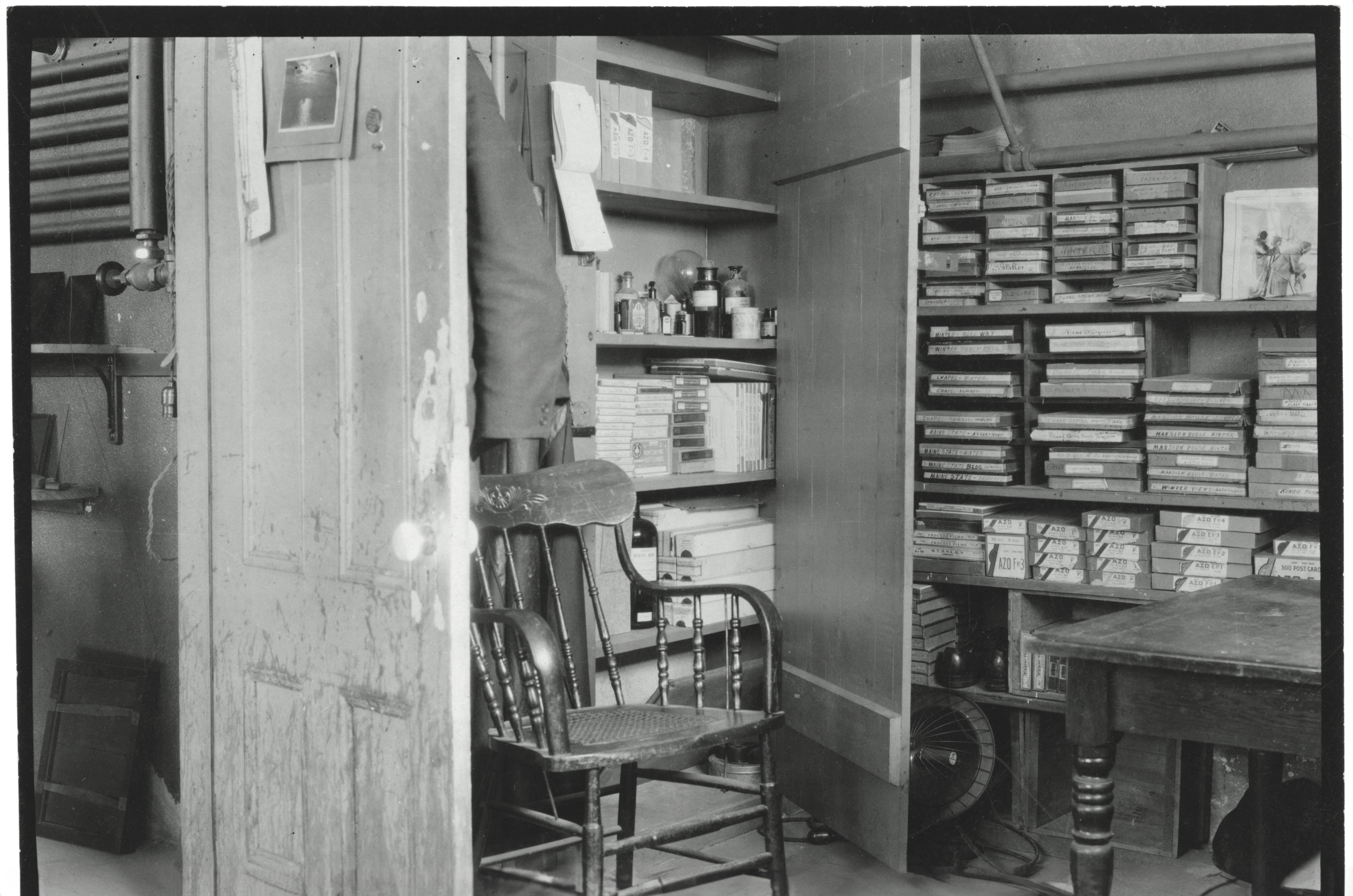
Strout’s studio at the Poland Spring Resort.
The history of Maine photography is a shifting universe. We believe we have the roster squared away—Lewis Hine, Berenice Abbott, Eliot Porter—and then one day we learn, through new research, that Gertrude Käsebier, Clarence White, and other twentieth-century photography giants spent time in Maine.
Now it is time to make room in that pantheon for Boston-born, Maine-based Leon Bertram Strout (1869–1937). Thanks to a team of researchers, archivists, and historians at Bowdoin’s special collections and archives, this little-known studio photographer from Brunswick is finding—and impressing—a new audience. While some of his images are familiar—the College has reproduced several over the years as holiday cards and the like—Strout’s work overall, asserts archivist Anne Sauer, is not, adding, “But we’re going to fix that.”
The story of how the Strout collection of more than 5,000 film and glass-plate negatives and 1,000-plus black-and-white prints came to Bowdoin dates back to 1937, the year the photographer died. His son, Bowdoin alumnus Roger Strout 1923, happened to be in Brunswick at the time after three years of sailing around the world. Obliged to settle his father’s estate in short order, he donated the collection to Bowdoin. The archives included many photographs Leon had taken of Bowdoin and its campus, students, and events, making the College, Roger thought, the logical repository.
The library accessioned the collection, stabilizing and securely storing it. The “securely” part was extra important: most of the negatives are cellulose nitrate film, which can be volatile. Now that they are digitized, the library keeps those negatives in freezer storage due to their flammability and the risk of deterioration.
The collection remained stowed away until the 1980s, when the library received a Maine state preservation grant to conserve the negatives. They rehoused everything, moving fragile film into acid-free paper sleeves. The funding also paid for duplication of some of the negatives, which meant copying them and then converting the copies into interpositive transparencies (scanners did not yet exist).
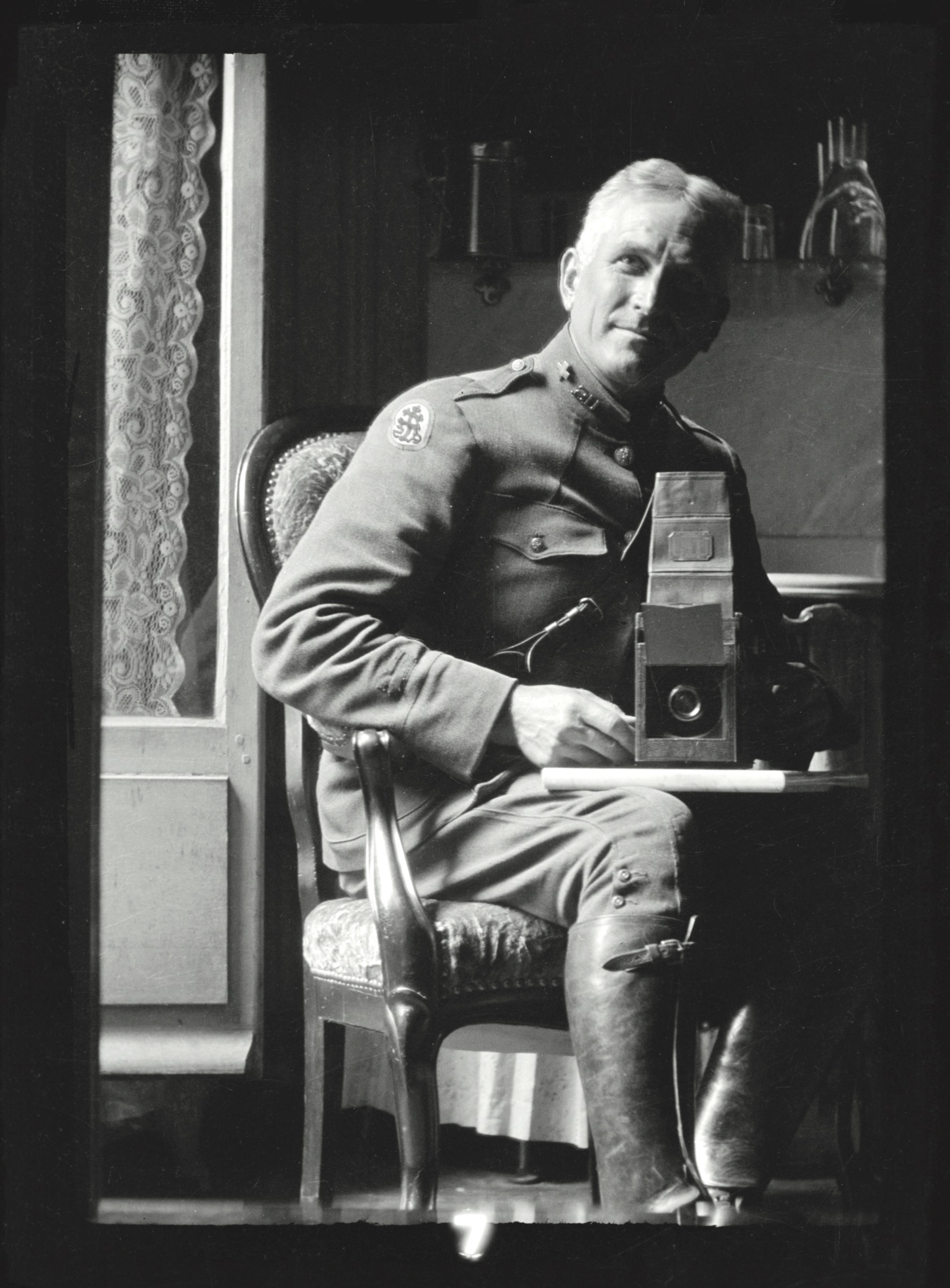
Self-portrait of Strout, wearing his Red Cross uniform, with his camera, an Auto Graflex Junior, 1919.
The funding also provided for a person to sort through the images, many of which lacked labels. As Sauer explains, Strout was still active as a photographer when he died, and he hadn’t identified many of his photographs. Categories included locales—Bowdoin, Brunswick, Bath, Poland Spring, and others—and subjects, among them, farm life and World War I cemeteries in France.
Fast-forward to fall 2023. Seated at the reference desk, archivist Sauer took a call from California, from a man named Ben Strout. He was coming to Family Weekend, he told her, to visit with his grandchild, a senior at the College. He was hoping to be able to see his grandfather’s photographs while on campus. Absolutely, Sauer replied.
When the weekend rolled around, Ben, his daughter, Kristin Strout—it was her child who was enrolled at Bowdoin—and other family members arrived at the reading room to look at a sample of the collection. “They were wowed,” Sauer recalls. She also helped them locate the resting places of ancestors in the Brunswick area and find Strout’s former farm on River Road.
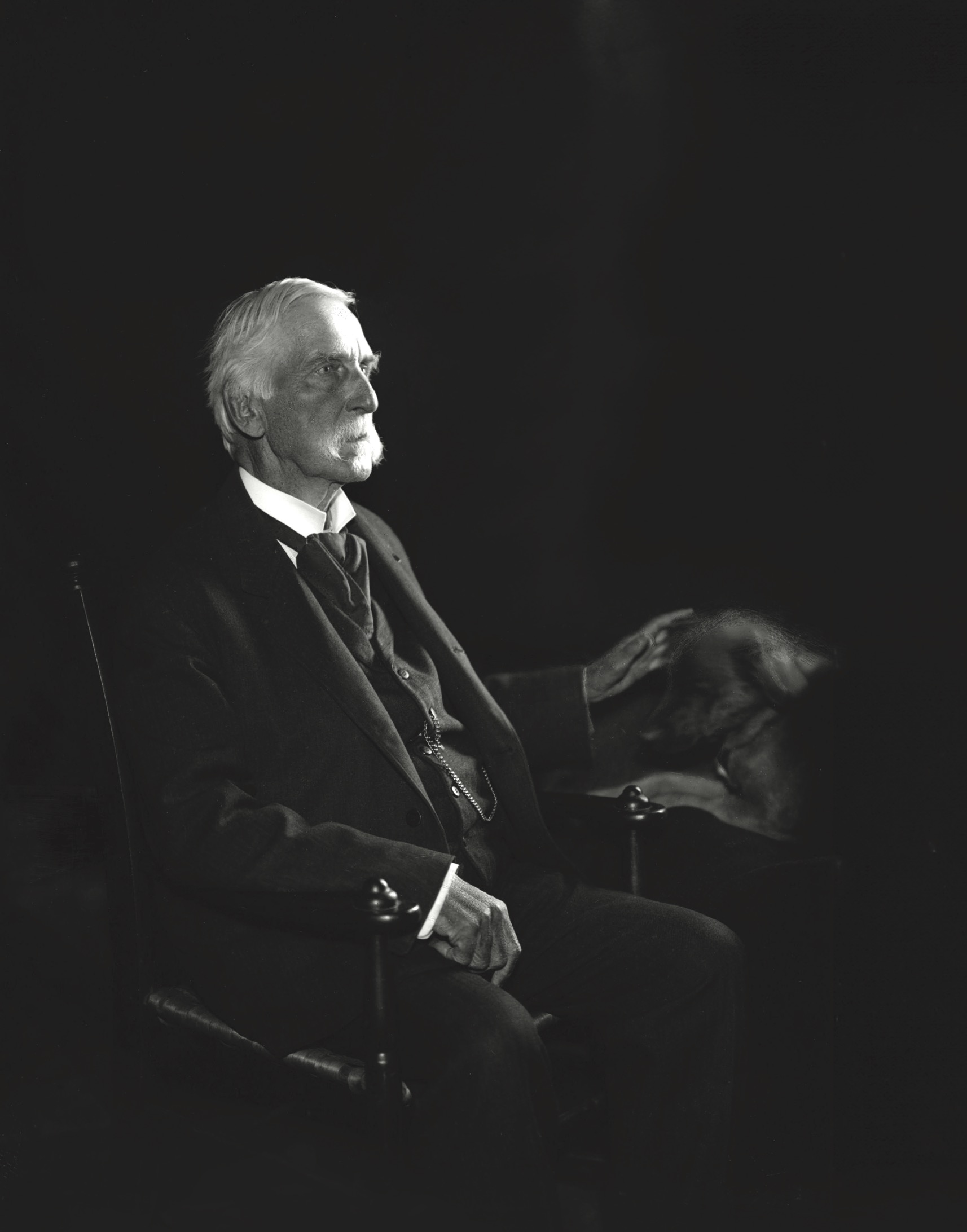
Portrait of Civil War general and past Bowdoin President Joshua Lawrence Chamberlain with his dog, Tiberius Caesar, 1911.
Sadly, the tragic shootings in Lewiston in October of that year limited the family’s viewing, as everything closed down while police looked for the shooter. Before she headed home, though, Kristin stopped back at the library to say that she wanted to do something to make the Strout collection more accessible. She recognized, says Sauer, that the only way the photographic materials would be usable was if they were fully digitized and there was someone dedicated to cataloguing the holdings.
The Strouts’ offer of financial support “broke it open” for the library, Sauer says. They hired Katie Perry, an experienced researcher and archivist, to focus full time on curating the collection. Spending time with the photographs, Perry was able to make connections, to identify subjects and date individual images. Now every photograph in the collection has a descriptive caption, and all the images can be found online.
Perry became a discerning detective. Formal portraits of unnamed young men led to searching the archives of The Bugle, the Bowdoin yearbook, between 1920 and 1937. There were several matches with photos in the Strout collection.
Strout also photographed renowned Civil War general and Bowdoin president Joshua Chamberlain, Class of 1852. Chamberlain’s portrait shows the distinguished aging general seated with his dog, Tiberius Caesar. The dimly lit image provides a stark contrast to the portrait Strout’s photography mentor A.O. Reed made of a much younger man.
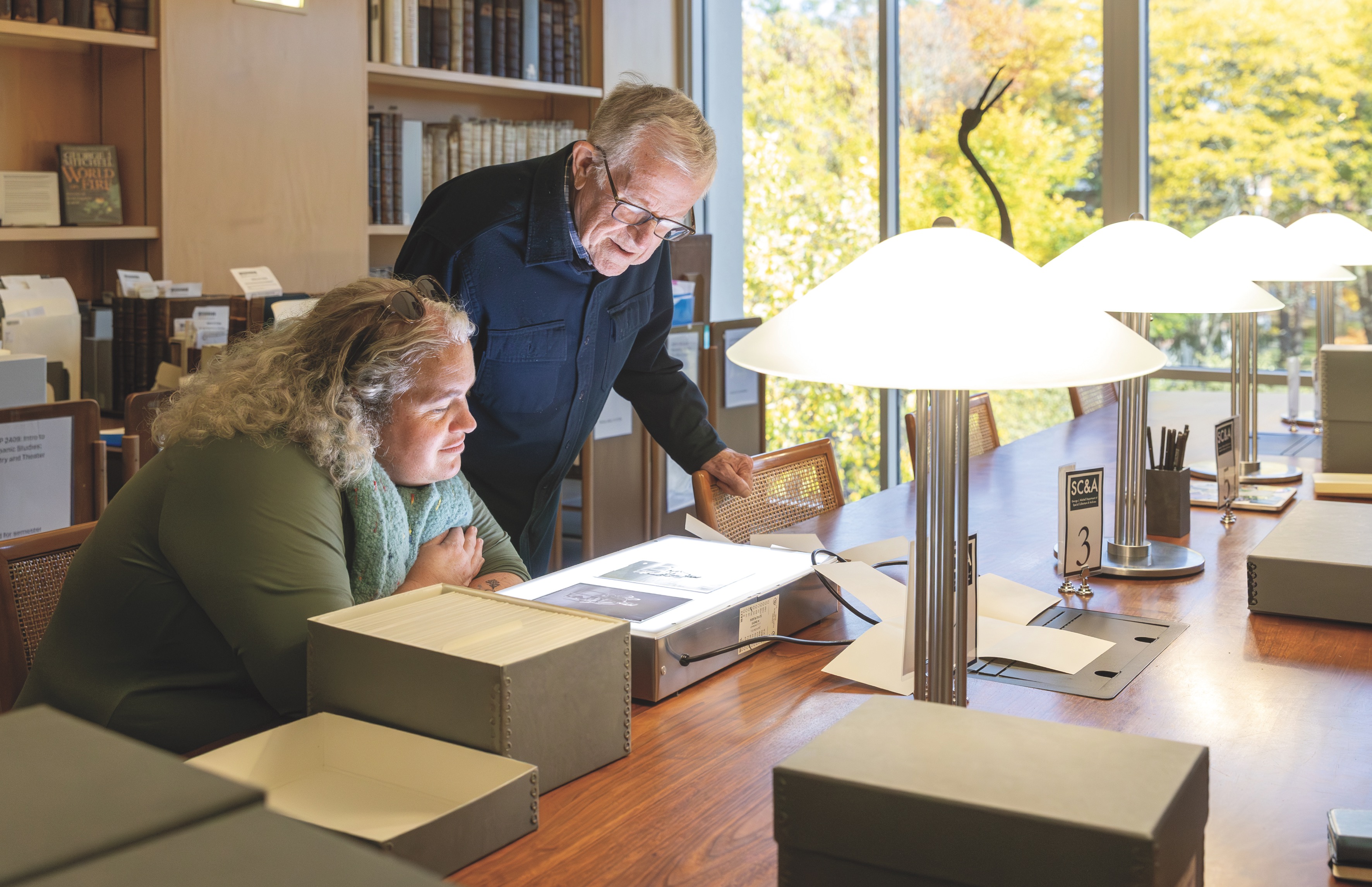
Libby Bischof and Ben Strout examine an object from the collection in the archives reading room.
The collection also includes a number of portraits of other dogs, including the huskies of Arctic explorer and 1898 Bowdoin graduate Donald MacMillan and a black cocker spaniel named Byng who belonged to President Kenneth Sills. According to Byng’s obituary in the 1933 Bugle, students loved the dog.
Strout’s many photographs of Bowdoin include various buildings under construction, among them the Walker Art Building, Moulton Union, Curtis Pool, and Sargent Gymnasium. Some campus views ended up in Bowdoin publications, including course catalogues. He also took wideangle shots of Commencement and photos of artworks for faculty member slideshows.
In March 2025, archivist Perry held an outreach event at the library (which the staff called “Stroutreach”) displaying a selection of Strout photographs, some labeled, some not. The event led to several research leads and to general excitement about the collection. The gathering also resulted in further Strout family connections and the acquisition of additional materials.
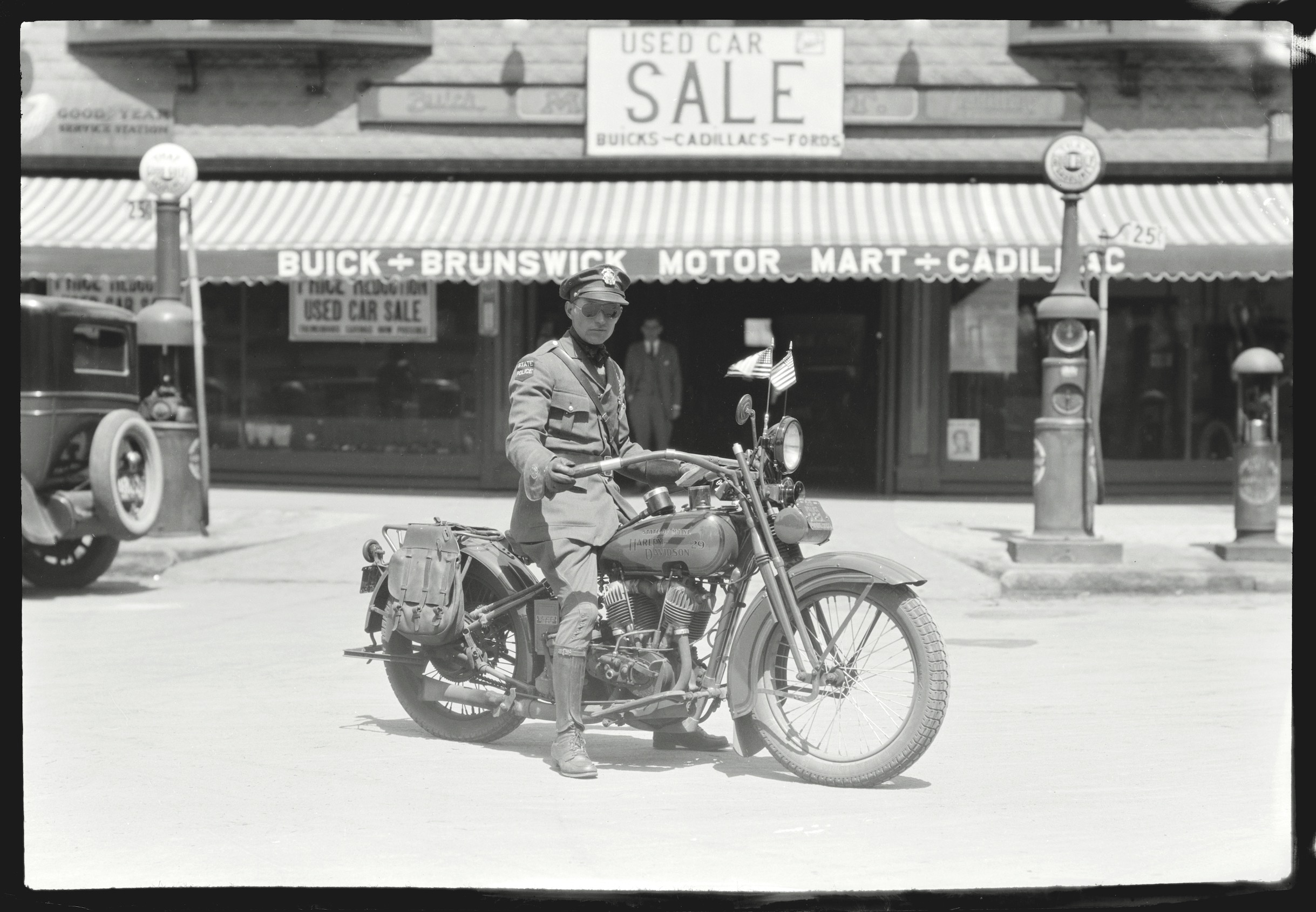
Brunswick police officer on a motorcycle in front of the Brunswick Motor Mart, a building that now houses Bull Moose Music.
You might call Leon Strout the photographer laureate of Brunswick. Working from his studio at 200 Maine Street, he documented diverse aspects of the city and its environs, creating a wide-ranging inventory of images.
Bringing to mind the photographer Walker Evans, Strout often focused his camera on the signage of various establishments, including the Citizen’s Laundry store, the Great Atlantic Grocery Store, and First National Bank. He covered events such as a parade on Maine Street and a student art show at the high school. Albeit unintentional, some of the images have a surreal quality, such as a photo of a hand placing a letter in a postal box and another of an indoor mini-golf course.
A favorite Strout subject was bridge construction. He recorded the building of the Carlton Bridge between Bath and Woolwich, the Black Bridge between Brunswick and Topsham, and the Cribstone, or Bailey Island, Bridge that connects Bailey and Orr’s Islands. His photos often appeared in The Brunswick Record, sometimes without proper credit.
At one point, Strout had tried his hand at farming, only to return to a more promising career behind the camera. During his brief years in this enterprise, he made many views of his family’s homestead. Area farms hired him to photograph prize bulls and other livestock. The Long Branch Sheep Farm in Bowdoinham was a regular client.
Farther afield, one of Strout’s largest accounts was the Poland Spring Resort in Poland, Maine. Over the years, he maintained a studio at the famous spa, taking photographs of the grounds, including the chapel-like Poland Spring watersource building, and visitors in all seasons of the year. One photo offers an aerial view of people forming the word “rotary” in a field.
Strout used an Auto Graflex Junior, a compact, portable single-lens reflex camera produced by Folmer & Schwing, a division of Eastman Kodak. He took photographs in a variety of sizes, with negatives ranging from two-by-three inches to eight-by-tens and panoramic shots measuring from two-by-seven to five-by-fifteen inches. He carried on correspondence with Kodak and other camera manufacturers, sharing process challenges and seeking guidance.
While a lot of work has been done to catalogue the collection, many mysteries remain. Who is the woman caught yawning in several photos? What is the setting of the photograph of a group of young women holding stringed instruments? Where was that indoor mini-golf course?
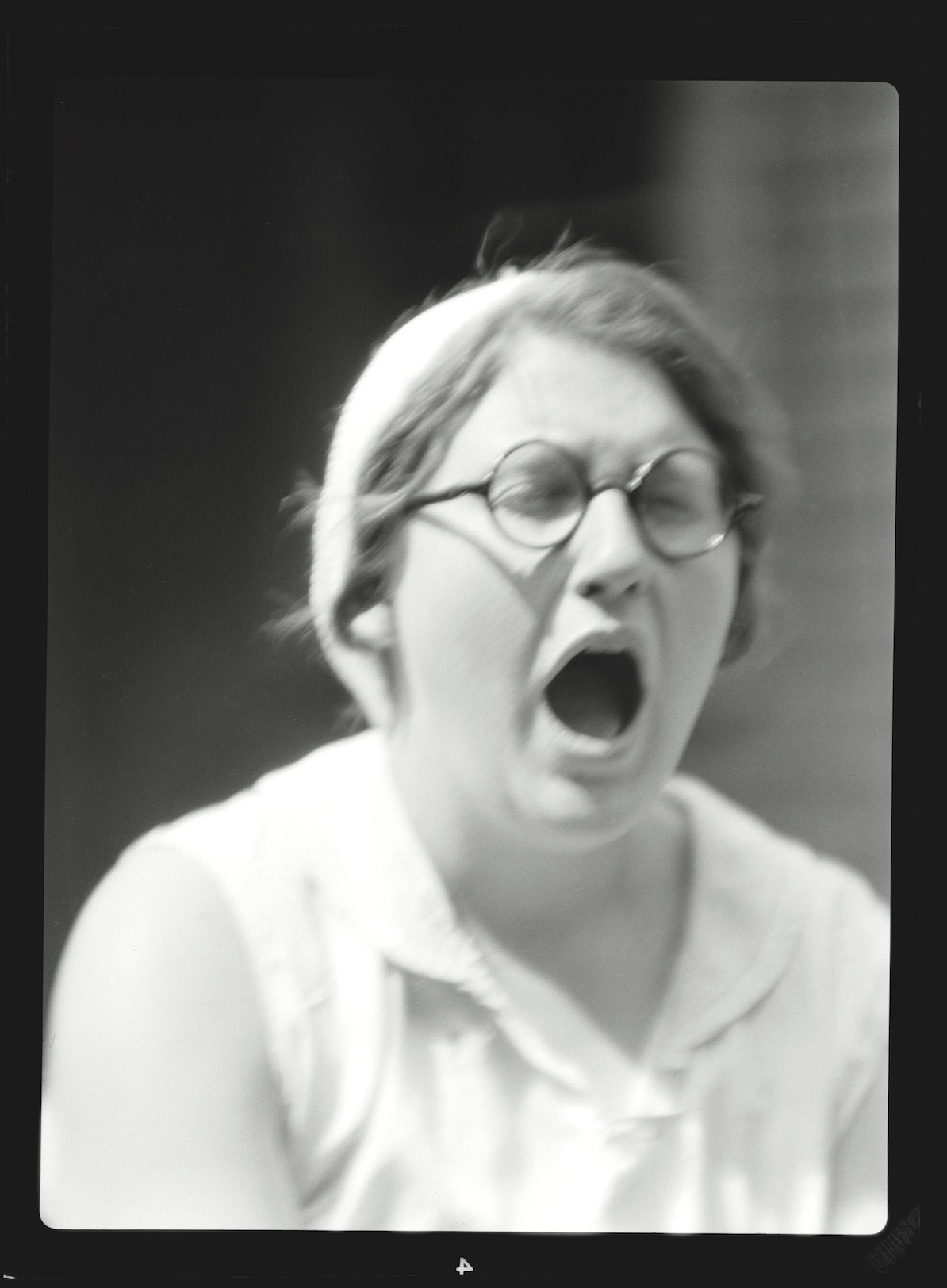
Some of Strout’s photos don’t have easy explanations, such as this one of a woman yawning.
In addition to an exhibition of Strout’s work in the library that will be on show through June 2026, the College is publishing a book highlighting his life and work. In her lead essay, Libby Bischof, coauthor of Maine Photography: A History 1840–2015 and executive director of the Osher Map Library in Portland, contextualizes Strout in the history of photography, both in Maine and writ large. “He fits squarely into what a late nineteenth- to early twentieth-century photographer would be doing,” she notes, “but he’s better than just a studio photographer.”
Through papers donated by another branch of the Strout family, Bischof has been able to connect him to F. Holland Day (1864–1933), the famed pictorialist photographer. Day invited Strout to exhibits at his studio in Boston on several occasions. Bischof believes Strout may have been scouting other studios for ideas for his own business. He was, in her words, “living the tension between amateur and professional.”
Bischof also sees an aesthetic connection. Some of Strout’s earlier work displays the moody atmosphere of the pictorialists, evidence that he was more than a simple documentary photographer. “Strout’s pictorialism carries through his work in France and up to 1920, and then it dies,” she explains.
Strout’s work was “all over the place,” Bischof acknowledges. In addition to the Poland Spring Resort, he had contracts to photograph summer camps in Maine, the cottages on Mere Point in Harpswell, and weddings. She also mentions his “weird side hustle” photographing cattle. He shared photos of wildlife with Thornton Burgess (1874–1965), author of such beloved children’s books as Old Mother West Wind.
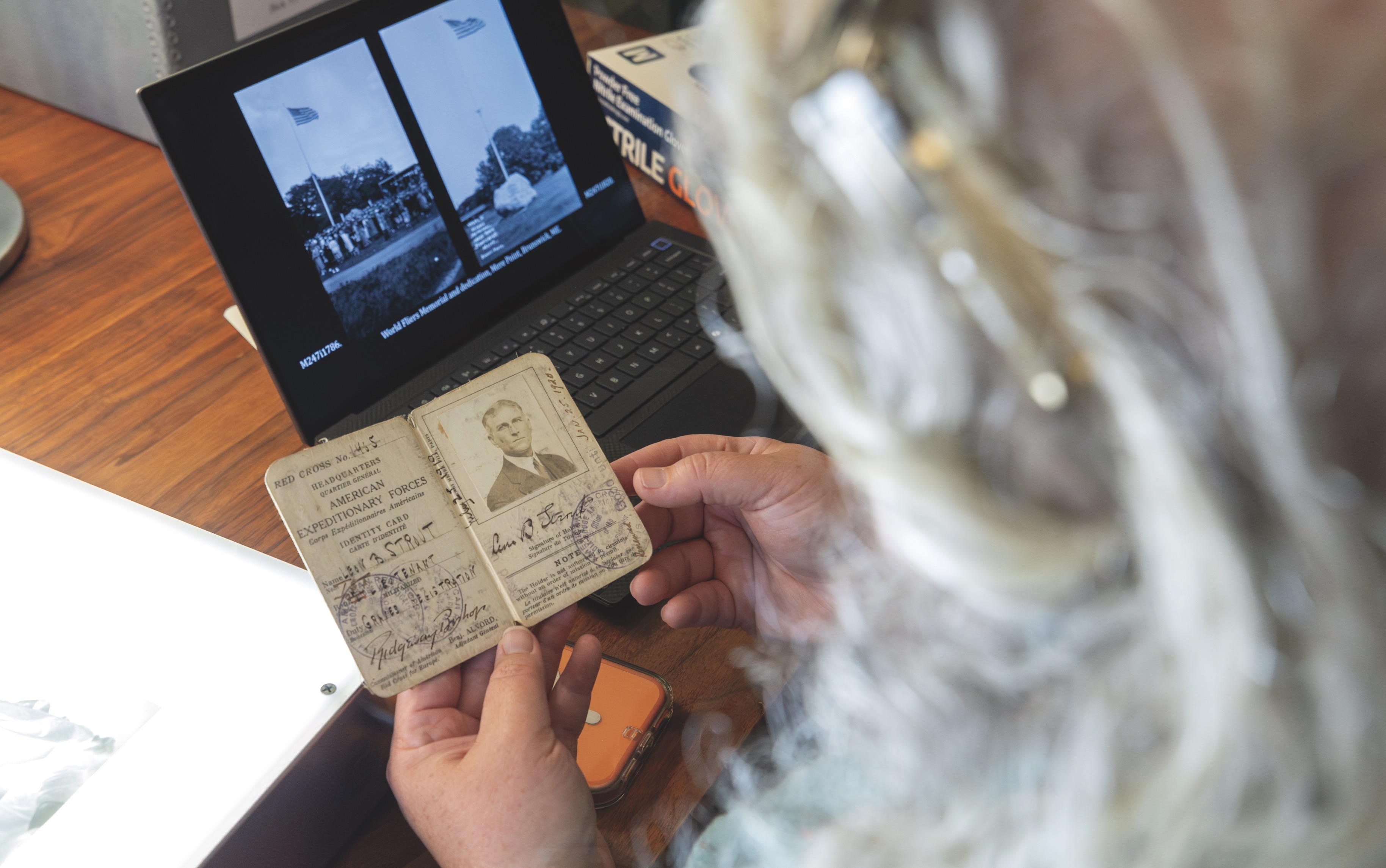
Strout’s identification card from his time in France documenting graves of fallen soldiers.
At one point, Strout made a series of photographs of athletes working out in the gymnasium in the Hyde Athletic Building at Bowdoin. Taken in the 1910s and ’20s, these “strength portraits” were made in natural light. “They’re very much of the period,” says Bischof, explaining that any college at the time would have been celebrating what she calls “the culture of masculinity.” She believes the illustrative photos might have been made for a guide to executing the various exercises.
One of Bischof’s favorite images shows a young woman in a smock posing with a clay bust at the Massachusetts Normal Art School. The lighting and her face half-turned toward the camera bring Vermeer to mind.
Bischof admires Strout’s industriousness. He was an all-around studio photographer who knew how to take portraits, single and group. His “real photo” postcard business thrived. Kodak had come out with a camera that would expose a postcard-sized negative that could be printed onto a blank card. People prized these photo postcards for their detail and for capturing everyday life on film.
A note on the back of a 1935 photo of a woman named Mrs. Malett seated on a couch in a living room highlights Strout’s business transactions. She has written, “I think this one will do. 2 doz printed on greeting cards. Cannot sit for picture now—no suitable clothes.”
Bischof mentions a sad aspect of Strout’s life. He and his wife, a librarian, divorced in 1914. She subsequently kept him from his three children, so he only saw them on the sly. In a telegram he sent when he was applying to the Red Cross photo position in France in 1919, he asks, “Can you use a thorough, healthy, and vigorous 48-year-old portrait pictorial commercial and news expert and hardened to all weathers, used to construction and repair?” Then he writes, “No dependents.” This document sat in a Brunswick basement until the library staff helped uncover additional materials through their outreach.
In the end, notes archivist Sauer, Kristin Strout and her father, Ben, deserve the credit for activating the photography collection. She finds it extraordinary that the collection came to the library so long ago, was cared for all those years, and is only now seeing the light of day. It was, she states, “this long-term hope for the future that one day we’d be able to do something with it.”
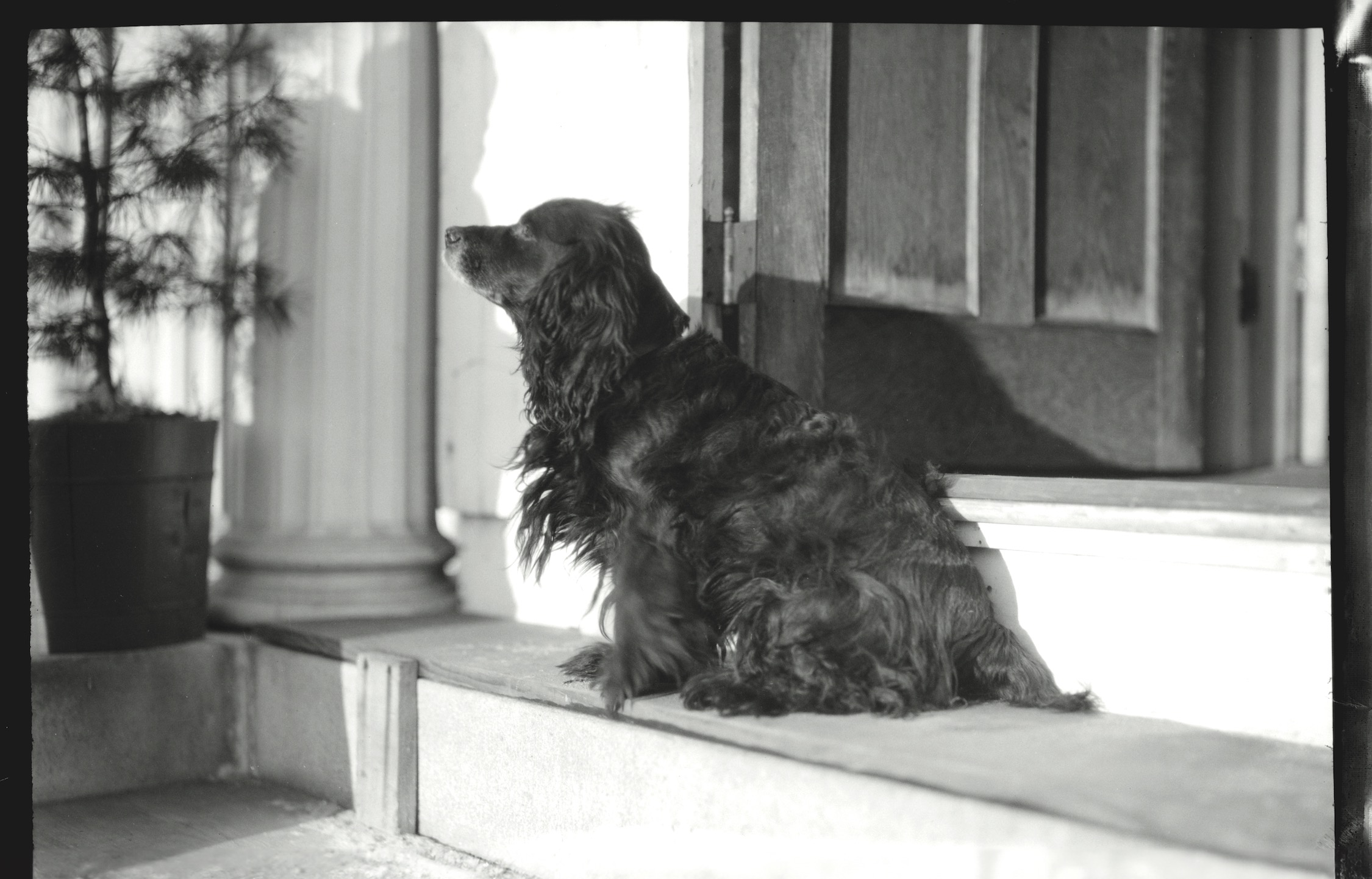
Portrait of Byng, a cocker spaniel owned by President Kenneth Sills. Several dog portraits appear in the collection.
Interviewed by Rob Caldwell on the popular 207 WCSH-TV show in November 2025, Kristin recounted how she and her father thought the photographs were “amazing” and should be made available to everyone. Toward the end of the segment, Caldwell says, “Until someone invents a time machine, photos are the best thing we have.” Strout’s photographs provide that time machine, bringing the past into focus through a well-aimed and nuanced lens.
Strout died the same year as another Maine photographer, the much-heralded Chansonetta Stanley Emmons (1858–1937), best known for her images of rural New England. With the efforts of the Bowdoin Library, will Strout attain a similar fame? Bischof calls the project “recovery work.” Regarding Strout’s photographs, she asserts, “We’ll get ’em out in the world.”
Carl Little has written books, essays, and articles on a number of photographers, including Barbara Goodbody, Jeffrey Becton, Nicholas Nixon, Rose Marasco, and David Etnier. In 2021, the Dorothea and Leo Rabkin Foundation presented him with a Lifetime Achievement Award for his art writing.

This story first appeared in the Spring/Summer 2026 issue of Bowdoin Magazine. Manage your subscription and see other stories from the magazine on the Bowdoin Magazine website.