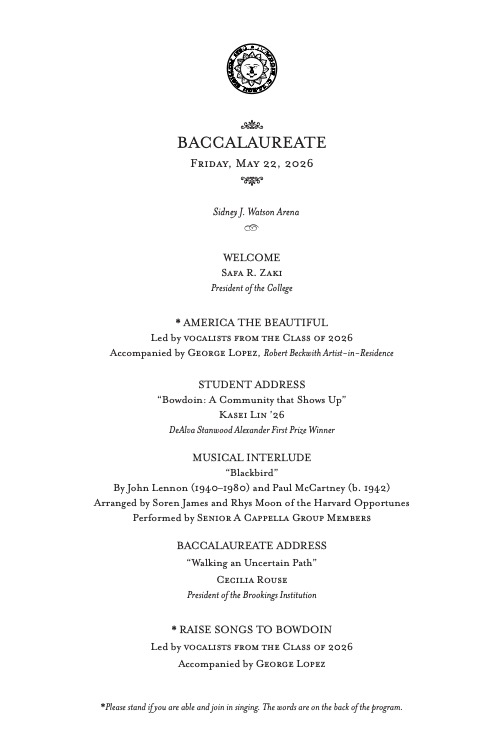
Good afternoon!
President Zaki, Bowdoin faculty and staff, parents, other family members and loved ones: I am going to give a shout out to Alex Wiseman’s grandmothers. It is a privilege to be with you today.
And to the Class of 2026: Congratulations!
This is a huge milestone, and your experiences at Bowdoin will forever play a role in shaping who you are, and who you become. Let’s give them a round of applause for that.
And yet...the world today is so full of uncertainty. I’m not telling you anything you don’t already know. But I thought share a few of the items hanging in my anxiety closet.
- Our nation is at war…with an uncertain resolution.
- Relationships with many of our allies are strained, reshaping the global order.
- Here at home, ICE activity has made many feel unsafe just going about their daily lives.
- Our federal policymakers don’t seem to have noticed that our national debt is approaching $38 trillion dollars (or about $114,000 for every person in America) with no plan for how to address it.
- And then there’s the labor market ...
- …And, this is far from a complete list.
Can I get a show of hands—how many of you are anxious about your next step, about what your future may look like?
You are not alone. But you cannot give up!
Rather, we need you to lean in. With all of today’s challenges, the world desperately needs your skills, your passions, and your talents.
Yet, as confident as I am in that fact, I also know that your path forward will not be crystal clear.
There will be rejections, disappointments, and plans gone awry.
And if you’re the sort of person who likes to have your future all mapped out, I’m sorry to be the bearer of bad news—your plans will almost certainly not play out the way you think they will.
As the great boxer and twenty-first century sage, Mike Tyson, once quipped, everyone has a plan until they get punched in the face.
And trust me—life will punch you in the face. Probably more than once.
Because you simply cannot control what is out of your control—which turns out to be quite a lot.
What you can control is your attitude, skillsets, interests, and values. These are the tools at your disposal to help you through whatever challenges come your way.
My own uncertain path has been guided by my values and interest in economics.
Over the past thirty years, I’ve focused on questions in labor economics as a professor at Princeton, during three White House tours—and now leading a think tank dedicated to using research and evidence to address policy challenges.
And some might argue, I’m still trying to figure out what I want to be when I grow up.
And yet if you had asked me on the day of my college graduation what my path would be, I would have had absolutely NO idea!
I just knew I enjoyed economics and the power it holds to address important questions in policy. And I wanted to improve my French.
Let’s fast forward to today. Things have turned out okay for me. I won’t say I’ve done everything right. I’ve certainly had my share of disappointments. And there were plenty of times I felt—and continue to feel—the anxiety that comes with walking down an uncertain path.
But I have tried to follow my interests, stay authentic to who I am, and seek opportunities to learn and do more.
So today, as you start down your own path, I want to leave you with three lessons I have learned over the years that have helped me:
First: You cannot know the road not taken…ever.
Years ago, while driving my daughter to camp, I heard on the radio the parable of the farmer whose horse runs away.
Some of you may be familiar with it.
After the farmer’s horse runs away, his neighbors lament his misfortune, but the farmer responds, “Good luck, bad luck, who knows?”
The next day, the horse returns with several wild horses, and the neighbors marvel at the farmer’s good luck. Still, the farmer replies, “Good luck, bad luck, who knows?”
Later, the farmer’s son falls off one of the horses and breaks his leg. The neighbors express sympathy at this misfortune, and still, the farmer replies, “Good luck, bad luck, who knows?”
Soon after, the army comes to call on able-bodied young men for service, and the son is spared because of his injury. The neighbors all call it good fortune, and again, the farmer replies, “Good luck, bad luck, who knows?”
What I love about this story is it reminds us that we cannot know how a decision, or an outcome, will impact the course of our lives. And we certainly can’t know what would have happened if things had turned out differently.
Because just like the farmer who was unwilling to place a value judgment on life events, you simply cannot know where life will take you, or how something will turn out.
Okay, on to my second lesson: Excitement happens outside of your comfort zone.
As I mentioned earlier, when graduating college, I knew I wanted to improve my French, ideally by studying abroad. So I applied for a fellowship to do so.
When I asked a mentor for advice on where to go and suggested I was thinking of a Caribbean island such as Martinique, his response was, “Why would you do that? You’ll go there on your yuppie vacations! Go someplace you would not otherwise go.”
That was how I ended up spending almost a year in Dakar, Senegal. The best advice ever.
During that year, I learned a little Wolof; spent many hours in Ngalam, the nightclub around the corner; learned to enjoy thieboudienne, the Senegalese national dish. I made friends at L’Université de Cheich Anta Diop from many other countries; and traveled around West Africa. Oh, and I improved my French.
Most importantly, it changed how I see the world and for that I am grateful.
I share this story now because right now, many of you are starting to make decisions about graduate school, jobs, where to live, what to pursue.
You may feel a tug toward what feels safe and predictable.
But pushing the boundaries of what feels comfortable can be the best way to grow and discover yourself.
It might mean taking a job that isn’t the obvious choice. Moving to a new city. Changing fields in the middle of your career. Or speaking up when it would have been easier to stay quiet.
Be bold! Be curious. You can’t know what lies just beyond your comfort zone until you take a leap and discover what’s there.
Which brings us to my third and perhaps most important lesson, one I repeat so often—just ask my family and friends: There are only twenty-four hours in a day.
I know, I know, that’s obvious! But truthfully, I don’t think many of us fully grasp this concept.
Think about it: No matter who you are—your age, your profession, where you live, how much money you have—we all get the same twenty-four hours each day.
This is both a constraint and a gift.
It’s a constraint because it cannot, under any circumstances be changed.
Other resources can be increased, at least in some way. They can be shared with others, lent or borrowed, saved or put in a trust for our kids.
But time marches on, you only get twenty-four hours a day of it, and you can never get it back.
But it’s also a gift, because it is yours and only yours, and you largely get to use it as you wish.
Now, I’m not going to tell you how to use your time—like I said, it’s yours. But I do have a couple of suggestions.
Spend it on things you genuinely value. For example, keeping in mind Bowdoin’s motto of the common good, it’s worth devoting some of your time to serving others. There are countless ways you can do just that.
Take my fellow honorees. Sharon Daley dedicated her career to bringing healthcare and other needed resources to people on Maine’s island communities. And Evan Gershkovich ’14 took great personal risk to bring important information to the public.
They chose to spend their precious time in service of the common good, and the world is most certainly better off for it.
And—reserve some of your time for yourself. You can’t do your best and help others if you haven’t taken care of yourself first.
Remember that: don’t forget yourself.
So, in closing, I ask you to take a deep breath.
You’re on the eve of a new stage of life. Your path forward won’t always be easy, but you must lean in, even as you cannot have a blueprint for the future.
When you find yourself feeling lost, questioning your direction, or uncertain of the road before you, remember: you cannot know the road not taken; excitement happens outside of your comfort zone; and there are only 24 hours in a day—use them wisely.
The good news? Your time at Bowdoin has prepared you not for a single path forward, but for the possibility of many—that is the “Offer of the College.”
And, of course, it also prepared you for crushing some serious lobster.
To the Bowdoin College Class of 2026: I cannot wait to see where your paths take you.
Congratulations!