 Museum of Art
Security Force Violence in Alexandra Township
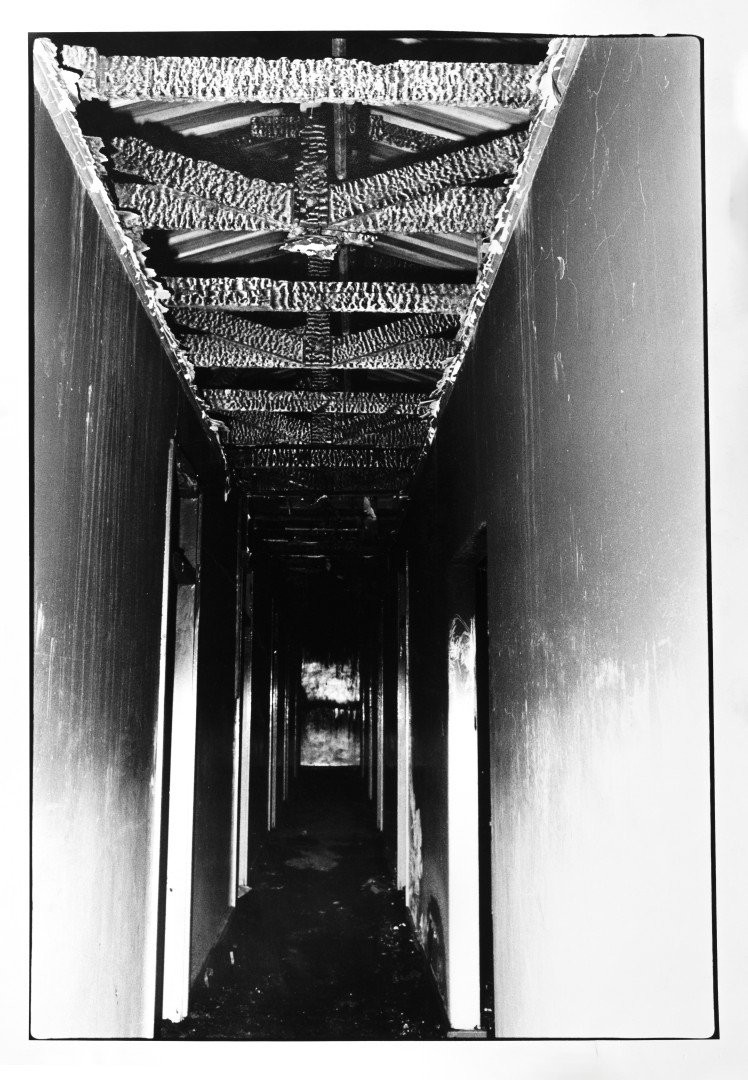
Michael Goldblatt, Petrol Bombed Nurses' Quarters, 1989, silver gelatin print
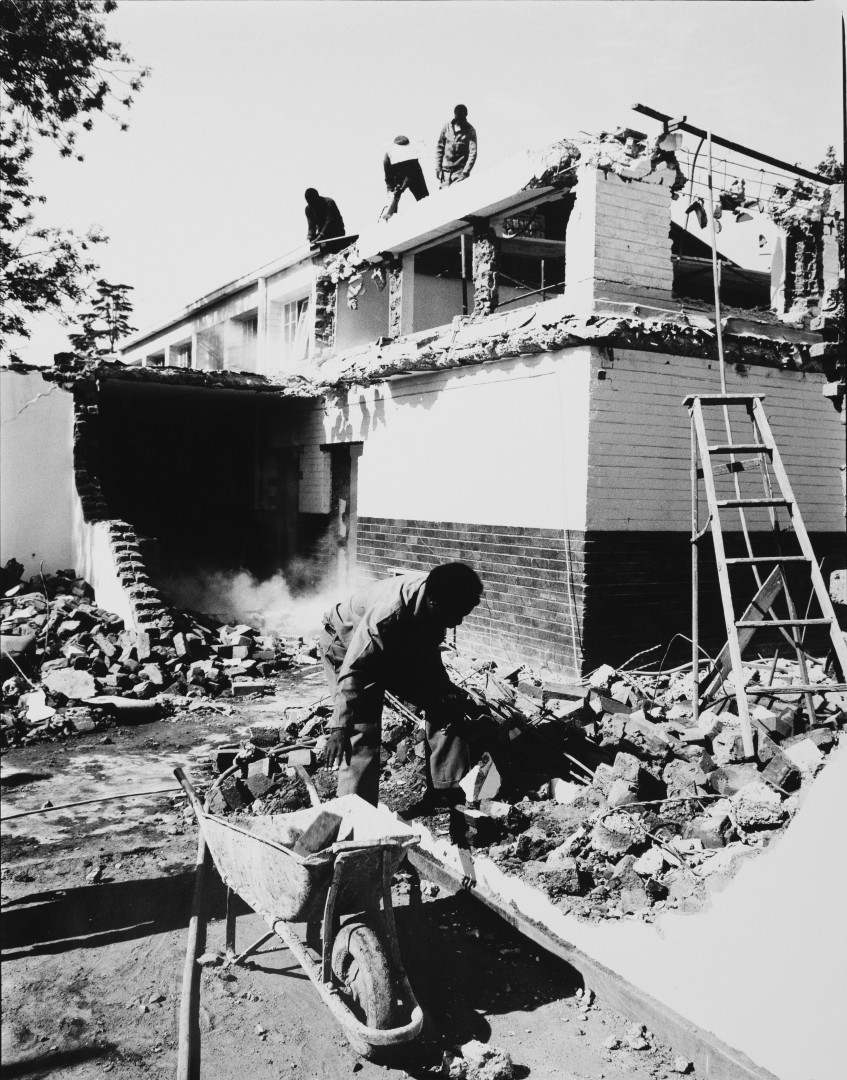
Michael Goldblatt, Rebuilding the Clinic, 1990, silver gelatin print
On July 27, 1989, members of the Security Branch of the South African Police firebombed the Nurses’ Home at the Alexandra Health Centre and University Clinic (AHC), believing it aligned with anti-apartheid organizations such as the African National Congress (ANC). The charred interior of the Nurses’ Home is pictured here, alongside reconstruction efforts a year later. The 1980s saw increasing resistance to the system of apartheid by activists in Alex and beyond. Recognizing that its power was threatened, the regime’s security forces repressed anti-apartheid activist groups. As the government’s control slipped away and a civil war between largely Black political groups emerged, these tactics shifted into a more covert practice of undermining negotiations that would create a unified post-apartheid government. Testimony by both victims and perpetrators of the clinic bombing were later shared before the Truth and Reconciliation Commission (TRC), a post-apartheid restorative justice body. A clinic nurse present at the bombing, the clinic director, and one of the police officers who carried out the bombing all testified, creating an invaluable record on this event.
Evan Carr '28
Scroll down to read additional materials collected by Evan Carr '28 as part of class work for After Apartheid: History and Identity in Contemporary South Africa, Spring 2026.
Additional Materials
Security Police Officer Paul Erasmus:
A transcript of excerpted testimony from Paul Erasmus, a white former officer of the Security Branch of the South African Police who watched the clinic burn and testified before the TRC as part of an application for amnesty from the post-apartheid ANC government.
- CHAIRPERSON:
- You stated that you never saw any petrol.
- MR ERASMUS:
- I never saw anybody filling containers or making Molotov cocktails or how that happened I don't know.
- MR VAN ZYL:
- But do you presume that the arrangement was made by the people that actually planned it that night, or do you think it was on the spur of the moment etc.?
- MR ERASMUS:
- It was a spur of the moment decision.
- MR VAN ZYL:
- Okay and then you went off to Alexandra Clinic. How many cars took the route to Alexandra Clinic?
- MR ERASMUS:
- We were all in radio contact, we had excellent radio communications. I've mentioned before, possibly six cars.
- MR VAN ZYL:
- Okay. And did all six arrive there simultaneously at the Alexandra Clinic?
- MR ERASMUS:
- We were the last - I recall that I was the last to arrive.
- MR VAN ZYL:
- And as you arrived there on the scene, you and the occupants of your car, what did you see there? What took place?
- MR ERASMUS:
- There were flames, the sky was lit up with flames.
- MR VAN ZYL:
- You saw the flames and what happened then? On your arrival you saw the flames, what happened then?
- MR ERASMUS:
- We left. Madam Chair, I believed that the job had been done. It served no purpose endangering ourselves or risking ourselves further by staying there, so we left.
- MR VAN ZYL:
- Did you know that anybody was going to firebomb the clinic that night? Was it said prior to you arriving there?
- MR ERASMUS:
- Prior to that evening, or during that evening?
- MR VAN ZYL:
- No, during that evening, prior to your arriving at Alexandra Clinic, did anybody say: "We are going to firebomb at all, the plan is to firebomb the Alexandra Clinic"?
- MR ERASMUS:
- Yes, I knew about it.
- MR VAN ZYL:
- Can you tell Madam Chair how you knew about it?
- MR ERASMUS:
- I mentioned this earlier that the decision was made between all of us, obviously with the approval of the senior members present, who would most certainly have stopped it if they felt that it should have been stopped, but yes, the decision was made during that night.
- MR VAN ZYL:
- What was the purpose of fire bombing the clinic?
- MR ERASMUS:
- As I mentioned, well ja, I don't want to go down that road again. I believed that this was part of the national strategy aimed at - these places were targeted because of assistance that they were giving radical elements, anti-government elements. At the time I was quite content with that.
- MR VAN ZYL:
- What do you contend was the political objective that evening in fire bombing the Alexandra Clinic?
- MR ERASMUS:
- To hinder the activities of enemies of the South African Government.
A transcript of testimony from Violet Ramhitshana, a nurse at the Alex Clinic who was awoken in the Nurses’ Home to find it burning; Gathered by the Truth & Reconciliation Commission:
- MS RAMHITSHANA:
- We went to sleep as usual and it was at night. In the middle of the night whilst we were sleeping or towards dawn, I woke up. Whilst I was relaxing I heard something like a cricket in the passage. I don't know if it was thrown through the window or how but it was near. Then I started listening and I heard one of my colleagues say there's fire. After some time I saw smoke through the passage. Then I said if I can go through that passage towards the corners of the passage and the back side of the kitchen, I won't be able to, so let me go back to my room and sleep so that I would just stand still, not be confused so that the person who will offer us help because I see that there is fire. When I looked through the window I saw a fire coming from - the building was L-shaped, there was a kitchen at the back door. Then at the back there was a washing line and a relaxing lawn. The next block was the student block and the doctors' residence who were coming for the clinical sessions. Then on my left hand side where there was a maternity ward but there was a wall. When I saw women arriving out of the maternity ward, screaming, saying get out, get out of the house and they were crying. I sat down because I saw that we were not able to go out because whoever would come to help you would not be able to locate you to save you so I looked at those women. At the same time the smoke was coming inside and I fainted. A certain person broke the window and then told me to go through the window. So I was not able to climb so I fainted. At the time I had a cut from a glass and then I was bleeding at that time. After some time I regained consciousness. I heard nurses screaming outside, then even the one next door, that is Deleka, Mrs Nonde, who was calling me by name. Then they said they will not be leaving me outside. Others were outside, that is Sister Nqecka was out, Sister Beauty was outside and others were able to go out. But all of them were screaming from outside asking for help. So I peeped through the window and told them not to scream but to call Sandton Fire to come and help because if you just scream you make me awake, don't scream you'll be able to get help but they couldn't believe it because they were so confused.
- MR NYAWUZA:
- Did you ultimately manage to go out ma'am?
- MS RAMHITSHANA:
- After some time the security guard came to the window and broke the window with a cutting device to break the burglar proofing and they broke the wall so that I'll be able to get outside. Then the other one opened the window where it was broken. Then from there they lifted me up. Then they helped me to climb the chair. Then from there I was pulled outside.
- MR NYAWUZA:
- Did you know the person that was involved in the burning down of the nurses home?
- MS RAMHITSHANA:
- I did not see the person but after the incident when Dr Wilson came to me, I spoke to him and said: "Dr Wilson, what happened? Is there somebody responsible or is there an accident?" Then Dr Wilson said there must have been an electrical fault but I said I suspect that somebody is responsible for the fire because when the security came to see me in the casualty room then he said he was running after somebody who ran through a certain gate.
- MR NYAWUZA:
- Ma'am, did the security tell you how this person looked like?
- MS RAMHITSHANA:
- The security said whilst he was running after that person he was able to observe that he's a White person.
- CHAIRPERSON:
- Ms Ramhitshana, were you during your service with the Alexandra Clinic from 1979 until 1989 when this incident happened ever instructed by Mr Wilson or by any of the senior doctors in Alexandra Clinic that you must treat ANC activists who came there for medical assistance? Were you ever given specific instructions to treat this special cluster of persons?
- MS RAMHITSHANA:
- No Chairperson, our seniors were instructing us that whoever is a patient who comes for help, we should attend to that person so we did not have the right to ask as to whether where does that person come from or from which area. We only knew that we were attending to any other person who is coming for help.
A transcript of testimony from Dr. Tim Wilson, who served as director of the Alex Clinic at the time of the 1989 firebombing; Gathered by the Truth & Reconciliation Commission:
- MS PILLAY:
- Dr Wilson, you heard the applicant [Officer Paul Erasmus] testify today that the Alex Health Clinic had provided medical support to ANC insurgents. What's your response to the allegation that the clinic provided medical support to ANC insurgents?
- DR WILSON:
- Okay. I listened as the Chairperson clarified there about medical assistance to people from outside. We had a clear policy that we provided medical assistance to anybody who came to us seeking medical help and we regarded it as that we were bound as professionals by the Hippocratic oath to do so and that anybody who came to us for medical help, received medical help and as I have said that included policemen, army, residents at Alex or people from outside of Alex and we provided treatment. We did ask where people came from, but we didn't demand identity documents or proof of where they came from… Our approach was that if somebody was coming to us as health professionals asking for medical assistance, we provided that assistance to the best of our ability and nothing else.
- MS PILLAY:
- Dr Wilson, you also heard the applicant testify that the perception was that the clinic was providing logistical support to ANC insurgents. What's your response to that?
- DR WILSON:
- That his information was totally incorrect, that I am absolutely certain that no logistical support was provided whatsoever. He mentioned in response to a question from the Chairperson as to what logistical support was, money, clothing, food and transport and certainly one of the things that we were trying to do at Alex Health Centre was to keep very tight control of money. We believed that money mattered. We needed to account for it as to how it was spent. We were entrusted with public funds and we were very proud of our bookkeeping and the fact that yes, occasionally, I remember one occasion when somebody had dipped their fingers in the till and the person got fired. It happens, but I would have known as Director if there were gaps, if money had gone missing out of the clinic. We didn't supply clothing to anybody, we didn't supply it to people in the township, we didn't supply money, we didn't supply food, the only transport we supplied was women after delivery, if they lived in Alexandra we took them home.
- CHAIRPERSON:
- But do you agree that in 1989 you were perceived as a facility for ANC activists?
- DR WILSON:
- No, I would disagree. I think that we were perceived as a facility that was open to everybody who came and certainly there were many people from different political persuasions who used the services of the clinic.
- ADV SIGODI:
- Before [1989] as a matter of normal course, you would not provide shelter to people who didn't come in for medical assistance?
- DR WILSON:
- No, no we didn't have people sleeping at the clinic unless they actually had a medical reason to sleep at the clinic because there were also a lot of homeless people around and we said no, we're not there, our function is not to provide accommodation for the homeless, so that was not part of our normal practice.
- ADV SIGODI:
- Not only the homeless, because why I'm asking this is because when the applicant mentioned that you were perceived to be providing logistical support, I think he mentioned that you were providing shelter for, mainly for ANC insurgents who were running away from the police, so that perception, you still maintain that it was wrong?
- DR WILSON:
- That is - you are correct, the perception is incorrect because we did not have people staying at the clinic who were not requiring medical treatment and we were fairly clear as to the people who stayed, it was women giving birth and that was the one group and then we did have what we called sleep-over beds, we did not have people sleeping on the floor, we had beds, which we provided for people whom we expected to be fit, to be able to go home within 24 hours, so an asthmatic who would be better within 24 hours, could sleep over if we thought that the asthma attack was so severe that they wouldn't be better within 24 hours, then we referred them to a hospital and we referred about, from casualty at night, about 20% of the patients. The severely injured would be referred to hospital, 80% we would either treat immediately, some we would keep overnight and let them home the next morning
- DR WILSON:
- No, I would disagree. I think that we were perceived as a facility that was open to everybody who came and certainly there were many people from different political persuasions who used the services of the clinic.