 Museum of Art
Public Space and the Informal Economy in Late-Apartheid Alexandra
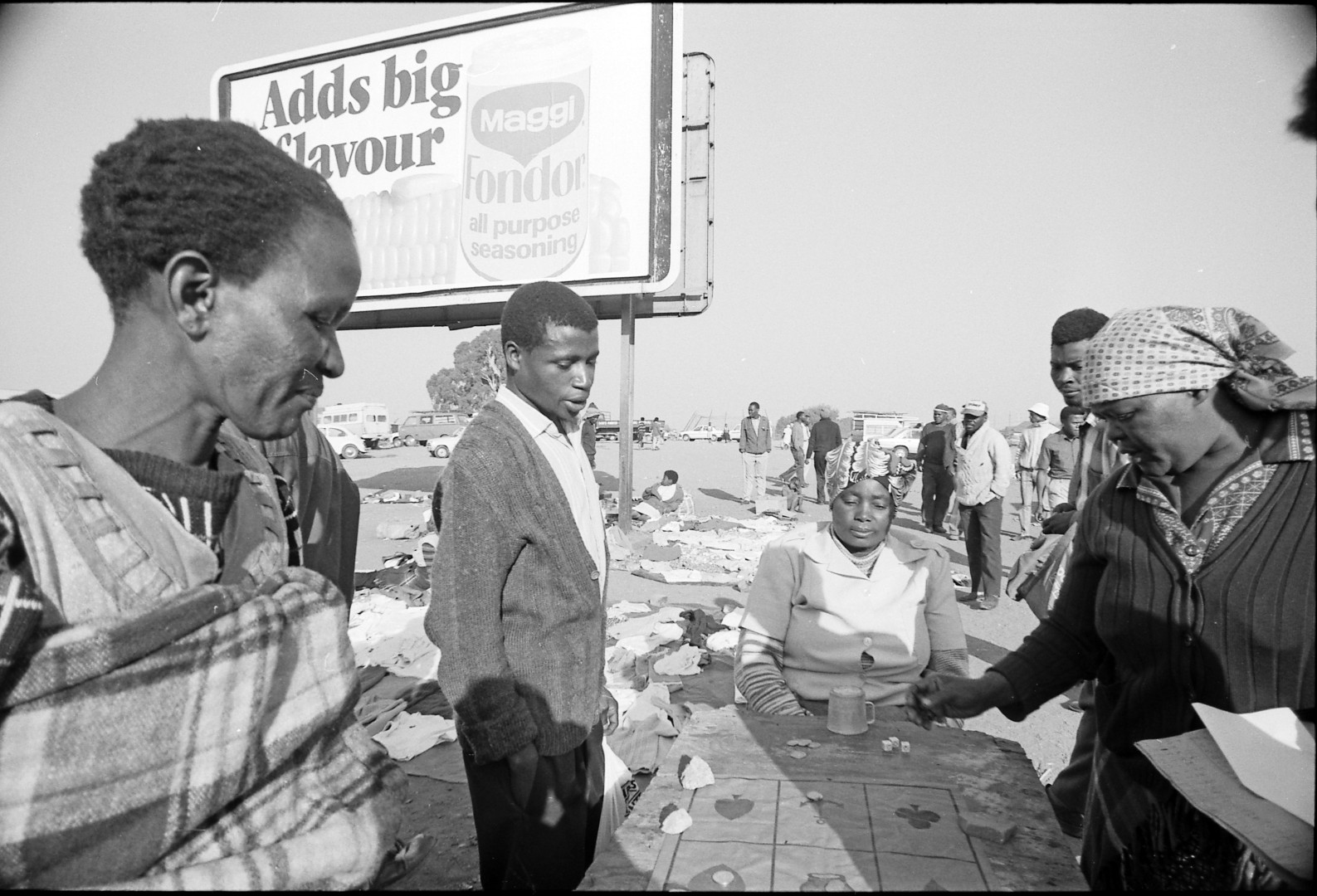
Michael Goldblatt, Maggi Adds Big Flavor, 1980s, silver gelatin print
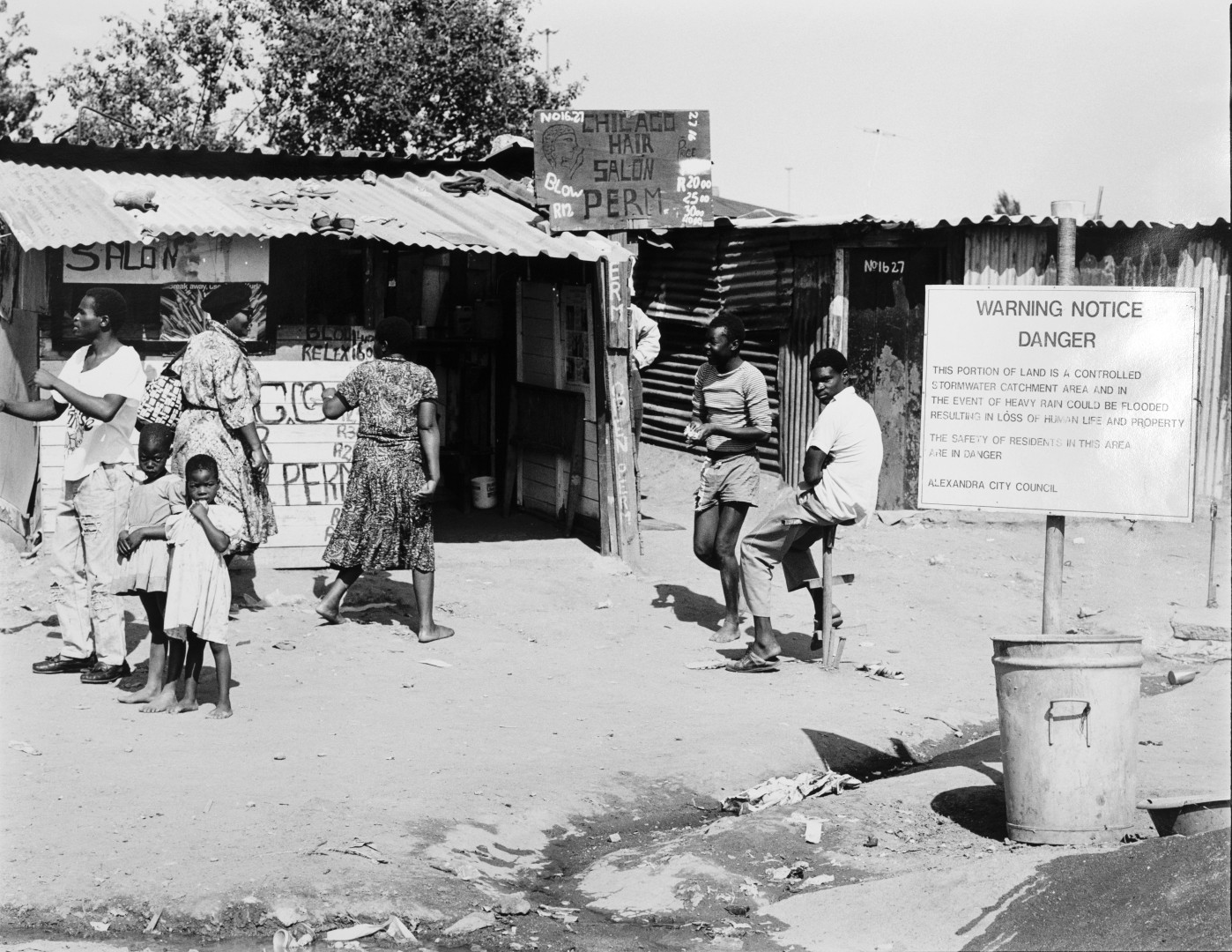
Michael Goldblatt, Chicago Hair Salon, 1980s, silver gelatin print
Apartheid restricted access to formal commerce in Alexandra while depending on workers who earned less than a living wage and relied on informal economies in the township’s unregulated public spaces. Chicago Hair Salon shows a hair salon built from corrugated iron and hand-painted signage beside a sign declaring the land unsafe for human settlement. That the warning and the enterprise share the same patch of ground reveals the paradox of apartheid urbanism: the state disclaimed responsibility for the space while leaving its residents no option but to earn a living on it. In the roadside scene, a Crown and Anchor gambling board, garments laid out for sale, and a corporate billboard for Maggi seasoning occupy a single frame. Together they show how gambling, petty retail, and sociability operated as overlapping strategies of survival beneath the imagery of an economy that excluded the people standing under it.
Jake Reiser '28
Scroll down to read additional materials collected by Jake Reiser '28 as part of class work for After Apartheid: History and Identity in Contemporary South Africa, Spring 2026.
Informal Economy Review
The informal economy anchored township life. A 1984 survey in Alexandra found that nearly 30 percent of households had members working as hawkers, hairdressers, dressmakers, herbalists, shebeen operators, tailors, cobblers, and golf caddies. A post-apartheid census across eight township sites identified 9,401 micro-enterprises, and researchers estimate the informal economy today employs at least 2.4 million people nationally, or about 13 percent of the labor force. This economy existed because apartheid urbanism produced it. Black residents were denied secure access to formal commercial premises, regulated trade, and stable wage employment. Johannesburg closed its central business district to black hawking in 1922. The state also had a contradictory relationship with informal activity: banning alcohol on the Witwatersrand from 1897 produced the illegal pub, the shebeen rather than eliminating drinking, and from 1937 onward the state funded township administration through its own sorghum beer monopoly, an informal-adjacent economy that collapsed when consumer preferences shifted to commercial lager during the 1970s.
Alexandra offers a particularly clear case. Proclaimed a black freehold township in 1912 and almost the sole surviving example of that form, it sat a few kilometers from the wealthy northern suburbs of Johannesburg and supplied labor to the white city around it. Designated for demolition in 1963, it was reprieved in 1979, but the 1980 redevelopment plan was never fully financed. Rents rose, overcrowding intensified, and economic life spilled from saturated households onto roadsides and open ground.