 Museum of Art
Maternal Health in Urban Apartheid South Africa
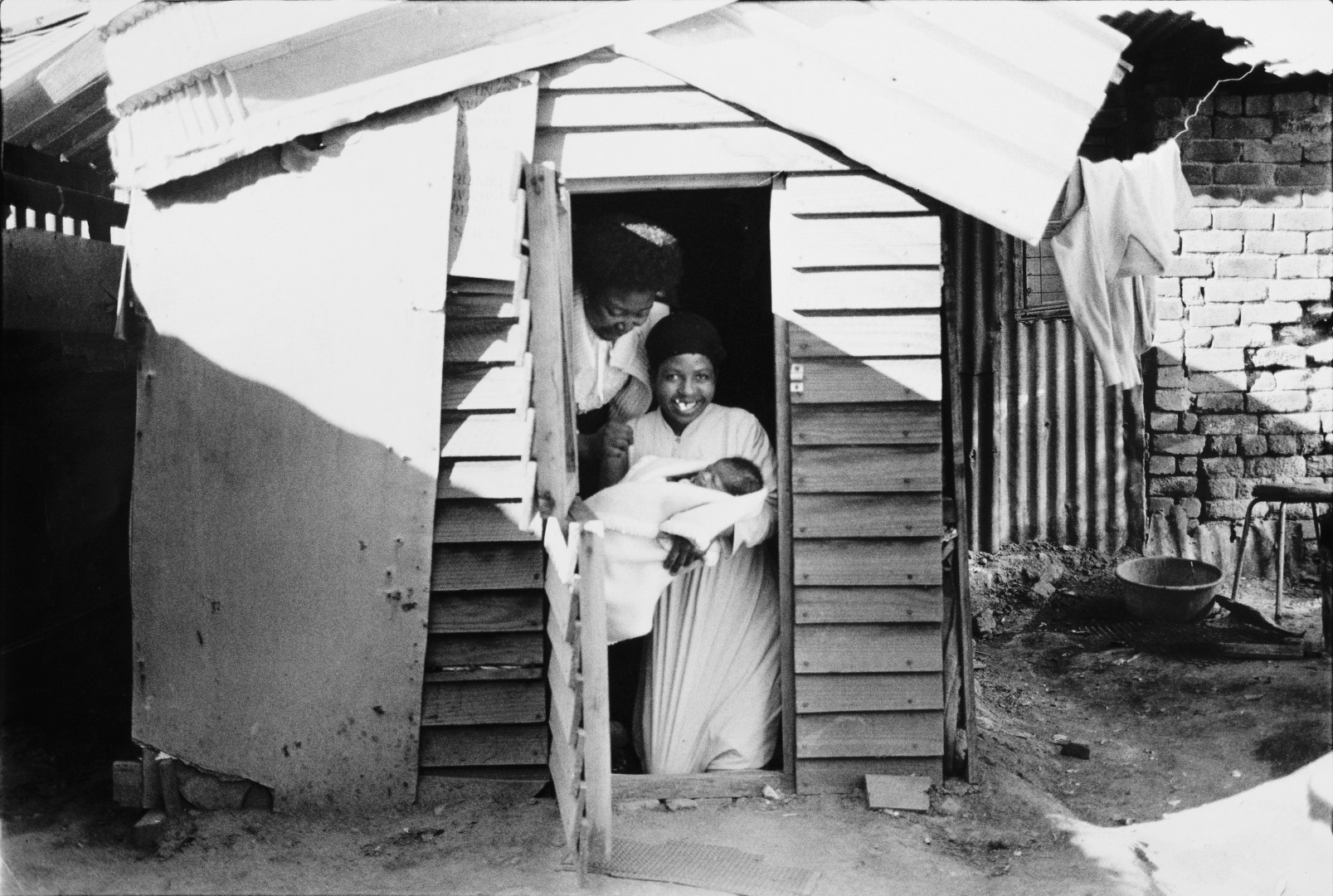
Michael Goldblatt, Mother and Child in Shack, 1980s silver gelatin print
Depicted soon after labor, two women proudly show a child born into Alexandra Township. Their roles as mother, midwife, or labor companion that likely occurred behind the doorway remain invisible. As in this photograph, a range of practitioners and patients blurred boundaries between formal and maternal healthcare in Alexandra. The Alexandra Health Centre and University Clinic (AHC) opened its Emergency and Maternity unit in 1989, which offered 24-hour care and established trusted space where women exercised their agency by seeking treatment. Initiatives like the AHC’s Labor Companion Program acknowledged its patients’ diverse cultural backgrounds and resisted the binary imagination of the apartheid regime, which regarded “rural” and “urban” social fabrics as separate. At the same time, other policies—like private labor rooms for women and their husbands—struggled due to their disconnect from the birthing norms of the women of Alex.
Thetis Fouri '26
Scroll down to read testimonies collected by Thetis Fouri, 2026 as part of class work for After Apartheid: History and Identity in Contemporary South Africa, Spring 2026.
Testimonies
Miriam Mokoana, one of the clinic’s most weathered midwives, recounts conditions that preceded the opening of a maternal health unit in 1989. She refers to Tim Wilson, the doctor who played a key role in the opening and administration of the unit. Midwife Mokoana’s recollection of the impact of Wilson’s arrival highlights the establishment of the clinic as a trusted space, where women exercised their agency by seeking treatment.
Before Tim came, I’m sure people remember the maternity ward was a room and there were a number of beds and there was a bucket in the corner and that was the toilet and people delivered their babies on newspaper, it was, it was really really shocking conditions and, and yet until Tim had arrived nobody questioned this and said we have to change this, people saw it as charity to say that “we are here to help you” and that sort of thing, so one of my most rewarding times was building the new maternity unit and having a beautiful, colourful place where women could give birth in dignity.
Miriam Mokoana, “Oral History Workshop on the Alexandra Health Clinic.” Workshop. Transcript, Wits Club, Johannesburg, November 15 2022
An excerpt from the AHC’s March 1992 Annual Report which details a clinic-led research program intended to inform labor conditions with the emotional and cultural background of patients:
Particularly among the new residents, feelings of alienation may characterise the emotional trauma of moving from a familiar rural to a strange urban environment…A study of the effects on women of having a companion during labour can indicate ways in which AHC can improve its health services to the community … There are certain taboos in traditional societies regarding being touched during labor. The way in which a lay companion can play a supporting role in an impoverished urbanising community therefore needs further exploration
Alexandra Health Centre & University Clinic, 63rd Annual Report for the Year Ended 31st March, 1992.
Testimony by Paulo Ferrinho, a doctor who joined the Alexandra Health Clinic in 1985. Dr. Ferrinho highlights the constant reimagining of medical practices required for a successful holistic primary health model rooted in the cultural practices of the Alexandra community.
We created labor rooms with some privacy so that women could be there with their husband or partner. They were never used because the men did not want to be there. So that was [an instance] of a group of Western doctors trying to bring our cultural approach to the delivery of babies without properly consulting with the community. We conducted a number of studies about women that visited the clinic late in labor, as well as the labor outcomes of the clinic.
Paulo Ferrinho, interview by David Gordon, Zoom recording, April 28, 2026.
An excerpt of the Freedom Charter, a document disseminated after the 1955 Congress of the People whose contents became the guiding principles for the African National Congress (ANC) and its affiliates. Dr. Mervyn Susser, a health practitioner who brought the framework of holistic primary healthcare to the AHC in the early 1950s, helped to write the segment below. The Charter emphasizes social determinants of health like security and comfort, as well as the centering of maternal and childcare.
There shall be houses, security and comfort!
All people shall have the rights to live where they choose. to be decently housed, and to bring up their families in comfort, and security:
Unused housing space shall be made available to the people:
Rent and prices shall be lowered, food plentiful, and no one shall go hungry:
A preventive health scheme shall be run by the state;
Free medical care and hospitalisation shall be provided for all, with special care for mothers and young children.
Slums shall be demolished, and new suburbs built where all have transport, roads, lighting, playing fields, creches and social centres;
The aged, the orphan, the disabled and the sick shall be cared for by the state:
Rest, leisure and recreation shall be the right of all;